

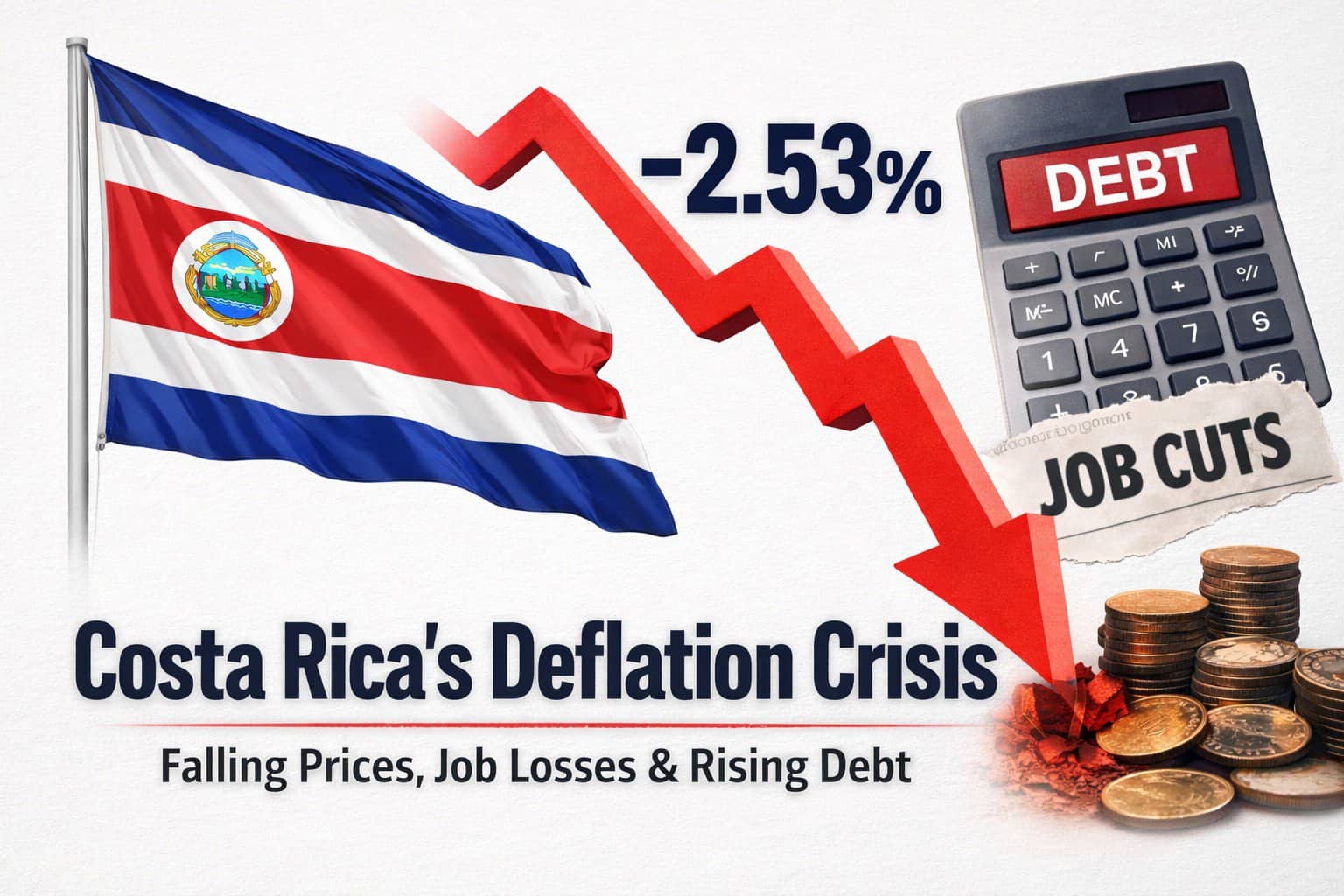
According to data released this week by the National Institute of Statistics and Census (INEC), the country recorded a -2.53% year-over-year inflation rate in January. This marks 33 consecutive months below the Central Bank of Costa Rica’s (BCCR) target range of 2-4%. The monthly drop of -0.96% from December to January represents the largest single-month decline since 1983.
While consumers might initially welcome declining prices on everyday items like tomatoes, eggs, electricity, and package tours, economists view sustained deflation as a warning sign of deeper economic problems. The phenomenon raises serious concerns about Costa Rica’s economic trajectory and its ability to maintain the stability that has made it Central America’s most prosperous nation.
Deflation creates a destructive economic cycle that is often harder to escape than inflation. When prices consistently fall, consumers and businesses delay purchases in anticipation of even lower prices. This waiting game reduces economic activity, leading to decreased revenues, potential layoffs, wage cuts, and further suppression of demand.
INEC’s breakdown shows that 48% of the goods and services in the consumer basket decreased in price in January, while 42% increased and 10% remained unchanged. Sharp declines hit the food, housing services, recreation, and tourism-related sectors particularly hard.
The persistence of deflation — now 33 consecutive months below the Central Bank’s target — points to fundamental weaknesses, primarily insufficient domestic demand. In an economy heavily reliant on tourism, remittances, and foreign investment, weak local consumption heightens vulnerability to external shocks.
The Central Bank’s projections offer limited immediate relief. Officials forecast continued negative inflation through the first half of 2026, with a return to the target range not expected until the second quarter of 2027. This extended timeline suggests policymakers believe they have few quick tools to reverse the trend.
Deflation particularly harms key segments of Costa Rica’s economy. Businesses face shrinking profit margins as they cut prices while fixed costs (such as rent, utilities, and debt servicing) remain stubborn. This pressure often leads to reduced investment in expansion, equipment upgrades, and hiring — all critical for long-term growth and job creation.
As prices and potentially wages fall, the real burden of debt increases, making repayment more difficult for households and companies. For a country that has worked hard to maintain investment-grade credit ratings, widespread debt distress could erode fiscal stability and investor confidence.
Tourism here in Costa Rica faces mixed effects. Lower domestic prices might appeal to budget travelers, but the broader signal of economic weakness can deter long-term investment and degrade infrastructure quality over time.
Costa Rica’s ongoing deflation challenge demands urgent attention from policymakers and economic observers. The Central Bank must find ways to stimulate demand without triggering instability. For an economy long known for its relative stability in the region, nine months of deflation — and the prospect of more ahead — represents a clear call for comprehensive policy reevaluation.





