

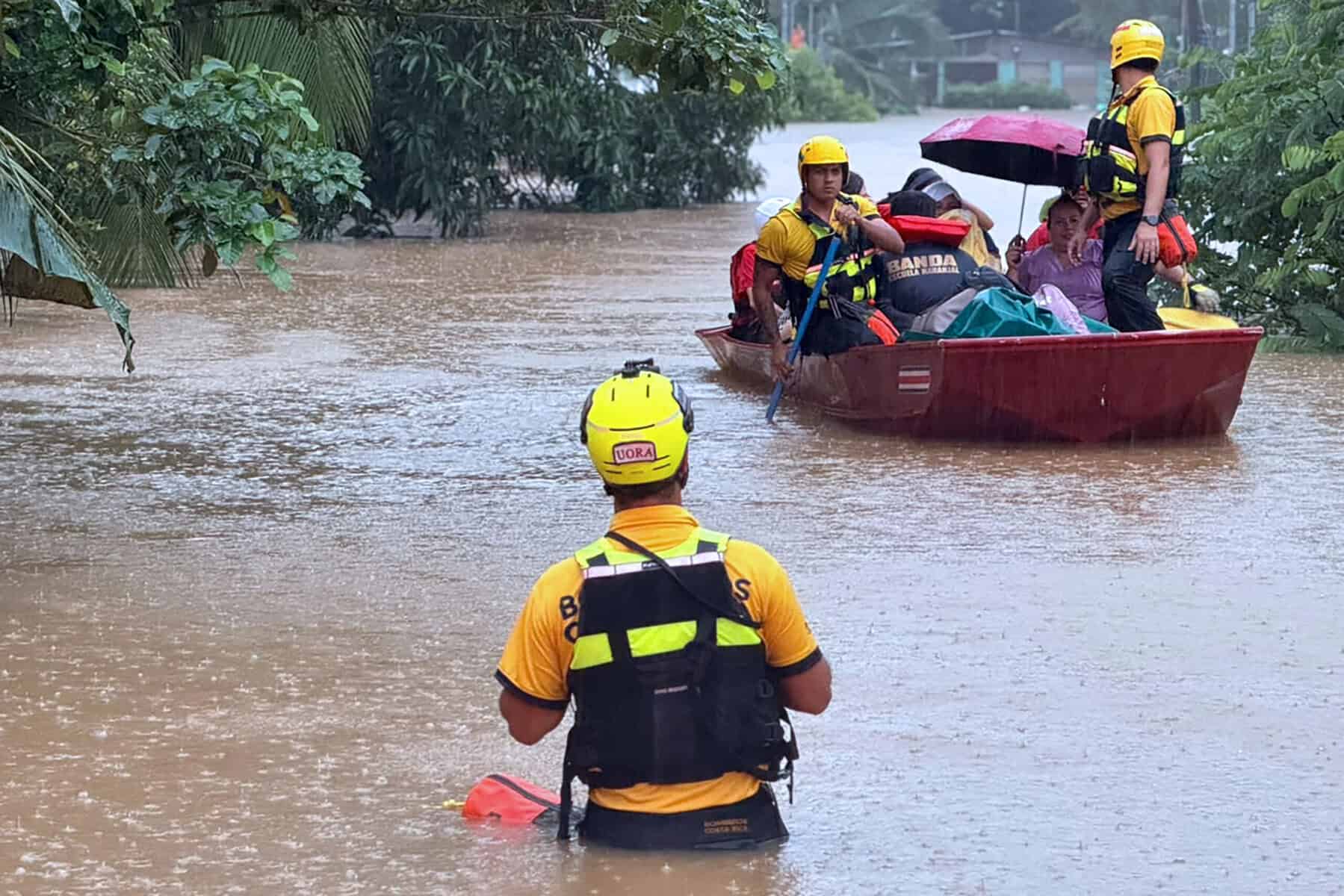
President Laura Fernández spent this morning touring flood-damaged communities in Limón province, as pressure built on her government to issue a formal emergency declaration for the Caribbean coast. Casa Presidencial released the itinerary last night and circulated an updated version at this morning
The schedule ran from a shelter visit in Valle La Estrella through damaged areas in Limón, Matina and Guácimo, closing at a shelter in Guácimo in the late afternoon, and included a meeting with agency heads and the mayor of Limón. Its been reported the tour was to begin at 8:45 a.m., while the agenda circulated Monday morning listed the first stop at 9:20 a.m.
The call for a declaration came yestarday afternoon from Mangell Mc Lean, a legislator with the opposition Partido Liberación Nacional who represents Limón. He said he had travelled through the province and described it as facing “a critical situation, with destroyed roads and isolated communities,” adding that he had contacted local authorities before formally asking the president to consider a declaration for the Costa Rican Caribbean.
Article 29 of the National Emergency and Risk Prevention Law, allows the executive branch to declare a state of emergency anywhere in the country by decree. This effect is financial since a declaration lifts the ordinary budget constraints imposed by Article 180 of the Constitution, which lets the government move money quickly and contract reconstruction work under an exception regime instead of standard public procurement timelines.
Once a decree is signed, the Comisión Nacional de Emergencias must produce a General Emergency Plan setting out the causes of the disaster, an estimate of damage and losses, and the works required to address it. Public institutions then have 30 days to submit documented damage reports, with a further 30 days available, and the commission verifies that the damage was actually caused by the event before any project enters the plan. The money runs through the National Emergency Fund.
The same stretch of coast has been through the process before. In 2021, an executive decree placed Limón, Matina, Pococí, Guácimo, Siquirres and Talamanca under a state of emergency, alongside Turrialba, Jiménez, Sarapiquí and five cantons in Alajuela, after a Caribbean storm system.
The damage that prompted Mc Lean’s request accumulated across the weekend as tropical wave No. 32 crossed. The Comisión Nacional de Emergencias reported 495 people in shelters nationwide as of its 5 p.m. Sunday count, distributed across 11 sites. Its earlier count, taken at 4:25 p.m. Sunday, logged 154 people sheltered in the Caribbean, with 11 at the Matina community hall, 67 at Escuela La Plástica in Valle La Estrella and 76 at Escuela Pandora Oeste. Reports have 134 people sheltered in Limón province.
The Costa Rican Red Cross evacuated 65 people across the Limón area, with 16 in Matina, 15 in Cariari de Pococí, 14 in Río Jiménez de Guácimo, 16 in Talamanca and four in Valle La Estrella. More than 100 others were evacuated in Sarapiquí. The Cuerpo de Bomberos reported responding to more than 33 flood incidents and rescuing roughly 150 people.
Rising flow on the Río Sixaola has left the communities of Gandoca and Sixaola without road access. In Turrialba, mayor Carlos Hidalgo Flores reported seven homes as total losses, among them a house destroyed by a falling tree in Verbena Norte, in the Santa Rosa district. The Ministerio de Educación Pública cancelled Monday classes across the Limón and Sulá regional directorates.
The commission, headed by Alejandro Picado, is holding an orange alert over the Northern Zone, the entire Caribbean slope and the canton of Turrialba, with a yellow alert across the Central Valley, Central Pacific and South Pacific. Only the North Pacific sits outside the alert system altogether.
The flooding is the first large natural disaster to test the Fernández administration, which took office on May 8 and holds 31 of the 57 seats in the Legislative Assembly. Whether it signs a declaration will determine how quickly damaged roads, bridges and drainage systems along the Caribbean are rebuilt, and how much of that work is paid for outside ordinary budget channels.





