

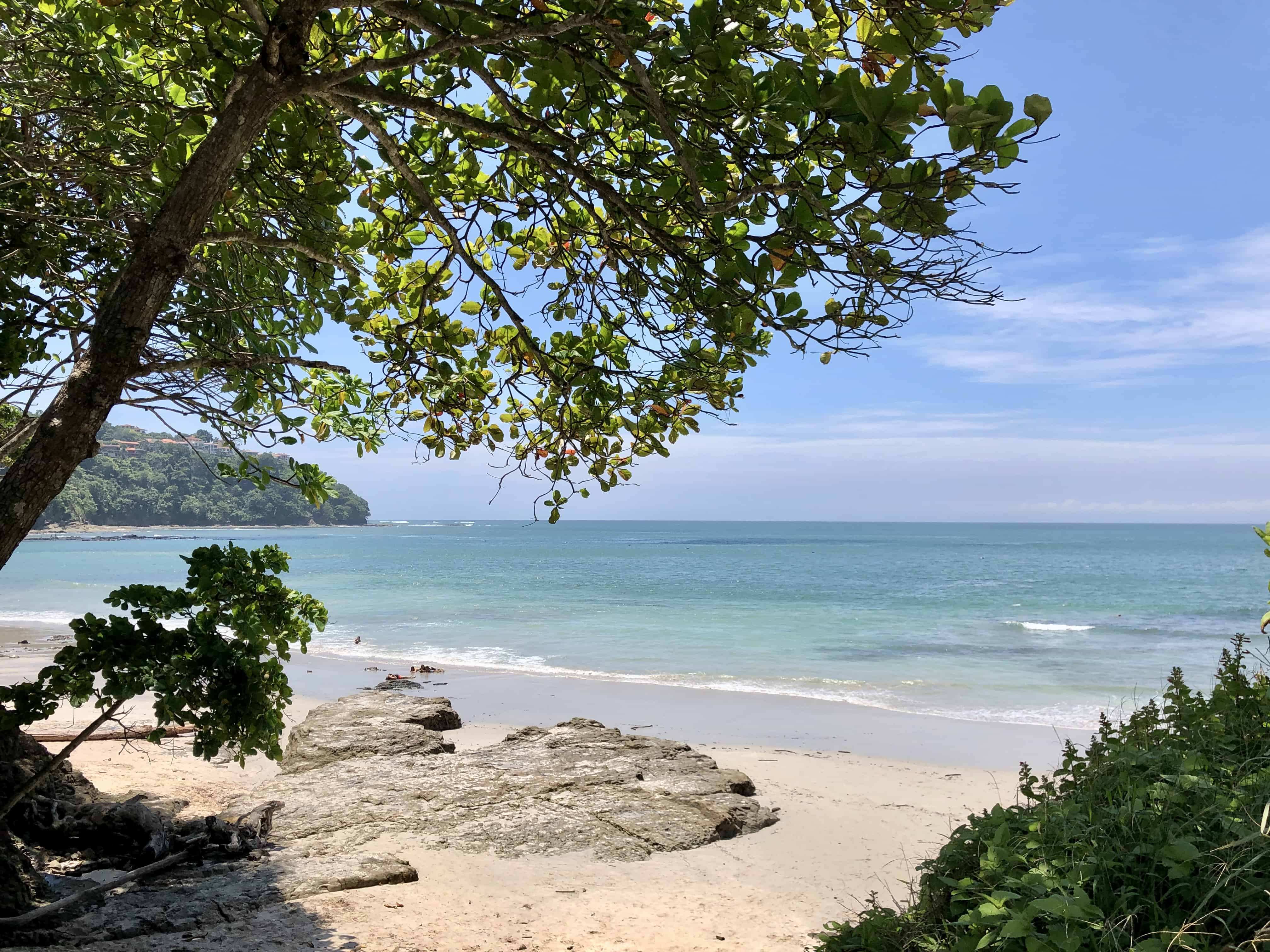
Costa Rica’s Constitutional Court has ordered environmental authorities to create a long-delayed management plan for the protected marine wetland at Playa Blanca, adding a new chapter to the controversy surrounding one of the Central Pacific’s most popular beaches. The court gave the Ministry of Environment and Energy (MINAE), and the National System of Conservation Areas (SINAC), a maximum of 12 months to complete the General Management Plan for the Humedal Marino Playa Blanca, located near Punta Leona in Garabito, Puntarenas.
The ruling is notable because the wetland was established in April 1994 and has operated for more than 32 years without an approved management plan. The court decision comes as Playa Blanca is already at the center of a separate fight over public access. In June, the Municipality of Garabito removed barriers at the entrance to Punta Leona after arguing that the road leading toward Playa Blanca is public. The move opened vehicle access through the resort area and led to a sharp increase in attention from visitors wanting to reach the beach. Punta Leona disputes the municipality’s interpretation and has continued challenging the matter in court.
The latest Constitutional Court ruling does not settle that access dispute. Instead, it focuses on how the protected marine area itself is being managed. The Humedal Marino Playa Blanca was created by executive decree on April 7, 1994, and is administered by SINAC through the Central Pacific Conservation Area. Despite its protected status, authorities never completed the management document normally used to determine how an environmentally sensitive area should be protected and used.
A management plan can establish which activities are appropriate in different parts of the protected area, identify environmental threats and set out programs for monitoring, restoration and enforcement. It also allows authorities to update scientific information about the area’s marine environment and surrounding ecosystem. The case was brought by environmental attorney Wálter Brenes Soto, who argued that leaving the wetland without such a plan made it difficult for authorities to properly protect the area.
Environmental officials told the court they had tried at least twice to begin preparing the plan but lacked sufficient financing and institutional resources. SINAC had proposed gathering information during 2026 and 2027, preparing contracting documents in August 2027 and seeking money for the project in its 2028 budget. Once contracted, preparing the plan was expected to take another 12 to 15 months.
The Constitutional Court rejected that timeline.The judges concluded that after more than three decades, a continuing lack of funding did not justify leaving the protected area without the required environmental planning. The court said the situation affects Costa Rica’s constitutional right to a healthy and ecologically balanced environment.
The ruling was issued August 27 and the 12-month deadline begins once authorities are formally notified.The timing adds another layer to the debate surrounding Playa Blanca. When Garabito removed the entrance barriers in June, Mayor Francisco González said the municipality was enforcing a determination dating back more than two decades that the road was public. Punta Leona has argued that the entrance and road cross privately registered property and says the dispute should ultimately be resolved by the courts.
Since then, anyone going there has been able to travel through the Punta Leona entrance toward Playa Blanca, although parking has become an issue. Authorities have warned drivers that public access to the beach does not allow them to park along the roadway. Private parking is available in the area, including parking operated by Punta Leona.
During a July 22 inspection, SINAC personnel reported relatively little tourist activity inside the actual boundaries of the marine wetland and said nearby development lies outside the officially protected area. Authorities acknowledged, however, that a management plan would allow them to better evaluate possible indirect effects from activity surrounding the wetland.
Brenes has linked the court case to what he describes as increased visitation since the Playa Blanca entrance was opened. He argues that the additional traffic makes proper environmental management more urgent. For those that go there, the important point is that the ruling does not close Playa Blanca and does not reverse the opening of the access road. It requires Costa Rican environmental authorities to finally establish a formal plan for managing the protected marine area alongside the beach.
What that plan ultimately contains remains to be seen. But after 32 years without one, the Constitutional Court has now put a firm deadline on the government to produce it.





