

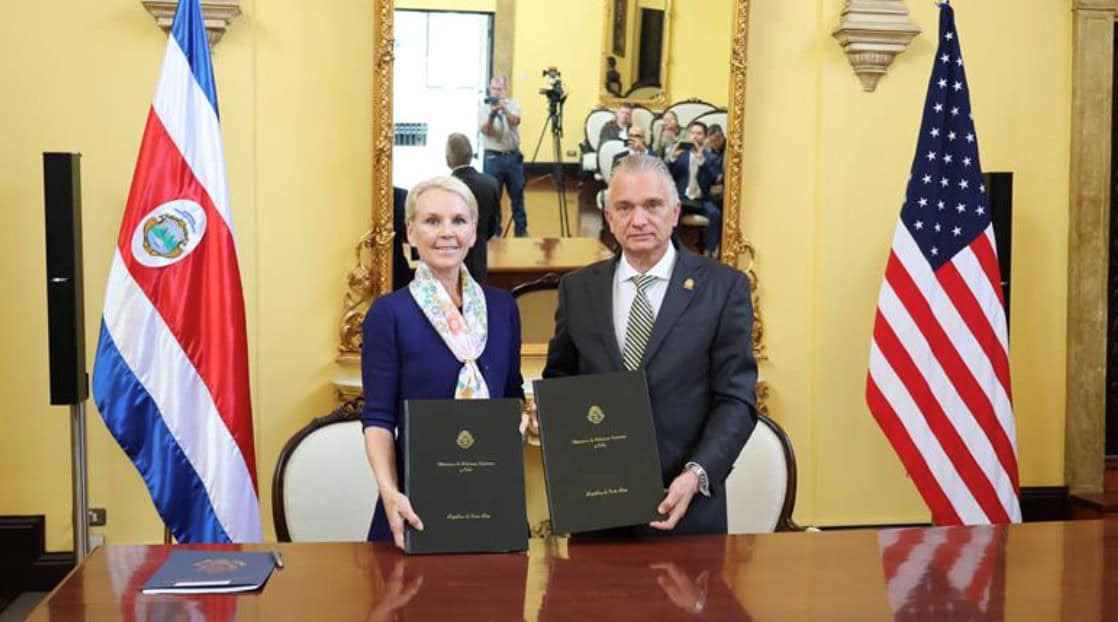
Costa Rica and the United States have expanded their Joint Patrol Agreement to include the fight against illegal, unreported and unregulated fishing, adding marine resource protection to a bilateral maritime-security framework long used against drug trafficking.
The protocol, signed April 30 in San José, amends the existing agreement and broadens cooperation beyond illicit maritime trafficking. Costa Rica’s Ministry of Foreign Affairs said the update adds tools to prevent, detect and deter activities that damage marine resources and threaten ocean sustainability.
The Joint Patrol Agreement has been a core part of Costa Rica-U.S. maritime cooperation since the late 1990s. It has primarily supported operations against international drug trafficking and criminal groups using Pacific and Caribbean routes. The new protocol adds illegal fishing to that mission, giving U.S. Coast Guard patrols working with Costa Rican authorities a broader role in protecting the country’s fisheries.
Foreign Minister Arnoldo André said the agreement, in effect since 1999, has been “a fundamental tool” against maritime drug trafficking and organized crime. He said the amendment marks another step by allowing the two countries to confront illegal fishing, a threat he described as one that “knows no borders.”
André said stronger patrol capabilities will help Costa Rica protect marine resources, support fishermen and defend long-term ocean sustainability.
U.S. Ambassador Melinda Hildebrand said the new protocol builds on the first Costa Rica-U.S. agreement signed in 1998 to intercept illicit maritime drug trafficking. She said U.S. Coast Guard patrols, which have focused mainly on counter-narcotics cooperation, will now be able to expand activities aimed at protecting Costa Rica’s fishery resources from illegal exploitation.
The amendment is tied to international rules and guidelines, including the United Nations Convention on the Law of the Sea and guidance from the Food and Agriculture Organization of the United Nations. The FAO defines illegal, unreported and unregulated fishing as activity that can occur on the high seas or inside national waters and may be linked to organized crime. It warns that this type of fishing removes resources from lawful fishers and can damage local fisheries.
For Costa Rica, the change comes as our country faces growing pressure to defend its vast marine territory, including fishing grounds, protected areas and routes used by criminal networks. Illegal fishing affects commercial and small-scale fishers, weakens conservation efforts and places added strain on marine ecosystems already under pressure from climate change and overfishing.
With the protocol, Costa Rica and the United States are reaffirming cooperation on maritime security while expanding the mission to cover a wider set of threats at sea. The practical effect is that joint patrols can now target not only drug trafficking and related maritime crime, but also vessels suspected of illegal fishing or activity that threatens Costa Rica’s ocean resources.





