
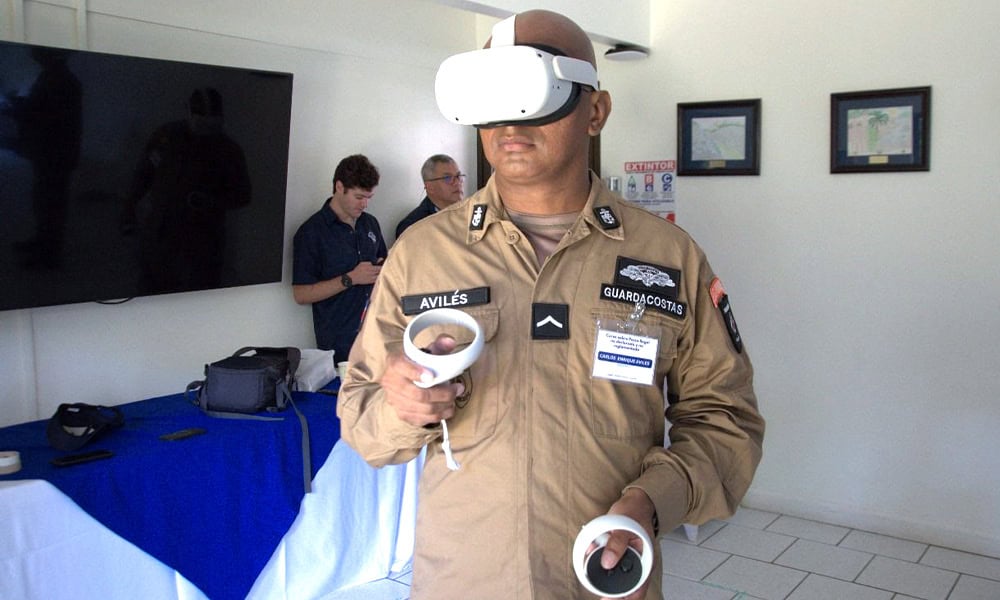
For the third consecutive year, the course on Illegal, Unreported, and Unregulated Fishing (IUU) was held last weekend, where 34 judges, environmental prosecutors, OIJ investigators, and officials from the Ministry of Environment and Energy (MINAE) strengthened their skills to deal with crimes related to this problem.
This training program combines theory through lectures given by experts with simulations of practical exercises in virtual environments, thanks to the use of virtual reality.
Through the use of avatars, participants experience firsthand the functions performed by the National Coast Guard police forces during the boarding of a vessel suspected of illegal fishing activities.
The course is organized by the Training Unit of the Public Prosecutor’s Office and developed in collaboration with the National Coast Guard Service, the Costa Rican Federation of Sport Fishing (FECOP), and Humane Society International (HSI). Ocean Mind and NOAA-Law Enforcement of the United States also participated.
Moisés Mug, FECOP’s Science Director, highlighted the importance of this type of training for the country, noting that “the gaps in knowledge in the chain of custody of the cases presented in the courts represent a serious threat to natural resources. These cases, often related to Illegal, Unreported, and Unregulated Fishing (IUU), can result in impunity for those responsible.
“In addition, this type of virtual practice is a more accessible and efficient alternative in terms of didactic resources available to justice personnel,” he commented.
Mug was grateful for the opportunity to support the country’s justice system with this course, as it provided an in-depth approach to the crimes committed at sea.
“We are often unaware of the arduous work carried out by the coast guard police in boardings of this nature. The inclusion of virtual reality tools makes it easier to become familiar with and better internalize the issues addressed. This knowledge is very valuable for being better prepared to apply the measures requested by the prosecution or to deliver a fair sentence in an eventual trial,” he said.
Illegal fishing represents a significant threat to the economy and the environment in Costa Rica. Around 19,000 sailfish are killed annually due to commercial fishing, and there are frequent reports of illegal fishing, which negatively impacts the country and sport fishing, a sector that generates around $520 million annually.
“This course is very important because it provides competencies, tools, and knowledge to all personnel dedicated to the prosecution of environmental crimes, with an emphasis on illegal fishing, so that they can develop their work and present evidence before the Public Prosecutor’s Office,” said Alejandro Alpizar, Deputy Prosecutor.