
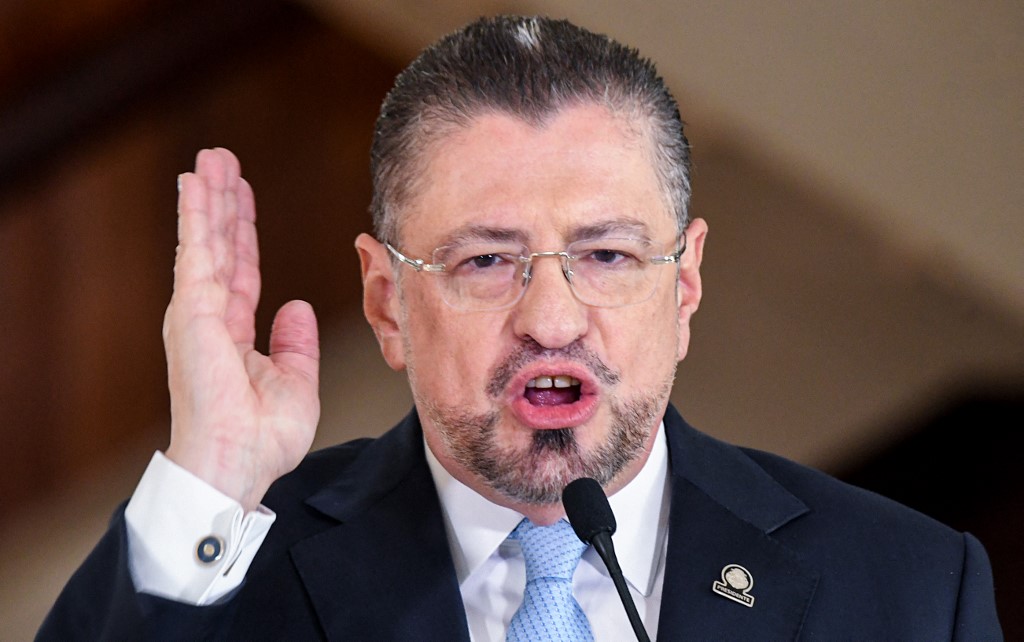
Costa Rica’s Congress will decide on Monday whether to lift President Rodrigo Chaves’s immunity so he can be tried for alleged corruption, in an unprecedented case in this country with a democratic tradition.
The three lawmakers on a special committee that reviewed the motion will present their arguments to the full Legislative Assembly that day regarding the request to strip immunity, which was endorsed by the Supreme Court on July 1.
The two opposition members on the committee support the request, while the pro-government member rejects it.
After the presentations, the 57 members of the unicameral Congress will vote to decide the president’s fate. Chaves has enjoyed high popularity since taking office in 2022. His term ends in May 2026 and he cannot seek immediate re-election.
These are key points about the case against Chaves, a 64-year-old conservative economist and former World Bank official who has frequently clashed with the other branches of government.
What is he accused of?
Prosecutors accuse the president of the crime of concusión (extortion/abuse of office by a public official to benefit someone), punishable by up to eight years in prison. According to the indictment, Chaves forced a communications firm hired by the Presidency to give $32,000 to his friend and former image adviser, Federico Cruz.
The firm’s hiring to provide services during Chaves’s term was financed with funds from the Central American Bank for Economic Integration (CABEI) through an “apparently” improper procedure, according to the prosecutor’s office. Culture Minister Jorge Rodríguez also faces a request to lift his immunity on the same charges.
What does the president say?
The president rejects the accusation and says the motion amounts to an “attempted judicial coup.” He also rules out appearing before Congress on Monday to present his defense. “I will not lend myself to give a veneer of legitimacy to this lamentable spectacle,” he said this week.
“Neither the Court nor the prosecutor seeks justice. No, what they want is payback,” because “this government has exposed the structures of great privileges of powerful groups in collusion with the leadership of the Judiciary,” he said the day after the Court endorsed the request to strip his immunity.
Since taking office, the president has confronted the heads of the other branches and called them a “putrid caste.”
And if his immunity is lifted?
If the motion is approved, “from that moment President Chaves would be indictable like any other citizen,” said constitutional lawyer Luis Felipe Rodríguez.
That “does not amount to a kind of recall of mandate, nor does it equal a temporary suspension from office,” added the University of Costa Rica professor.
However, because this is “something that has never happened in our constitutional history, there are certain gaps that experience does not allow us to fill,” the jurist warned.
Will there be enough votes?
Although the opposition controls Congress, it seems unlikely the motion will obtain the “qualified majority” of 38 votes needed to lift Chaves’s immunity. Alongside the nine pro-government lawmakers expected to vote against the motion, six legislators from another conservative party and some independents would likely join them.
“I very much doubt, honestly, that they can get the 38 votes,” said political scientist and analyst Gustavo Machado. Rodríguez shares that view: “It is difficult to reach that majority, unless, of course, there is a broad multi-party legislative agreement.”
Machado says that even if he loses immunity, Chaves “could emerge politically stronger” because “he will continue with a narrative that all this is the result of his brave fight against the caste.”
Is the country’s image hurt?
Rodríguez and Machado say the case harms the image of the Central American country, but former president Laura Chinchilla argues that “far from damaging Costa Rica’s image, it strengthens it.”
“It is a very powerful message about the health of the rule of law and the independence of powers, despite the attacks to which President Chaves himself has subjected them,” said the former president (2010–2014).
“It is a confirmation that no one is above the law in Costa Rica,” she added.