

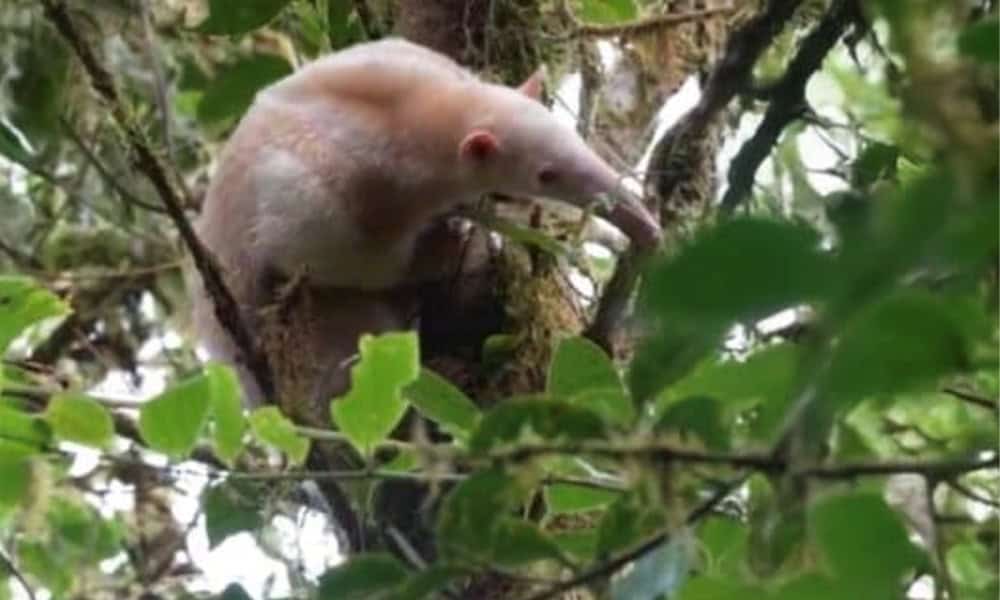
Costa Rica is home to hundreds of animal species that surprise locals and foreigners alike. Recently, an especially unusual sighting occurred in Bajo La Paz, San Ramón, where a tamandua anteater was observed with a striking lack of pigmentation. This rare anteater was observed by Ignacio Arias, who operates an ecotourism business in the area. According to experts, anteaters with unusual coloration are incredibly rare in the wild. Carolina Sáenz, a specialist from the International Institute for Wildlife Conservation and Management at the National University (UNA), noted that due to the distance from which the animal was observed, it remains unclear whether it has albinism or leucism.
Pigmentation anomalies in wildlife can arise from two main conditions. Albinism, which is characterized by a complete absence of melanin, typically results in white skin and fur along with red or pink eyes. Leucism, on the other hand, causes a partial loss of pigmentation that can leave an animal with a lighter or patchy coat but usually normal eye color. In anteaters, both conditions are extremely uncommon and can have significant impacts on their behavior and survival. Reduced pigmentation might make these animals more conspicuous to predators, and it could also affect their ability to camouflage or interact with other members of their species.
Bajo La Paz is part of a region in Costa Rica celebrated for its rich biodiversity and strong emphasis on ecotourism. The area is a hub for local conservation efforts, and sightings like this one often generate considerable interest among both tourists and wildlife researchers. Documenting such rare occurrences can provide valuable data for monitoring genetic diversity and population health within the species. While Costa Rica is well known for its robust system of protected areas and conservation programs, unusual genetic traits can sometimes signal environmental stressors or natural variations that require further study.
Local authorities and conservationists are always on the lookout for atypical specimens, as they can offer insight into broader ecological trends. The sighting of a white anteater adds an extra layer of intrigue to Costa Rica’s already impressive array of wildlife, which includes sightings of jaguar cubs and other endangered species. This rare encounter not only reinforces the notion that Costa Rica remains one of the world’s biodiversity leaders, but it also highlights the importance of continued monitoring and research. Ecotourism operators in the region, like Ignacio Arias, play a crucial role in bringing these conservation stories to the public eye, potentially influencing both local policies and global awareness about wildlife protection.
While anecdotal evidence and sporadic reports of unusual anteater coloration exist, this recent sighting is one of the few documented cases in Costa Rica’s wild landscapes. It encourages further investigation and may prompt local wildlife authorities to integrate such anomalies into their ongoing monitoring programs. As researchers continue to explore the causes and implications of pigmentation differences, every observation contributes to a broader understanding of how species adapt to their environments.





