
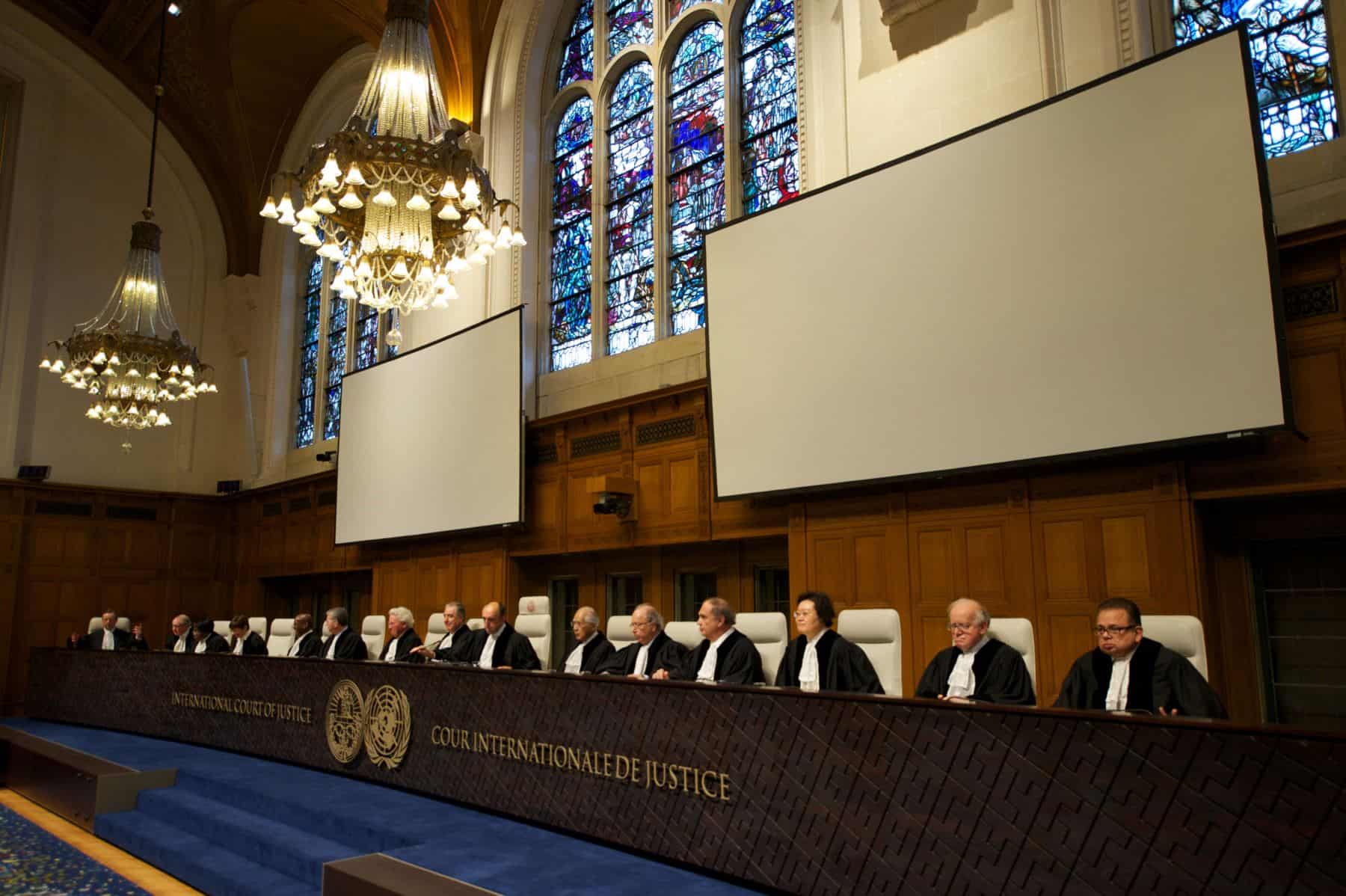
Nicaragua on Tuesday accused El Salvador of maintaining hostile actions in its maritime space in the Pacific Ocean and invited it to resolve eventual border disputes peacefully at the International Court of Justice (ICJ).
“The Government of El Salvador has carried out and continues to carry out hostile activities in Nicaragua’s exclusive economic zone” in the Pacific, denounced the government of Daniel Ortega in a press release.
According to Managua, the incursions began last Friday with the presence of Salvadoran military gunboats southwest of Punta Cosigüina, in the northwest corner of the Nicaraguan coast.
Nicaragua affirmed that on Saturday the Salvadoran vessels returned to incursion “less than 30 miles away from our coasts”.
The Salvadoran vessels “remain at that site claiming sovereignty over those maritime spaces without any geographical, historical or legal support,” the Nicaraguan government claimed on Tuesday.
“If the government of El Salvador really considers that there is a boundary dispute, we call on it to cease resorting to the threat or use of force against the territorial integrity of Nicaragua and submit the alleged dispute to the International Court of Justice,” it demanded.
El Salvador Rejects Overture
Last Sunday, Nicaraguan Foreign Minister Denis Moncada had already sent a note protesting the incursion to his Salvadoran counterpart, Alexandra Hill, who rejected the accusations.
“The government of El Salvador strongly rejects the full content of your note above, for stating that the waters in which the Salvadoran vessels were located are Nicaraguan, when they are unequivocally Salvadoran,” Hill said Monday.
Those maritime spaces “are and have always been under the sovereignty and jurisdiction of the Republic of El Salvador, in accordance with state practice and international law,” the minister added.
The Ortega government clarified however that Nicaragua “does not share limits in the Pacific” with El Salvador, and therefore, “does not have any boundary dispute” with that country and that “it only has limits with Honduras” on its northern border.
There Are No Limits
Punta Cosigüina, near where the incidents took place, is part of a Nicaraguan peninsula of the same name, which is bordered to the south and west by the Pacific Ocean and to the north by the Gulf of Fonseca, waters that are shared by Nicaragua, Honduras and El Salvador.
The Gulf of Fonseca has been the scene of political tensions and conflicts between fishermen and coast guards who accuse each other of illegal incursions.
In 2021, in a surprise agreement, Nicaragua delimited its maritime border with Honduras in the Gulf of Fonseca and recognized sovereignty over part of what was historically considered Nicaraguan sea. In this way, according to Managua, a 1992 ICJ ruling was ratified.
But El Salvador did not participate in the signing and questioned the agreement. El Salvador and Honduras still dispute the sovereignty of Conejo Island in the gulf.
“This is a tripartite territorial conflict that dates back to colonial times, which has not been fully resolved (…) There has never been a tripartite negotiation” of maritime boundaries, Carlos Murillo, an expert in maritime law at the University of Costa Rica (UCA), explained to AFP.
He recalled that El Salvador and Nicaragua “have never formally drawn” their maritime borders in the Pacific, so it cannot be said that one invades the territory of the other.
Furthermore, while for El Salvador its territorial sea is 200 nautical miles, for Nicaragua it is 12 miles, which may overlap their sovereignty projections.
Murillo further explained that Nicaragua’s claim is for incursion into its exclusive economic zone, a maritime area where foreign military vessels can sail without warning if their weapons are not in a position to attack, according to the Law of the Sea Convention.
“If it were a legitimate and non-political claim, it is a very interesting case (…) but here there is a political intentionality that is not very clear, as if to divert attention from internal matters in their own countries,” Murillo considered.