


MUNICH, Germany – Germany said it was reinstating border controls on Sunday as Europe’s top economy admitted it was stretched to the limit trying to cope with a record influx of refugees.
Also on Sunday, Germany’s rail service halted train services with Austria for 12 hours. Rail links between the two neighbors will be effective until 5 a.m. (0300 GMT), Deutsche Bahn said. Its announcement follows a similar move by the Austrian rail service to suspend trains between the countries.
The announcements came as tragedy struck again off the coast of Greece, with 34 more migrants — among them babies and children — drowning when their overcrowded wooden boat capsized in high winds.
German Interior Minister Thomas de Maiziere said border controls would be reintroduced with immediate effect, and the Czech republic announced similar measures on the border with Austria.
“The aim of this measure is to stop the current influx to Germany and to return to an orderly process,” de Maiziere said, as the city of Munich recorded an influx of 63,000 asylum seekers in two weeks.
Asylum-seekers must understand “they cannot chose the states where they are seeking protection,” he told reporters.
Under EU rules, the first country of entry is required to deal with an asylum-seeker’s request for protection, but Germany had waived the rule for Syrian refugees.
Local authorities in Germany, which has earned praise for its welcoming stance towards refugees, have buckled under the sudden surge of migrants at the end of an exhausting and often perilous journey.
See also: Europe’s migrant crisis: What you need to know
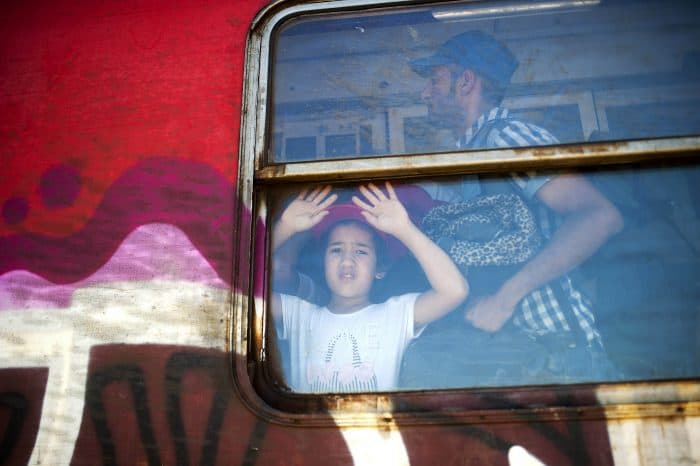
European Union home affairs ministers will hold an emergency meeting on Monday to discuss deeply divisive European Commission plans to introduce compulsory quotas for refugees.
“The German decision of today underlines the urgency to agree on the measures proposed by the European Commission in order to manage the refugee crisis,” the EU said.
Europe’s biggest economy has become the destination of choice for many, particularly for Syrians after Chancellor Angela Merkel decided to relax asylum rules for citizens of the war-torn country.
“Given the numbers from yesterday, it is very clear that we have reached the upper limit of our capacity,” said a Munich police spokesman.
In Greece, on the frontline of the massive surge of people trying to reach Europe, the coast guard said 34 people — including four babies and 11 young children — perished when when their boat capsized off the Aegean island of Farmakonisi.
The coast guard was also still searching for four children missing after another boat capsized on Saturday off Samos, a Greek island just off the Turkish coast.
The latest tragedies follow the death of a Syrian toddler whose lifeless body was photographed washed up on a Turkish beach last week, becoming a heartwrenching symbol of the plight of refugees fleeing war.
Merkel herself had called Saturday on Athens to make more effort to protect the EU’s external borders.
But Greece’s interim Prime Minister Vassiliki Thanou branded the criticism “unacceptable.”
“Greece is strictly applying European and international treaties without ignoring the humanity of the situation,” she said on a visit to Lesbos, an island which has been struggling with the massive influx.
The Organisation of Islamic Cooperation was also due to discuss the crisis Sunday.
While Jordan, Lebanon and Turkey are housing millions of refugees from Syria, many wealthy Gulf states are facing increasing scrutiny over their apparent reluctance to take in people fleeing the conflict.
The International Organisation for Migration said Friday that more than 430,000 people have crossed the Mediterranean to Europe this year, with 2,748 dying en route or going missing.
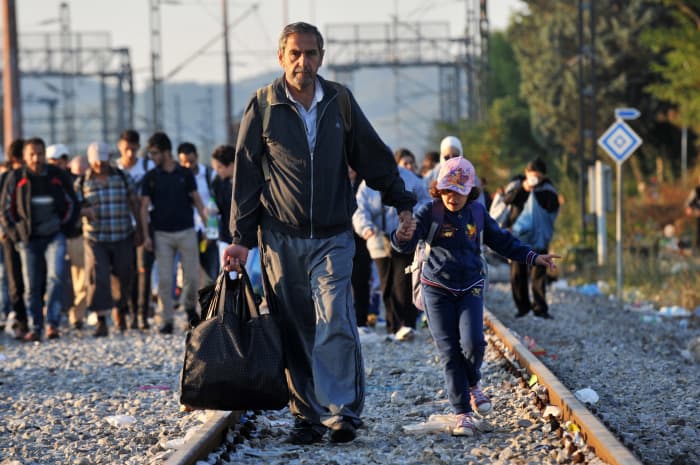
‘Brink of collapse?’
In Munich, order had largely returned to the main railway station although the federal interior ministry said 13,015 people had arrived over the past day.
But Germany’s local authorities say they are at the end of their tether.
The president of the Upper Bavaria region, Christoph Hillenbrand, said he did not know “how we can cope,” according to the Bild am Sonntag tabloid which headline its article “Munich on the brink of collapse.”
Bavarian public television BR said the city “came very close to a humanitarian disaster.”
In a sign that the city was running out of options, regular passenger trains will be cleared out to transport refugees.
The authorities are also mulling whether to open up the Olympiahalle — a stadium used for the 1972 Olympics and which today serves as a concert hall or sports arena — as a temporary shelter for the refugees.
European divisions over refugee crisis
As the continent scrambles to respond to the biggest movement of people since World War II, sharp divisions have emerged among the European Union’s 28 member states.
While Germany and France back proposals to help “frontline” states Italy, Greece and Hungary struggling with the influx, European Commission plans for sharing 160,000 new arrivals in a quota scheme are facing resistance from eastern members.
Czech Prime Minister Bohuslav Sobotka insisted his country would never accept compulsory quotas, saying that the system “won’t work,” while Slovakia said it would also vote against the measure at Monday’s EU meeting.
Hungary, which reported a new record in migrant arrivals — 4,330 on Saturday — was working around the clock to finish a controversial anti-migrant fence along its border with Serbia.
Budapest has recorded some 180,000 people entering illegally this year and has passed a raft of tough new laws that will take effect on Tuesday, meaning anyone crossing the border illegally can be deported or even jailed.
Hardline Prime Minister Viktor Orban had said the migrants are “not coming our way from war zones but from camps in Syria’s neighbours. … So these people are not fleeing danger.”
Describing the “very dismal situation” at Hungarian police camps, Human Rights Watch emergencies director Peter Bouckaert said people are kept in tents with very little food and given almost no information.