

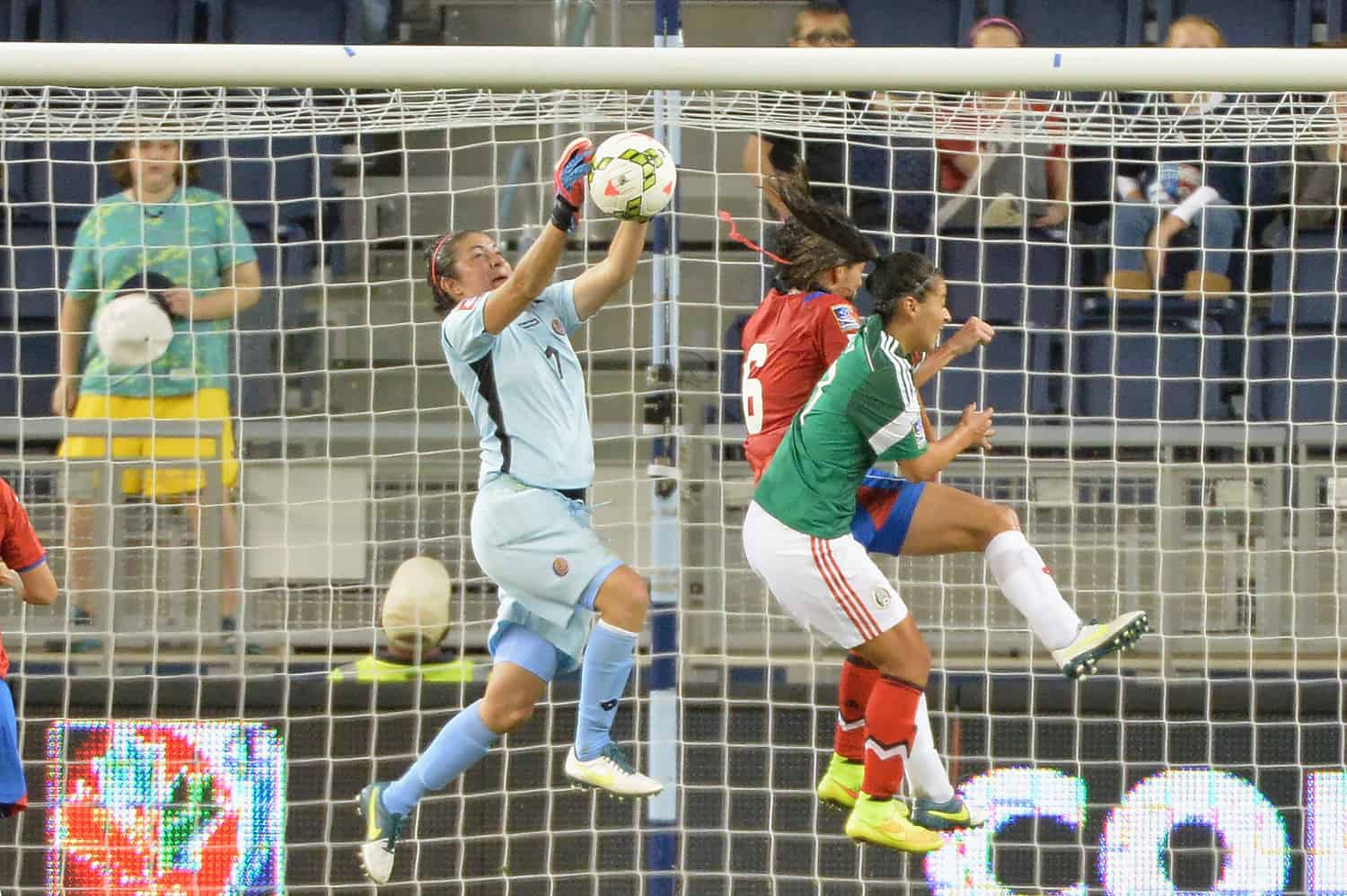
“Her name is Dinnia, not Keylar.” This was the phrase that filled social media networks in a loud, clear voice a few days ago, as private and public figures including former President Laura Chinchilla responded to the cover of a well-known sensationalist newspaper in Costa Rica. The newspaper’s cover referred to Dinnia Díaz – the goalkeeper of the Costa Rican Women’s National Soccer Team, which just qualified for the Women’s World Cup for the first time in history – as “Keylar.” (This allusion to renowned male Costa Rican keeper Keylor Navas is roughly akin to referring to a women’s basketball star as “Michelle Jordan.”)
With the stroke of a key on a newsroom computer, Dinnia was removed from her identity, from her abilities, from her gender, from her achievements. The newspaper’s play on her name may have sounded funny to some, clever to others, and even completely harmless to most of the population. But it was not. The cover and the title were sexist, and there is no other word for it. A male player would never be compared to a female player in such a way. And if the sexist allusion was unintentional, that doesn’t take the issue off the table. Actually, it sets up the scenario for this month’s column: veiled discrimination.
In Costa Rica we are used to providing and accepting, without hesitation, comments and jokes that are sexist, homophobic, racist and generally discriminatory. Fortunately, things are changing, as showed by the reaction on social media to the “Keylar” fiasco; but this is happening at a very slow pace. It’s promising that the National Soccer Federation (Fedefutbol) reacted to the episode by supporting Dinnia’s epic performance and rejecting the sexist allusion, since fighting discrimination requires official efforts, including government policies to fight every type of discrimination. Above all, it requires efforts from sports associations, companies, civic groups, political parties, religious congregations, universities and citizens in everyday life. To build a free and democratic society where everyone can have a voice, and not only a vote, entails an ongoing political exercise of unveiling and condemning discriminatory comments and actions at all levels. This, of course, is not easy, since discrimination has been with us for centuries.
Our history, culture and traditions are filled with marvelous practices and values of which we should feel proud. However, we should also be aware that many of our institutions and social conventions have a non-inclusive historical background, not just in Costa Rica but around the world. On a personal note, I was surprised a few years ago when I first came to study in the United Kingdom, and specifically a year ago when I came to Oxford, to discover how accustomed I was to listening to discriminatory comments and letting them pass. I admired, and began to emulate, the way that many of my fellow students (not all of them, unfortunately) had internalized an automatic, vocal reaction against sexist, homophobic or racist comments and jokes. In most cases, the person who made the comment or joke recognized it and proceeded to apologize. Although universities are not perfect, one can sense in academic settings a growing culture against discrimination. I now feel a part of that culture, and empowered to speak out against discriminatory comments and actions at a dinner table, over coffee, in a sports match or simply in a class. Once you start living like that, it’s hard to go back.
That is the goal that our elected officials and other social leaders should keep in mind: to make every person feel supported and empowered to confront discriminatory acts and people. The opposite attitude is exactly what can bring us down as a free and tolerant society. Costa Rica is a country in which people who discriminate put themselves in a position of power while the rest remain silent, powerless and frightened. Let’s think for example of our children in elementary school, our teenagers in high school, of men and women in their jobs and their families. How often has each of us been exposed to comments that attack our dignity, our essence, our very nature? How often have we have remained silent?
This has to change. People who discriminate should be exposed and censured, as in the case of “Keylar.” Those who oppress and discriminate with horrible words should be fought with strong words in favor of tolerance and respect. Just as a small exercise, take five minutes and think about how many discriminatory words and jokes you say daily. Be conscious about them next time you talk to your family and friends. I understand that to have different opinions is also part of living in a free and democratic society; therefore, I am not trying to convert anyone here to a particular ideology. I am also aware of the existent debates on freedom of expression and discrimination. My intention here is simpler: to encourage people who are against discrimination to be outspoken about it.
Whether using social media or simply at a party with friends, in a meeting or in a class, we should be loud and clear against discrimination. We may sound like outsiders at the beginning, accused of being uptight or humorless, but we will be surprised later on by how many people are on our side. Laws, state policies, and institutions all matter, but they always lag behind social change. We need to start by changing ourselves.
Our National Women’s Soccer Team showed the country that women and men have the same abilities and capabilities to succeed in sports, just as other women have demonstrated this in the media, in government, in the arts, and in the world of business. So, let’s say it again loud and clear: to use the allusion to “Keylar” was sexist and wrong. We have an amazing female keeper on our national soccer team, and her name is Dinnia. Yes, Dinnia.
Tomás Quesada-Alpízar is pursuing his doctoral degree in politics at the University of Oxford. In “Politic(o)s,” published the first Monday of every month, he explores current events and political issues in Costa Rica and around the region. He welcomes reader questions and comments at politicostt@gmail.com.
See also: When ‘politician’ is a dirty word





