

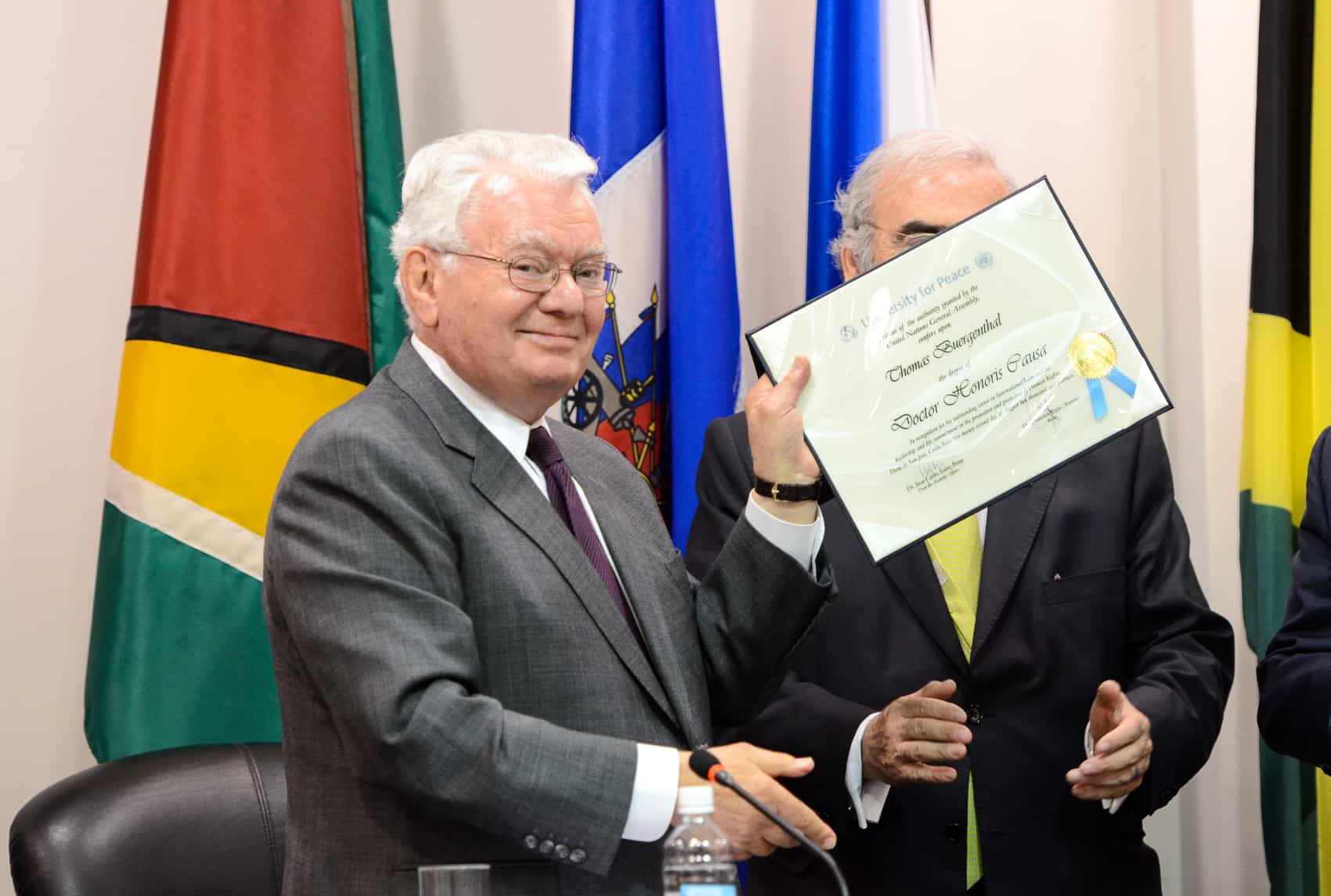
Auschwitz survivor and former Inter-American Court of Human Rights (IACHR) president Thomas Buerguenthal received an honorary doctorate on Friday in recognition of his leadership in and promotion of human rights, including the founding of the Inter-American Court of Human Rights.
The University for Peace granted Buerguenthal the honorary doctorate during a ceremony at the IACHR in San José. Buerguenthal served as a judge on the court from its founding in 1979 until 1991. He was president of the court from 1985 to 1987. In 2000, Buerguenthal joined the International Court of Justice at The Hague, in the Netherlands, where he served until 2010. Buerguenthal, a U.S. citizen, was active in the 10-year effort to create the Inter-American Court of Human Rights here in Costa Rica.
Born in Slovakia in 1939, Buerguenthal was one of only three children who survived the death march to the Sachsenhausen death camp from the Auschwitz camp, an ordeal that claimed the lives of thousands. He and his mother were liberated from the camp in 1945. His father was killed days before the end of the Second World War (TT Nov. 9, 1979). Buerguenthal emigrated to the United States in 1951 and eventually graduated from the New York University School of Law in 1960 and received a Doctor of Juridical Science from Harvard Law School in 1968.
The judge told The Tico Times that some of his most important work on the Inter-American Court dealt with the 1989 case of forced disappearances in Honduras, a first of its kind for a human rights court; the United Nations-backed truth commission in El Salvador; and a freedom of expression case in Costa Rica brought by The Tico Times that opened the practice of journalism to anyone, regardless of their university degree.
The following is a selection of topics from The Tico Times’ conversation with Buerguenthal Friday at the IACHR’s office after he received the honorary doctorate.
Why do institutions like the IACHR matter?
We have lots of human rights conventions these days, but without courts to apply them, these conventions are going to be disregarded by states continuously. With a court, you can really review [a state’s] adherence to various treaties. It’s a way to ensure that fewer human rights violations take place. Even when they don’t comply with the decision, just being in the court has an effect on them.
Did your past experience with hardships during the Second World War affect your decision to go into international law?
It must have. We always thought that what we needed was help from abroad and that would have made a big difference. Then you start thinking about, how do you get help from abroad? That’s when international law comes into play. I didn’t set out to change the world, I came to the subject naturally. In those days, there were few people in law school or NGOs [dedicated to international human rights]. Now you have them all over the world. In my day, I felt like it was something that people needed to look into and see how it would work. When I started there was only one court like it, the European Court of Human Rights. When the Inter-American Court of Human Rights finally came about, it had a hard start because of all the dictatorial regimes in the region.
How did you become involved with human rights in Latin America?
It’ll surprise you to hear that I was really not involved with any human rights activities in the region. Only when there was the overthrow of the Chilean government did I publish a letter in The Washington Post to try to draw attention to what was happening here. It was only when I got on to the court that I really became aware of what was going on here, because my general orientation was toward Europe.
How has the court changed?
It’s matured as a court. In our day, getting a case was a big deal. Now they have a lot of work and more cases than they would like to have. The court is pretty much accepted in the region; that wasn’t true in my day. Then, even the countries that had ratified the convention didn’t really believe that they had any obligation [to the court] or to comply with anything. It’s a very different ballgame today. They’ve made good decisions and bad decisions, and you can argue about that, but it’s generally a court that is accepted except in countries that don’t like human rights courts.
With Venezuela’s decision to pull out of the IACHR and others threatening to pull funding from bodies like the Organization of American States’ Special Rapporteur on Freedom of Expression, do you see human rights law taking a step backwards in the region?
Yes, but I think it begins with some of these states violating human rights and the various commitments they have under this convention and the U.N. convention on civil and political rights. If you look closely at what some of these countries are doing, there are serious violations of human rights. If you are a serious violator, you don’t want the court to look at you.
One of the principle concerns when the court was founded was that the court would step on states’ right to govern their own territory. This has come up recently in Costa Rica, which has yet to pass a law on in vitro fertilization to comply with the IACHR’s ruling.
It’s not unusual if democratic states have problems giving effect to decisions because of the way they operate. It’s very different from countries that have dictatorships of one form or another. They don’t have a democratic process that’s preventing them; they have policy of not giving effect to human rights decisions. It’s very different.
Let me give you a straight legal answer: Any country that ratifies a human rights treaty has, to that extent, given up its sovereignty with regards to what is in that treaty. This is utter nonsense when they talk about sovereignty. They ratified the treaty, so to that extent they accept it, regardless of what their ideas about sovereignty are. It’s always the countries who violate human rights who are the first ones to tell you all about it. The Chinese use sovereignty all the time, but they haven’t ratified many human rights treaties. Don’t ratify it for propaganda purposes, and then say it interferes with sovereignty. There are countries that think this court infringes on their sovereignty and want to remove it. That’s one of the biggest challenges facing the court. I think it’s very important for other countries to resist that.





