

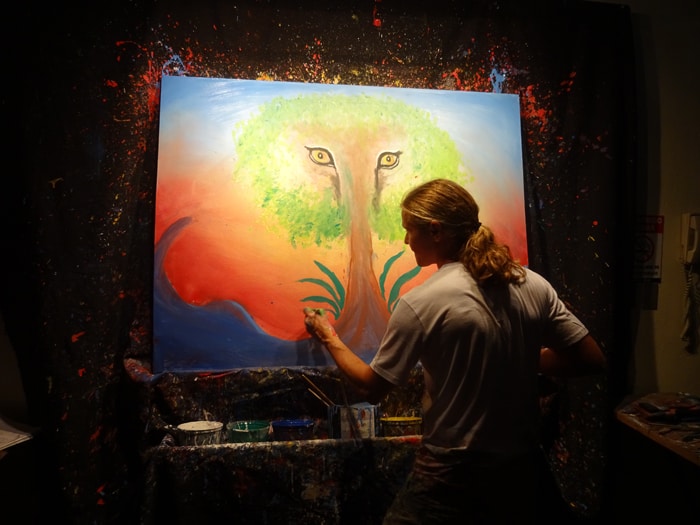
There you are at Daniel Oduber International Airport in Liberia, and you have to catch your plane. You spring from your taxi. You check in. You head for you gate – and then, just as you enter the terminal, you see them: paintings of fish. Each portrait is so realistic you might almost mistake it for an photograph. The sailfish, roosterfish and golden fish are shown close-up, underwater, as if you are swimming peacefully beside them. They are smoothly painted in acrylic pigments, like illustrations in a textbook.
“I wanted to express the beauty of these animals,” says artist Carlos Hiller, who created the series. The exhibit is called “Sparkle: Vibrant Colors,” and Hiller can speak poetically about the iridescence of the sea and its creatures. “Usually, we see mahi-mahi and think of fishing. But they are interesting and important to me as living animals.”
Given the many trajectories of his life, it seems improbable that Hiller would become a professional painter of aquatic wildlife in small-town Guanacaste. Hiller grew up in a landlocked community in Argentina, and he never laid eyes on the ocean until he was 15 years old. He tried studying marine biology at university, but that attempt fizzled.
After a while, Hiller decided to travel across the Americas, and he managed to hitchhike his way from Argentina to Colombia. “When I got to Colombia, I had to decide – do I keep going north, or do I go back to Argentina?” he recalls. “I decided, keep going.”
But after he cut across Panama, Costa Rica gave him pause. He was 19 years and free as a toucan. He had no obligations and nowhere in particular to go. But he was drawn to the rain forests.
“When I came to Costa Rica, I knew I had found something very interesting,” he says, 22 years later. “After many months here, I knew that this was where I wanted to live. I knew it was my home.”
As he settled into life in Guanacaste, Hiller embraced the ocean and learn to snorkel, scuba dive, and stand-up paddleboard. In 1999, he decided to focus on the creatures of the deep. “Before that, I painted mostly the jungle,” he said. “I was painting from my own experience, and when I came to Costa Rica, I was traveling through the jungle.”
Today, Hiller is a full-time artist and advocate for marine education. He offers weekly workshops on painting, and he recently returned to Argentina and visited Easter Island to present at elementary schools. He has produced several murals in France and does regular commission work.
After many showings in Guanacaste, he managed to place his work in Liberia’s airport, which has hosted rotating art exhibits for several years. The space is not ideal, as visitors can only see the paintings as they are departing. But Hiller is grateful for the opportunity. He says friends in the U.S. and Canada have written him about the display when they return home.
Such a lifestyle seemed impossible only a few years ago, but Hiller credits Hidden Garden Art Gallery in Guanacaste with improving the fine arts culture of the region.
“Being an artist is very difficult,” he says. “Before [Hidden Garden], if you wanted to be an artist, you had to move to San José. Now we have a lot of artists in San José who want to exhibit here in Guanacaste.”
The most captivating aspect of Hiller’s work is his process. He frequently paddles a board into the ocean while carrying a snorkel and a waterproof camera. When a shark or a school of fish catches his eye, he slips into the water and takes photos. Later he returns to his atelier and uses the photos for inspiration.
“But I do not want to copy a photograph,” he says. “I never copy a photograph. A photograph is helpful to me to remember details. I don’t try to be a good photographer. I don’t want to document something specific. I take it back to the studio, and from my memory I finish the painting.”





