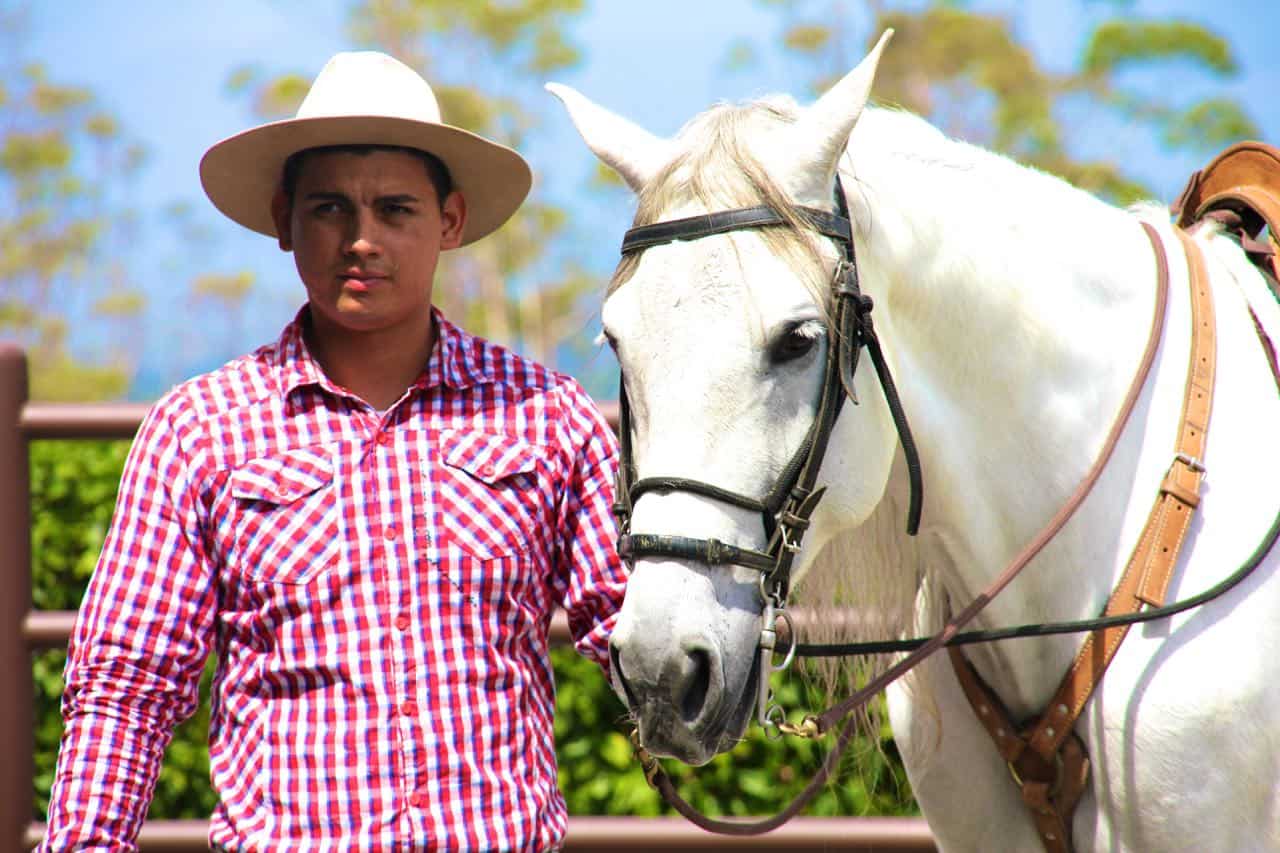
Picture a dusty afternoon in the center of one of Guanacaste’s many small towns. The pueblo’s annual patron saint festival is in full swing. Sabaneros, mounted proudly on meticulously bred and trained steeds lean sideways in their handcrafted, leather saddles, sipping warm beer. A small brass band with dented instruments and boisterous enthusiasm blasts out a lively tune. Women, children, campesinos and drunks crowd around, bouncing to the music.
Suddenly, the band comes to a screeching silence. Somebody tips his head back, thrusts his chest forward and lets loose with a short, rhythmic verse:
Soy como el pájaro cuervo,
pájaro que no hace nido,
pájaro que pone un huevo
y otro pájaro lo cuida.
As quick as it went, the music strikes up again, as the spontaneous performer and much of his audience yell out the distinctive Guanacaste call: uy uy uy uy uy, amid laughter and approving, or disapproving, howls.
That, dear reader, was a bomba, a tradition thrown like a verbal firecracker into the midst of any good fiesta guanacasteca. But the truth is, one need not travel to Guanacaste just to witness the spectacle. Bombas are thrown nationwide, and according to one expert, have roots and representation in many regions, though the tradition is most commonly associated with the northwestern province.
“The rhyme and verse is a tradition that comes from Spain, and before that, the moors, I believe, and has extended across all of Latin America,” explains Walter Quesada, a Culture Ministry-recommended expert on bombas. “In Costa Rica, where it has been most common is Guanacaste, but also in the Central Valley.”
Bombas, also known as coplas, were traditionally used to talk about and praise one’s region and culture, Quesada says.
“Bull riding, horsemanship, the beaches of Guanacaste,” Quesada says, listing examples. “But more recently, these rhymes have taken a different direction also. They are also used to draw attention to political or social things. It is a way to ridicule things, to make fun of politicians or criticize politics.”
All this in short verses of four, occasionally six, lines, with a variety of rhyming patterns: the second line with the fourth; the first line with the third and the second line with the fourth; or just the first line with the last. “Normally, they’re done at festivals. There didn’t use to be all the machinery and the games. People would get together in a cantina, or wherever there was dancing. Bombas have particularly been used during the patron saint festivals of each town,” the bomba expert explains.
“The coplero (a person well-practiced in the art of coplas or bombas) goes from house to house, with musicians, or sometimes with payasos (traditional oversized puppets worn over the torso), asking for money for the festivities.”
A good coplero, Quesada continues, is someone who – in addition to being able to produce spontaneous, rhyming bombas –also knows everybody in the community and, more importantly, their business.
“The coplero knows about everything that is going on in a community, and so when he does his bomba, he takes things from the communities and turns it into verse – if this person has just slaughtered a pig, or if that person has just sold a cow,” Quesada explains. “What other people see as normal, for those of us who do coplas, it is a motive to improvise a verse. To see someone with their hand between their legs is normal, but for us it is an opportunity to do something burlesque, something teasing.”
Bombas can also be more challenging, with two copleros squaring off against each other, using their art to entertain an audience at the expense of their rival. “They bring up the other’s mother, his sister, sometimes ending up in fight.At the end, they can get offensive,” Quesada says.
Bombas are also appearing in other aspects of Costa Rican society. In a recent protest march in downtown San José, a protestor called out bombas against the Central American Free-Trade Agreement with the United States (CAFTA) over a PA system rigged to a van.
“In recent years, people have been doing bombas about political and social things: government programs, the use of cell phones, the way we give directions. One can be critical by way of the verses,” Quesada explains.
Like music, like sculpture, like poetry, the ability to craft and present bombas is something a person either has or doesn’t – something one is born with, the expert asserts.
“And presenting coplas, young people, old people, nationals or foreigners – those who can understand a little bit of Spanish –they laugh, because they admire the improvisation,” Quesada opines. “It is a beautiful experience.”
A Sampling of Bombas
| Spanish | English |
|---|---|
| Ayer pasé por tu casa | Yesterday I passed by your house |
| Me tiraste una flor | You threw me a flower |
| La próxima vez | The next time |
| Sin maceta por favor | Without the flowerpot, please |
| Dicen q’el amor es ciego | They say love is blind |
| Hay q’ser realista | Let’s be realistic |
| Si el amor es ciego | If love is blind |
| El matrimonio le devuelva la vista | Marriage returns one’s sight |
| Los hombres y los pericos | Men and parakeets |
| Tiene cierto parecido | Have a certain resemblance |
| Que entre más viejos se ponen | The older they get |
| Más verdes son los bandidos | The greener (more lecherous) |
| Sabanero, sabanero | Cowboy, cowboy |
| Sabanero sin sábana | Cowboy without a sheet |
| A mi cama no se anima | Not one son of your mother |
| Ningún hijo de tu mamá | Excites my bed |
| No me gusta la zanahoria | I don’t like carrots |
| Ni tampoco la remolacha | Nor beets |
| Yo no vengo por las viejas | I didn’t come for the old women |
| Sino por las muchachas | But rather for the young ladies |
Today, the tradition of bombas continues to live on, always evolving and adapting to modern times while maintaining its roots in our culture. Whether at festive gatherings or political protests, these lively rhymes provide a platform for humor, critique, and social commentary.
Through the quick wit of a talented coplero, everyday events transform into verses that entertain, provoke thought, and foster a shared sense of community. As bombas continue to echo through the streets of Costa Rica, they serve as a reminder of our vibrant heritage, blending the past with the present in a celebration of creativity and cultural pride.