

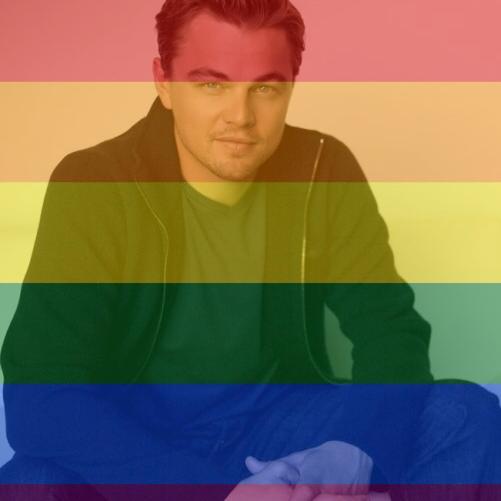
In the wake of a landmark Supreme Court decision that made same-sex marriage a right nationwide in the United States, a whopping 26 million people slapped a rainbow flag over their Facebook photos to “celebrate pride.”
The movement, fomented by a photo-editing tool that Facebook launched Friday, is a response to major news events that we’ve seen before: Profile picture change campaigns have become as common as cat videos on certain social networks. There were green filters for Iranian protesters in 2009, yellow ribbons for Hong Kong in 2014, black dots to oppose sexual violence in India, Arabic “Ns” to support Iraqi Christians.
Famously, in 2013, the LGBT rights group Human Rights Campaign got several million Facebook users to change their picture to its logo, a coup the organization was quick to describe as “a transformative moment for equality.”
But now, as then, one big question remains: Does changing your profile picture ever actually transform anything?
On first glance, of course, the answer would appear to be “no”: The momentary, risk-less act of editing my profile picture is decidedly not what persuaded five Supreme Court justices to side with marriage equality. And the flicker of colorful squares in the News Feed is not what will, say, end workplace discrimination against LGBT people in 29 U.S. states.
“Profile picture campaigns are effective in showing the friends and family in your social network that you have some affinity for a political candidate or cause,” said Philip Howard, a sociologist at the University of Washington and the director of the Digital Activism Research Project. “… Policy changes are not usually the outcome.”
See also: PHOTOS: Costa Rica’s pride marchers hopeful after US gay marriage decision
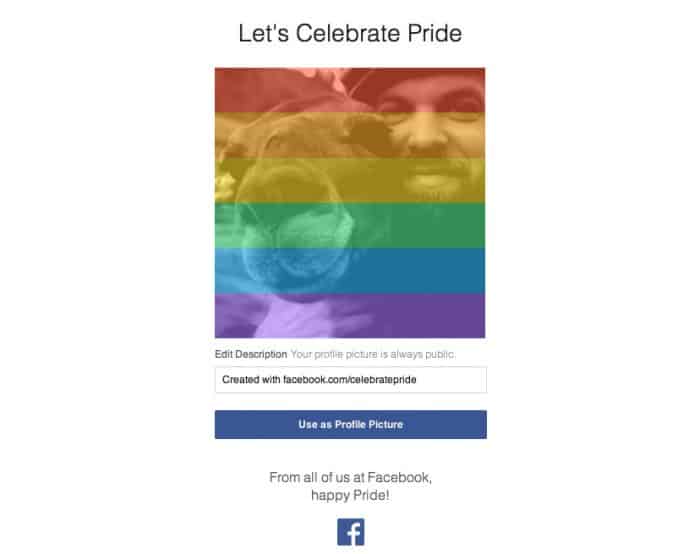
But wait! Marriage equality, like so many thorny issues, is not just about policy change. It’s also, crucially, about changing social attitudes toward an entire group of people. And it’s here that there could be a real role for social media campaigns.
See, our social attitudes are informed largely by what we believe is standard or acceptable in our social group as a whole. And every day, whether we realize it or not, we receive lots of different messages on these norms: some unspoken (I can’t come to work naked), some based in law (I can’t kill even my most-hated commenters), some very literal (“buckle up,” “just say no”).
Profile pictures, arguably, are a very particular and effective type of message. They don’t dictate how you should or must behave, as laws and PSAs typically do; instead, they simply tell you how your peers are behaving. In other words, they support marriage equality; why don’t you?
“When people try to change behavior, they often focus on … telling people what they should do,” the social psychologist Melanie Tannenbaum explained in 2013. “We often underestimate just how strongly we respond to what other people actually do.”
Case in point? Facebook itself has found that people tend to change their profile pictures in response to their friends’ picture changes: In a paper on the HRC’s 2013 campaign, published this February, Facebook data scientists found that users were more likely to adopt the equal-sign icon if they saw multiple friends doing so. The more friends they saw, up to a point, the more likely they were to change. That social influence was more of a factor, in fact, than even religion, politics or age.
There are nuances here, of course: For better or worse, the mere sight of a rainbow-tinged photo will not zap the homophobes among us. People tend to be persuaded more by this type of normative social influence when the group asserting those norms is close to them, for instance, and personally important. If I use Facebook only to keep up with half-forgotten high school friends, all the rainbow pictures in the world aren’t likely to do much.
Howard, the UW sociologist, also points out that individuals tend to self-select friends who share their views. In other words, if I’m the type of person who’s inclined to support equal marriage, my Facebook friends probably are already, too.
“Still,” Howard said, “openly declaring your support for gay marriage or dissatisfaction with modern policing (on social media) can create a brief moment where people who see the image have to think about the issue.”
And if they don’t have a clear opinion, or see that image many times, it could — potentially! gradually! — shift their social views.
© 2015, The Washington Post





