


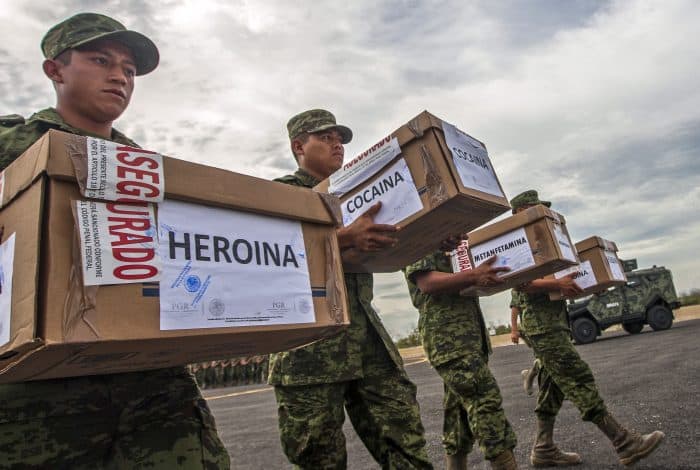
SAN YSIDRO, California — Mexican traffickers are sending a flood of cheap heroin and methamphetamine across the U.S. border, the latest drug seizure statistics show, in a new sign that the United States’ marijuana decriminalization trend is upending the North American narcotics trade.
The amount of cannabis seized by U.S. federal, state and local officers along the boundary with Mexico has fallen 37 percent since 2011, a period during which U.S. marijuana consumers have increasingly turned to the more potent, higher-grade domestic varieties cultivated under legal and quasi-legal protections in more than two dozen U.S. states.
Made-in-the-USA marijuana is quickly displacing the cheap, seedy, hard-packed version harvested by the bushel in Mexico’s Sierra Madre mountains. That has prompted Mexican drug farmers to plant more opium poppies, and the sticky brown and black “tar” heroin they produce is channeled by traffickers into the U.S. communities hit hardest by prescription painkiller abuse, offering addicts a $10 alternative to $80-a-pill oxycodone.
“Legalization of marijuana for recreational use has given U.S. consumers access to high-quality marijuana, with genetically improved strains, grown in greenhouses,” said Raúl Benitez-Manaut, a drug-war expert at Mexico’s National Autonomous University. “That’s why the Mexican cartels are switching to heroin and meth.”
U.S. law enforcement agents seized 2,181 kilograms of heroin last year coming from Mexico, nearly three times the amount confiscated in 2009.
Methamphetamine, too, has surged, mocking the Hollywood image of backwoods bayou labs and “Breaking Bad” chemists. The reality, according to Drug Enforcement Administration figures, is that 90 percent of the meth on U.S. streets is cooked in Mexico, where precursor chemicals are far easier to obtain.
“The days of the large-scale U.S. meth labs are pretty much gone, given how much the Mexicans have taken over production south of the border and distribution into the United States,” said Lawrence Payne, a DEA spokesman. “Their product is far superior, cheaper and more pure.”
Last year, 15,803 kilograms of the drug was seized along the border, up from 3,076 kilos in 2009.
“Criminal organizations are no longer going for bulk marijuana,” said Sidney Aki, the U.S. Customs and Border Protection port director here at the agency’s busiest crossing for pedestrians and passenger vehicles, just south of San Diego. “Hard drugs are the growing trend, and they’re profitable in small amounts.”
Voters in the District of Columbia and 23 U.S. states have approved marijuana for recreational or medical use, with Colorado, Washington state, Alaska and Oregon opting for full legalization. Estimates of the size of the U.S.’ marijuana harvest vary widely, and DEA officials say they do not know how quickly it may be increasing as a result of decriminalization.
Mexican cartels continue to deploy people as “mules” strapped with 50-pound marijuana backpacks to hike through the Arizona borderlands and send commercial trucks into Texas with bales of shrink-wrapped cannabis so big they need to be taken out on a forklift.
But the profitability of the marijuana trade has slumped on falling demand for Mexico’s “brick weed,” so called because it is crushed into airtight bundles for transport across the border. Drug farmers in the Sierra Madre say that they can barely make money planting mota anymore.
The cartels, and consumers, are turning away from cocaine, too. Last year, U.S. agents confiscated 11,917 kilograms of cocaine along the Mexico border, down from 27,444 kilos in 2011.
This reflects lower demand for the drug in the United States, experts say, as well as a cartel business preference for heroin and meth. Those two substances can be cheaply produced in Mexico, unlike cocaine, which is far pricier, and therefore riskier, because it must be smuggled from South America.
The Sinaloa cartel, considered Mexico’s most powerful drug trafficking organization despite the capture last February of leader Joaquín “El Chapo” Guzmán, remains the dominant criminal power along Mexico’s Pacific Coast. Its territory spans the entire western half of the U.S.-Mexico boundary, from Ciudad Juárez, opposite El Paso, to Tijuana, on the Pacific Coast.
Related: How do ‘El Chapo’ Guzmán’s kids live? Follow them on Twitter
At harvest time, the cartel’s middlemen make their rounds to remote Sierra Madre stream valleys in pickup trucks and four-wheelers, armed with guns and cash. They buy sticky balls of raw opium from hardscrabble farmers and deliver them to crude heroin kitchens that prepare the drug for shipment. The U.S. interstate highway system is less than a day’s drive away.
Heroin and meth are far easier to transport and conceal than marijuana. Especially worrisome to U.S. officials is a growing trend of more border-crossing pedestrians carrying the drugs strapped under their clothing or hidden in body cavities.
“The criminals are trying to blend in among the legitimate travelers, who are 99 percent of the individuals crossing through here,” said Aki, the San Ysidro port director. “That’s the hard part for us.”
At the San Ysidro crossing, soon to expand to 35 lanes, U.S. agents with drug-sniffing dogs and foot-long screwdrivers weave among the lines of cars that back up into Mexico.
Agents say the screwdrivers, some so old their handles are worn to a nub, are their most valuable investigative tool. Agents knock them against tires and gas tanks for a quick sonic impression.
“If you tap a tank with something solid inside, there’s a thud,” one inspector said. “It’s like hitting concrete.”
Harder to detect are “deep-concealed” drugs buried in fake engine cylinders, dashboard panels, even acid-proof capsules inside car batteries. One vehicle seized here last year carried liquid meth in its windshield-wiper reservoir.
Finding small packages in the river of cars and trucks coming across is akin to a game of “Where’s Waldo?” for U.S. inspectors. Vehicles that arouse the suspicions of border agents or get their dogs barking and lunging are sent to a secondary inspection station with giant X-ray machines and larger teams of screwdriver-wielding inspectors.
If drugs don’t appear, the agents may drive the vehicles into garages to open their engines, pry apart interior panels and search for any signs of suspicious alterations. Traffickers will sometimes mist decoy vehicles with marijuana oil or resin to provoke the dogs and draw agents into a fruitless search.
“It’s like a fish fry,” Aki said. “The fish is gone, but the scent is still there.”
With the dogs and agents tied up inspecting the decoys, the traffickers may try sneaking meth and heroin through.
In recent years, Mexican cartels also have begun producing higher-value “white” heroin, typically associated with traffickers from Colombia or Asia, according to DEA officials.
“The Mexicans are evolving in their production abilities and getting more sophisticated,” said Payne, the DEA spokesman. “It’s not just black tar anymore.”
Colombian and Caribbean traffickers once controlled heroin distribution east of the Mississippi River, but Mexican criminal groups now dominate the entire North American market, he said.
The United States has an estimated 600,000 heroin users, Payne said — a threefold increase in the past five years. But that number is dwarfed by the estimated 10 million U.S. citizens who abuse prescription painkillers.
Those addicts are the prime target for the booming heroin business. A U.S. crackdown on prescription opiates has driven up the price for drugs such as OxyContin and Percocet, enticing desperate addicts to switch to cheap heroin to fend off withdrawal symptoms.
The profile of U.S. heroin addiction is also changing, said Phil Herschman, chief clinical officer with the CRC Health Group, which operates 170 treatment centers in 30 U.S. states.
“Now, we’re seeing housewives coming in who had been addicted to Vicodin for two or three years before switching to heroin, or adolescents who got hooked by snorting it, thinking it was safe, only to end up injecting themselves,” he said.
“You can’t even begin to measure how it tears families apart,” he added. “It’s devastating.”
See also: Tico lawmaker presents bill to legalize medical marijuana
© 2015, The Washington Post





