

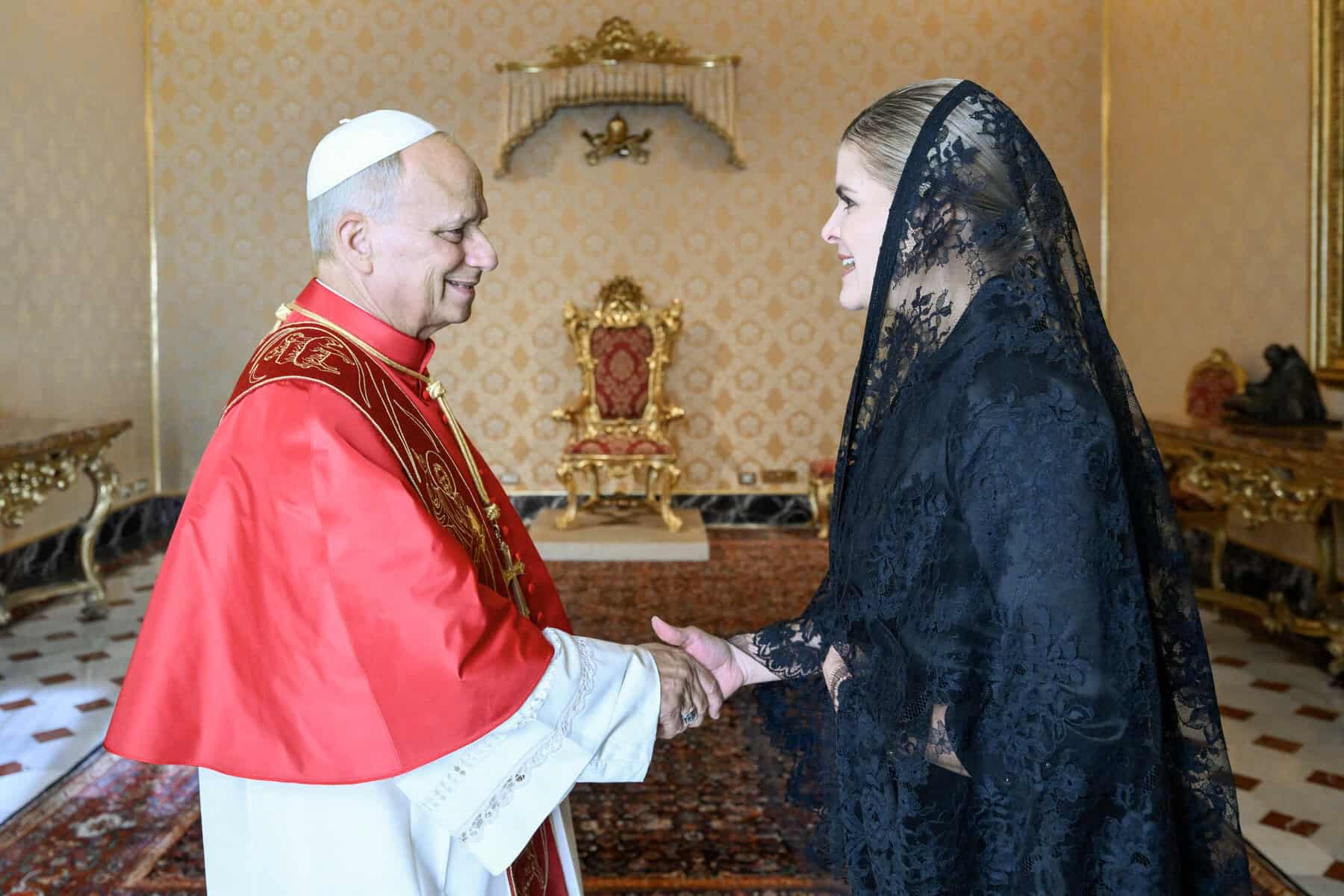
President Laura Fernández formally invited Pope Leo XIV to visit Costa Rica during a private audience at the Vatican, proposing a trip in 2027 that would make him the first pontiff to set foot in the country since John Paul II in March 1983. Fernández delivered the invitation in a letter and handed it to the pope in person at the Apostolic Palace. In it, she extended what she called a fraternal and respectful invitation on behalf of the people and government of Costa Rica, describing the country as a land where work and peace prevail.
The letter ties the proposed visit to two anniversaries Costa Rica will mark in 2027. One is the 203rd anniversary of the declaration of Our Lady of the Angels, known here as La Negrita, the patron saint. The other is the 180th anniversary of the Constitution recognizing Catholicism as the official religion of the state.
No date has been set and the letter leaves the timing to the pope, and Fernández offered to coordinate preparations for an eventual pastoral and official visit through the Vatican’s Secretariat of State and the Apostolic Nunciature in San José. The Vatican has not said whether the pope will accept.
Fernández also presented the pope with a replica of the Virgin of the Angels and coffees from several Costa Rican growing regions. It is not the first time Costa Rican coffee has reached Leo XIV. Speaking to Catholic media after the meeting, Fernández said she had invited the pope to come and greet La Negrita, and that it would be very special for Costa Rica to receive a pope again after 1983. She said the conversation lasted about 30 minutes, that she told him Costa Ricans had been praying for him, and that she felt at home.
She added that the pope appeared in good spirits and in good health following a recent medical procedure, though she said the two did not discuss his recovery directly. The Holy See Press Office said in a statement after the audience that Fernández also met with Cardinal Pietro Parolin, the Vatican secretary of state, and Archbishop Paul Richard Gallagher, secretary for relations with states and international organizations.
According to the statement, those talks highlighted good relations between the Holy See and Costa Rica and between the state and the local Church and covered social and political issues in the country and the region, particularly security and migration. Fernández said she discussed with the pope the situation of Nicaraguan migrants, the largest migrant group in Costa Rica, as well as cooperation with the United States on people going through deportation proceedings.
On security, she said her government pairs investment in education, health and support for young people with measures against organized crime, including efforts to stop inmates from directing violence from inside prisons. The audience came two weeks after Fernández toured El Salvador’s CECOT mega-prison, and as Costa Rica moves inmates into its own maximum-security facility, the CACCO.
Bishop Bartolomé Buigues of Alajuela, vice president of the Costa Rican Episcopal Conference, said closer engagement between the Church and civil authorities is of great importance. The bishops’ conference thanked the president for promoting the meeting. The Vatican stop opened Fernández’s third official trip abroad since taking office in May, following visits to El Salvador and Colombia. Her schedule in Rome also includes a meeting with Italian President Sergio Mattarella.
She then travels to Madrid for the 30th Ibero-American Summit of Heads of State and Government on Nov. 4 and 5 and is scheduled to return to Costa Rica on Nov. 6. A papal visit would carry particular weight in a country where devotion to La Negrita draws pilgrims from every province to the Basilica of Our Lady of the Angels in Cartago each August. John Paul II’s 1983 stop, part of a tour of Central America, remains the last time a pope visited the country.





