

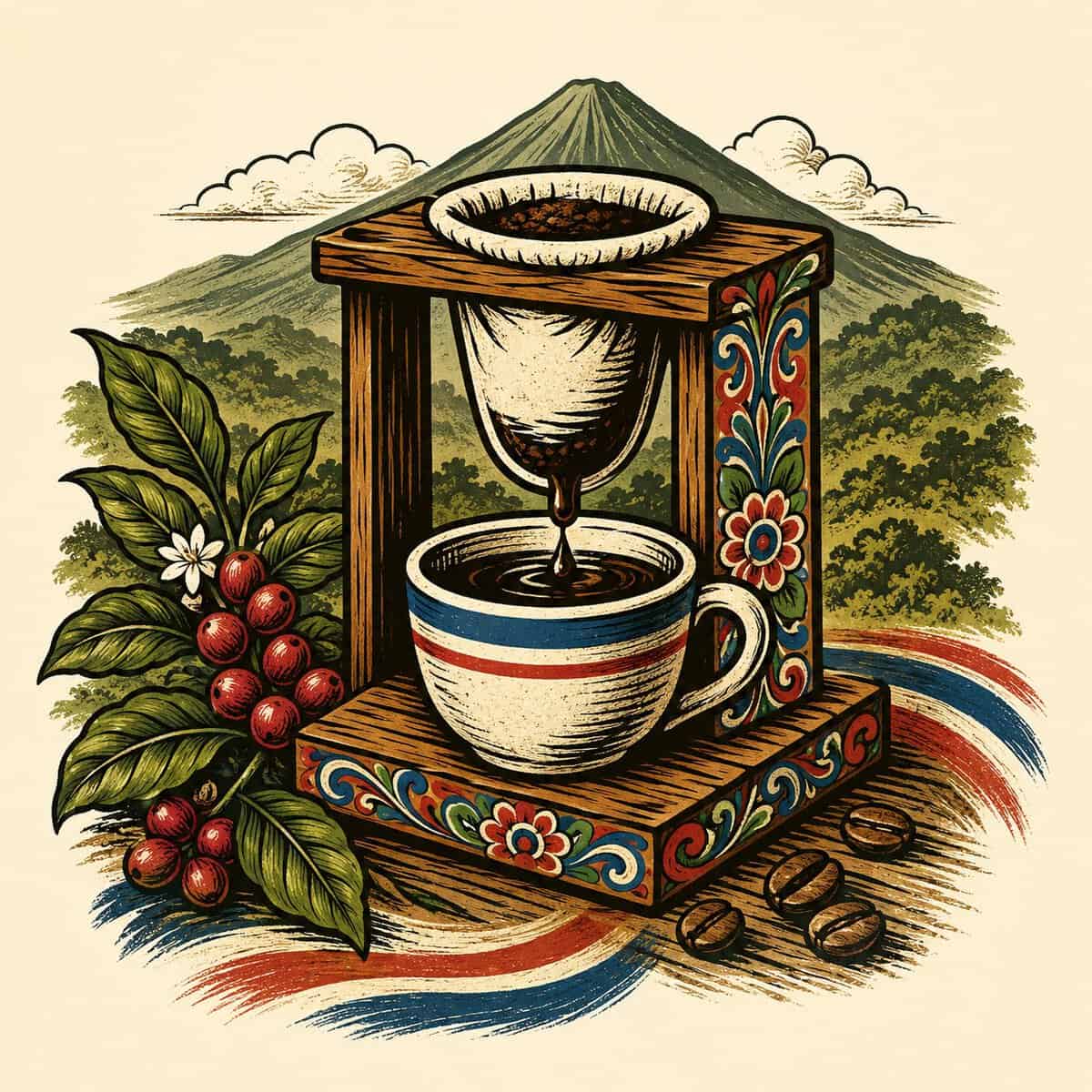
A Costa Rican chorreador, one of our country’s most familiar coffee brewers, has reached an unlikely destination: the hands of Pope Leo XIV. The hand-painted coffee maker was given to the pontiff aboard the papal plane during a flight from Rome to Madrid, along with Costa Rican coffee. The gift was delivered by Costa Rican journalist Jovel Álvarez, who was traveling with the papal press group during Leo XIV’s visit to Spain.
The exchange was brief, but the reaction quickly resonated back home. When Álvarez asked the Pope about Costa Rican coffee, Leo XIV responded that it was “very good.” The pontiff appeared surprised by the gift, then nodded as he received the chorreador, a simple wooden stand and cloth filter long associated with Costa Rican homes.
The idea carried a family touch. Álvarez said his 99-year-old grandmother had told him the Pope should drink coffee the way Costa Ricans do. That meant not just sending a bag of coffee, but placing it inside our country’s most traditional brewing ritual.
The chorreador was created through a collaboration between Plinc, a Costa Rican design studio based in Monteverde, and El Canto, a cultural art project known for bringing traditional Costa Rican patterns into clothing, accessories and handcrafted pieces. Plinc developed the functional chorreador, while El Canto added the hand-painted artistic work through Luis Madrigal Aguilera, a traditional cart painter from Sarchí.
For the designers and artists involved, the moment landed with emotion. A piece made in Costa Rica, through local hands and local symbols, had crossed from workshops and design tables to one of the most visible figures in the Catholic Church.
The object itself is deeply Costa Rican. A chorreador uses a cloth filter, known locally as a bolsita, suspended over a cup or pot. Hot water is poured over ground coffee and allowed to drip slowly through the fabric. It is simple, reusable and familiar across generations.
Plinc has worked to reintroduce the chorreador as both a daily coffee tool and a design object, keeping the traditional method while refining the structure, filter and measurements for modern coffee drinkers. Its version uses Costa Rican design language while preserving the ritual at the center of café chorreado.
El Canto’s contribution added another layer of national identity. The project draws from the painted patterns of Costa Rica’s traditional oxcarts, a craft closely tied to Sarchí and recognized as one of the country’s most important cultural symbols. Madrigal’s work brought that ornamental tradition onto a coffee object that already carried its own place in Costa Rican life.
That combination is why the gift struck a chord. It was not a luxury item or a diplomatic ornament. It was an everyday Costa Rican object, made carefully and painted by hand, sent with a message about how the country drinks coffee, receives guests and remembers home.
The Pope’s reaction also gave the moment a wider reach. Costa Rican coffee has long been one of the country’s best-known exports, but the chorreador speaks to something more personal. It is less about branding and more about the daily pause around the table, the smell of coffee passing through cloth, and a method many Costa Ricans still associate with parents, grandparents and small kitchens.
For Plinc, El Canto and Madrigal, the gift placed local craft in a global setting without changing what made it meaningful. The chorreador remained what it has always been: wood, cloth, coffee and patience.
Now it also has a story tied to the Vatican, a Costa Rican journalist, a grandmother’s suggestion and a Pope who smiled at the sight of a coffee maker from Costa Rica.





