

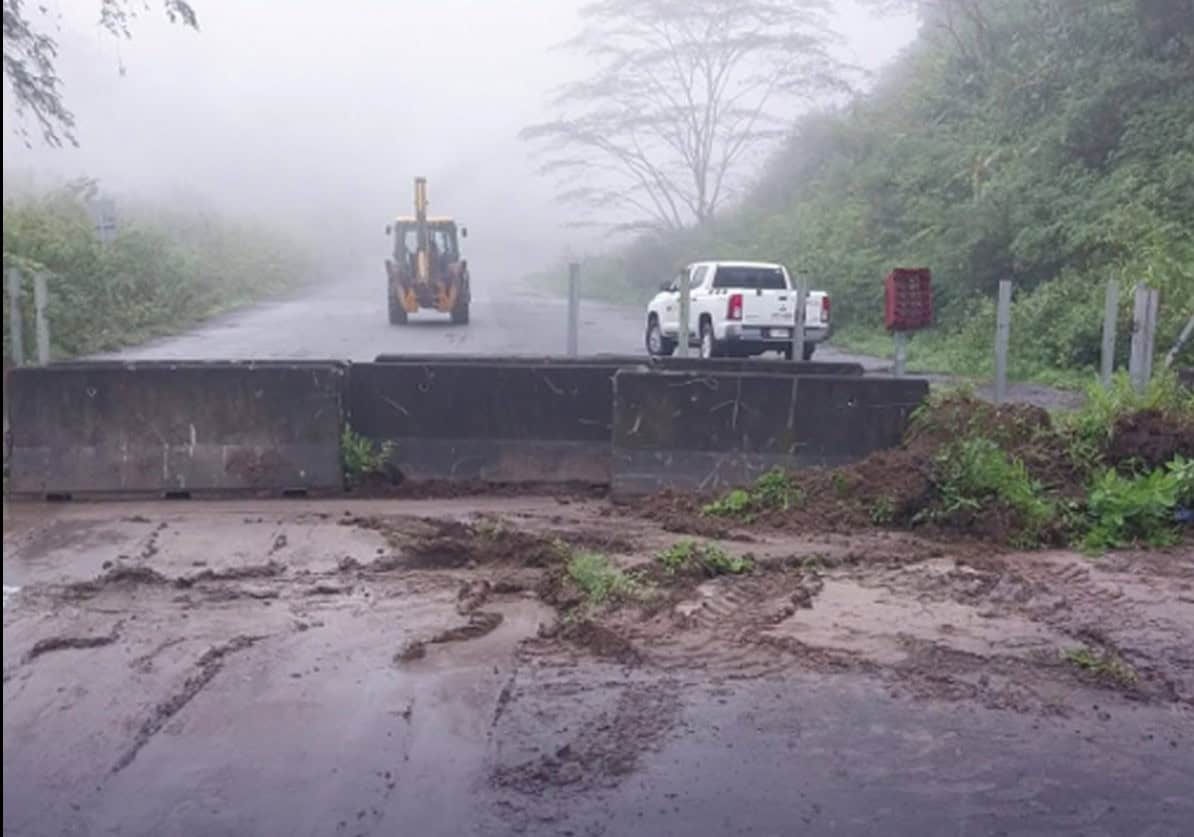
If you’re driving to or from the Caribbean coast or the Northern Zone today, or you own a home near a river in either region, plan around the rain before you leave. Costa Rica’s emergency commission is holding a yellow alert for the Northern Zone, the entire Caribbean slope and the canton of Turrialba as tropical wave 24 and the intertropical convergence zone keep dumping water on ground that is already soaked.
A yellow alert is not a formality. It means the soil can’t absorb any more water, rivers are running high, and a road that’s open when you set out can close behind a landslide or a flash flood an hour later. If you live near a river, a steep slope or a low-lying spot in any of those regions, the practical takeaway is simple: be ready to leave quickly, and don’t wait for water to reach your door before you move.
Route 32, the main artery between San José and Limón, has been the biggest casualty. The same system that shut the road and forced evacuations earlier this week keeps triggering material falls in the mountainous Zurquí stretch, and the highway has closed and reopened repeatedly. Don’t assume it’s open. Check its status before you commit to the drive, because the road gets closed without much warning whenever debris comes down or crews need to clear the lanes.
If Route 32 is shut, your alternates are limited and also under strain. Route 10, between Siquirres and Turrialba, is the usual detour; it reopened earlier in the week after a landslide was cleared, but it sits inside the alert zone and can close again. The Vara Blanca route (Route 126) is open only to light vehicles, so leave the truck and the loaded SUV off it. Bajos de Chilamate–Vuelta de Kooper is the other option. Whichever you pick, expect delays, and never drive around a barrier or into standing water on any of them.
If your trip runs through the Northern Zone toward San Carlos, plan around a separate closure. The bridge over the Tapezco river, on the central stretch of Route 35 — the main road up to Ciudad Quesada and on toward La Fortuna and Arenal — is fully shut. This one isn’t about a single storm: inspectors found the structure itself no longer safe to carry traffic, and with the ground this saturated the risk only grows. The danger isn’t something you can spot from behind the wheel, which is why there are barriers at both ends. Don’t move them and don’t try to squeeze across. Expect to detour, follow the posted signs, and give yourself extra time.
The hardest-hit spot so far is Guácimo, where the Parismina River pushed into several communities. The crossing at La Perla is closed, and a landslide has weakened the Guacimito bridge — treat both as impassable. In Sarapiquí, the Tigre, Sarapiquí, Puerto Viejo and Sucio rivers all climbed, forcing families out of Naranjal Uno, Álamo, Oropel, Carretones and El Tigre. As of the emergency commission’s latest count, 264 people and six pets were staying in six shelters across the Sarapiquí area and Guácimo. That number has been rising through the week and may climb again if the rivers keep coming up.
If you’re near water, the danger is less the rain falling on you than the rain that already fell upstream. Saturated soil can’t take any more, so it runs straight into rivers that are already high, and levels can jump fast with little warning. Move anything you can’t afford to lose to a higher floor now, not later. Keep documents, medication, phone chargers and a change of clothes in one bag by the door.
Agree on where your household will go and how you’ll reach each other if the power drops. And the rule that saves the most lives every rainy season: never walk or drive through moving water. It takes surprisingly little to sweep a person or a car off the road, and you can’t see whether the surface underneath is still there.
For today, the weather service expects yet another unstable day. Rain has been moving over the Caribbean and Northern Zone since the early hours, with storms forming off the Limón coast before dawn. Through the afternoon the rain spreads nationwide, with the heaviest totals over the Pacific, part of the Central Valley, and the mountains of the Northern Zone and Caribbean. Expect a mostly grey day on the Caribbean side, with lows around 22°C (72°F) and highs in the high 20s°C (low-to-mid 80s°F), and more showers in the mountains overnight.
All this to say, and keep in mind this is constantly changing but if your day involves the Caribbean, the Northern Zone or Turrialba, build in extra time, check road status before you leave, and stay off flooded roads and weakened crossings. If it doesn’t, and you’d planned a Caribbean-coast trip, weigh whether it can wait a day





