

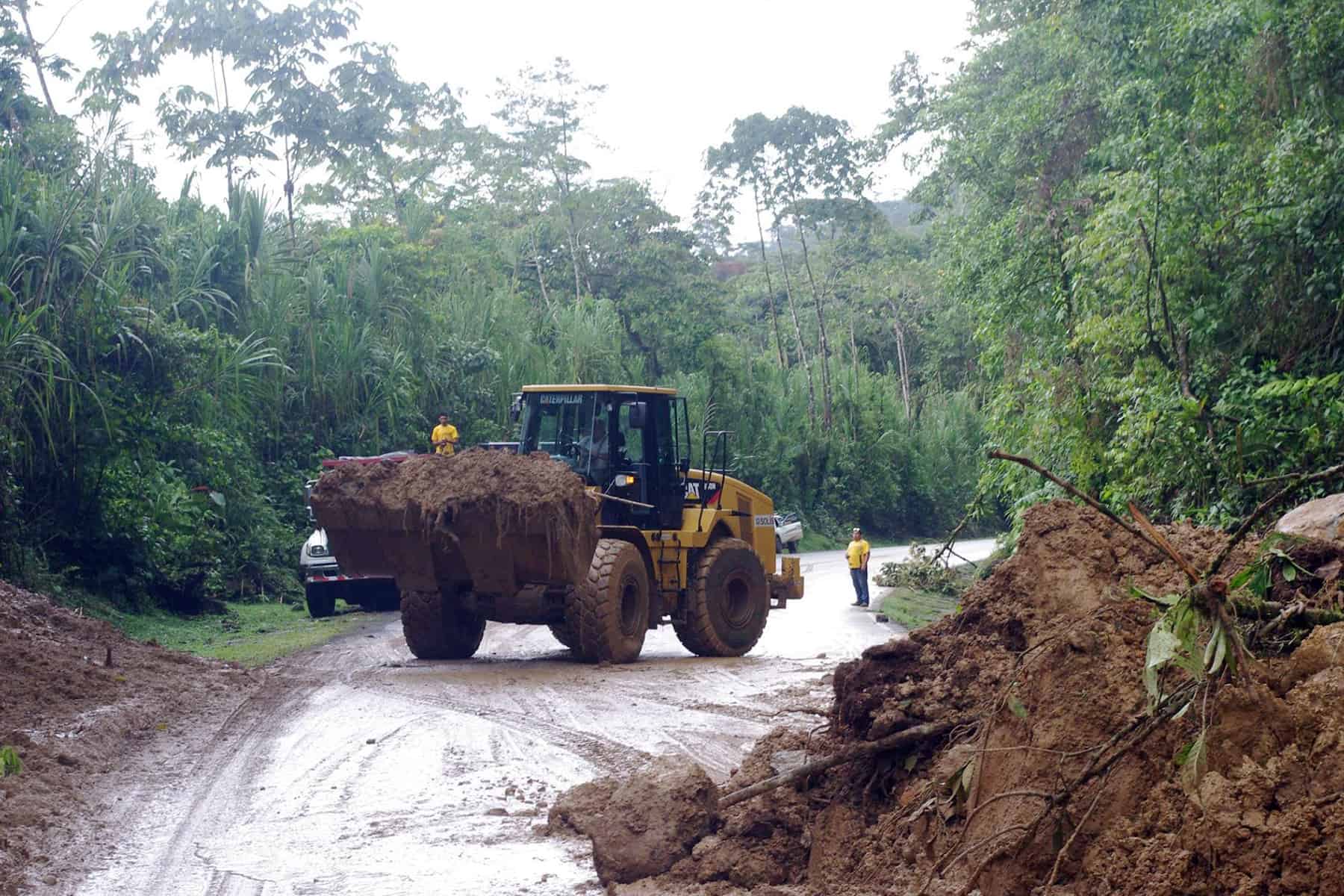
If you are driving to the Caribbean coast or the Northern Zone today, plan for trouble. The main highway between San José and Limón, Route 32, closed overnight after mud and rock slid onto the road, and there is no guarantee it will stay open once you set out. Days of rain from tropical wave 24 have soaked the region, and officials have placed the entire Caribbean slope, the Northern Zone, and the canton of Turrialba under a yellow alert.
Here is why the closures keep happening. After days of rain, the steep ground above Route 32 is 80 to 95 percent saturated, which means it cannot soak up any more water. Every new downpour sends loose soil, rock, and whole trees sliding onto the highway, and crews have to shut the road to clear it. When more rain falls before they finish, the material comes down again. That cycle is why a road can reopen in the morning and close by afternoon, so the status you saw last night tells you almost nothing about the status right now.
As of early Tuesday, Route 32 was closed and had not reopened. Your most reliable alternative for any vehicle is Route 10, which runs through Turrialba between Siquirres and Turrialba; crews cleared a landslide there and reopened it. The Vara Blanca route (Route 126) is open only to light vehicles. Route 4 was cut entirely at the El Tigre straightaway, where water ran across the road. Check conditions right before you leave rather than the night before, because the picture changes by the hour.
The worst damage so far is in Guácimo, in Limón province, where the Parismina River overflowed into several communities. A washed-out crossing at La Perla is closed, and a landslide has weakened the Guacimito bridge. In Sarapiquí, the Tigre, Sarapiquí, Puerto Viejo and Sucio rivers all climbed, forcing preventive evacuations from Naranjal 1, Álamo, Oropel, Carretones and El Tigre, and crews were still moving families out of Los Ángeles de Nogal and Pénjamo.
By Monday night, five shelters were housing evacuated residents; the National Emergency Commission counted 220 people, while later reporting put the figure closer to 254 as more communities were cleared. Officials expect the number to rise. A temporary shelter has opened in Santa Rosa.
More rain is coming. Forecasters expect another 60 to 80 millimeters (2.4 to 3.1 inches) across Limón and the Northern Zone through Tuesday, with some areas nearing 100 millimeters (3.9 inches), and the heaviest bursts arriving in the afternoon, at night, and again before dawn. The unsettled pattern holds through Wednesday. Strong trade winds are a second hazard, with gusts capable of bringing down branches, signs and power lines.
If you can postpone a trip to the Caribbean or the Northern Zone, do it. If you have to go, take Route 10, carry enough fuel and water to wait out a long closure, and never drive through water sitting on the road. You cannot see whether the surface beneath it has washed away, and moving water hides how deep it really is. Stay well back from swollen rivers and quebradas, and if you live near one, decide now where you would go if the water rises. The emergency line is 9-1-1.





