

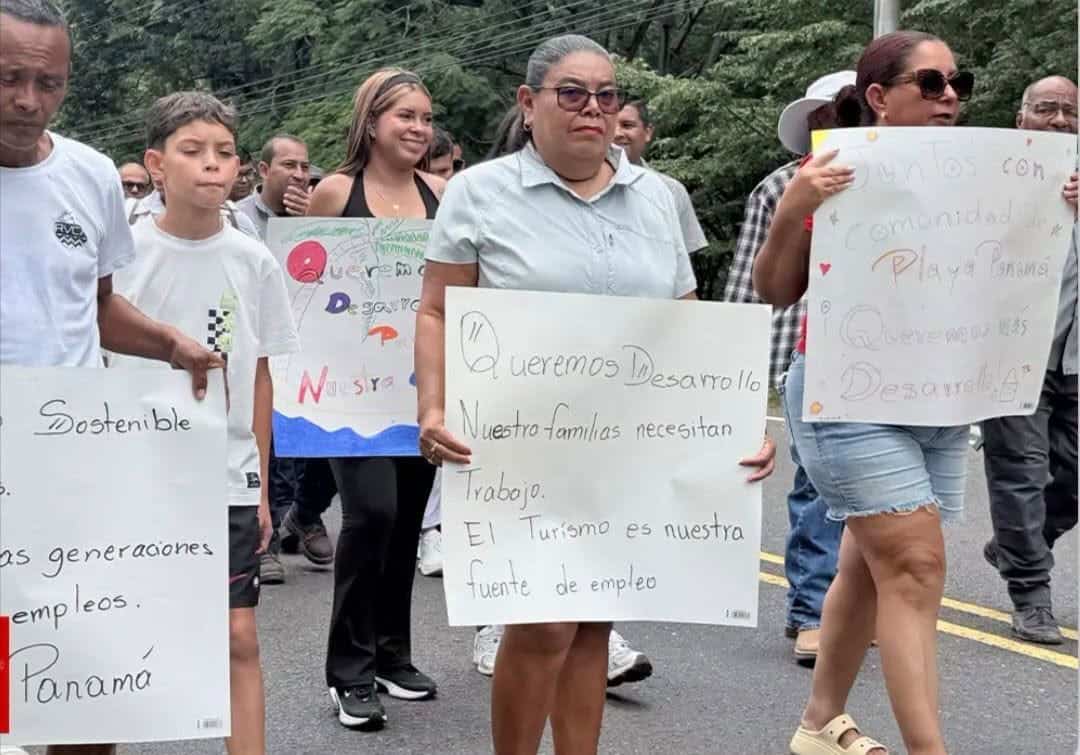
Residents of Playa Panamá marched on Sunday, calling for stalled tourism projects in the Gulf of Papagayo to move forward, saying the delays are costing their community jobs and business opportunities. The peaceful march was organized by the Playa Panamá Integral Development Association(ADI). Participants walked from the roundabout near El Mangroove hotel to Plaza Playa Panamá under the slogan “Walking Together for Sustainable Development.”
Organizers said families in the area depend on tourism, construction and the small businesses that serve workers and visitors. They argued that development and environmental protection can happen at the same time if projects follow Costa Rica’s environmental rules. The protest comes more than four months after Constitutional Court Justice Fernando Cruz issued temporary restrictions while the court reviews a challenge to development rules in the Papagayo Tourism Development Area.
The April 17 order placed a moratorium on new tree-cutting permits for hotel projects. It also stopped construction permits and changes in building density involving a disputed rule that allows developers to transfer unused building rights from one plot of land to another. The restrictions are not a complete ban on all construction in Papagayo. Cruz clarified in May that the construction limits apply specifically to projects using, or planning to use, the disputed density-transfer rule.
The dispute involves the Bahía Papagayo project and a permit issued for the removal of 748 trees at Playa Panamá. Environmental campaigners argue the land qualifies as forest and should receive greater protection. The court issued its temporary order to prevent possible environmental damage while it decides whether the development rules comply with the Constitution.
For those who joined Sunday’s march, however, the delay has immediate economic consequences. Rigoberto Contreras, spokesperson for the Playa Panamá ADI, said earlier construction activity brought as many as 300 workers into the area, benefiting residents who rented rooms or operated local businesses.
“Since the projects began, there has been more activity,” Contreras said. “There were up to 300 people when they were working on the project. Imagine how many people benefited.” Contreras said the suspension disappointed residents who had expected to rent homes, rooms and cabins to workers.
Steven Mendoza, another community member, said construction would provide short-term employment while hotels, restaurants and other tourism businesses could create longer-term opportunities. “There will be a lot of work while all this is being built,” Mendoza said. “People who sell food or rent houses and apartments will also benefit.”
Community representatives also asked to be included in discussions about the future of Playa Panamá. They said decisions involving nearby land, employment and tourism should take into account the people who live in the area. Hotel industry representatives have raised similar economic concerns. They estimate that projects worth approximately $700 million are affected by the legal dispute, although that figure comes from the industry and has not been independently verified.
Arnoldo Beeche, president of the Costa Rican Chamber of Hotels, has argued that prolonged uncertainty could make international investors more cautious about Costa Rica. Rodrigo Castro, executive president of the Association of Developers in the Gulf of Papagayo Tourism Development Area, has also warned that changing the rules after projects have begun could hurt the country’s credibility.
The Constitutional Court has not issued its final decision on the disputed development rules. Until it does, the restrictions remain in place. Sunday’s march showed that the Playa Panamá dispute is no longer only a fight between developers and environmental campaigners. It has also become a local debate over jobs, economic opportunity and how the community wants tourism development to proceed.





