

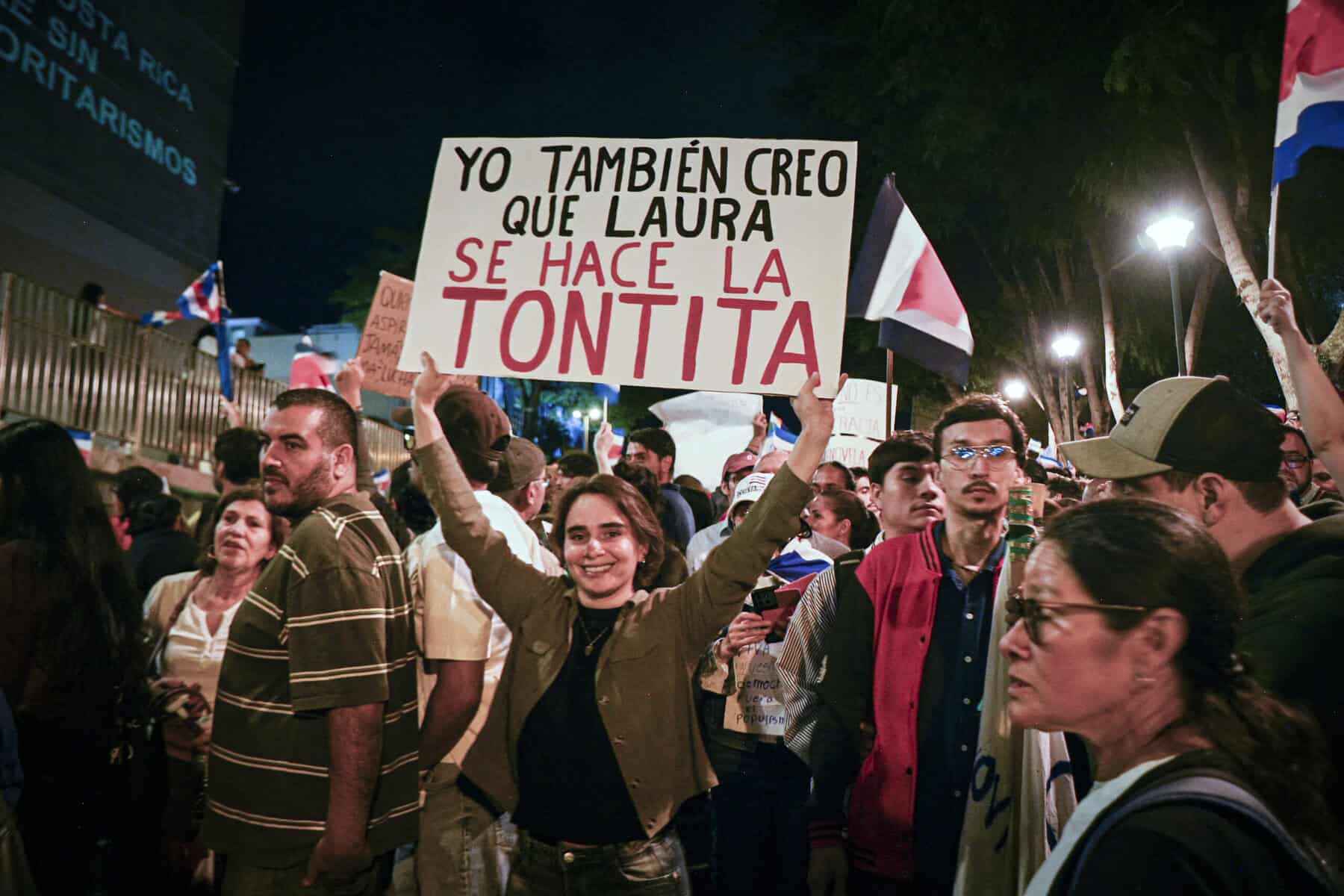
Thousands of Costa Ricans packed the Plaza de la Democracia in San José last evening and spilled across several blocks of Avenida Segunda, closing more than four hours of demonstrations in defense of judicial independence by singing the national anthem. Organizers ended the gathering shortly after 8:15 p.m. No incidents were reported.
The demonstration, called the Plantón por la Justicia Democrática, was convened by the Colectiva Autónoma por la Resistencia Social and supported by judicial employee unions, university groups and social organizations. It began at 4 p.m. A separate march called by the National Council of University Rectors left the Fuente de la Hispanidad in Montes de Oca at 3:30 p.m. and walked into the capital to join it.
Simultaneous gatherings formed outside courthouses in Cartago, Pérez Zeledón, Nicoya, Quepos, San Carlos, San Ramón, Atenas and Limón. San Carlos is widely regarded as a stronghold of the governing Pueblo Soberano party. Costa Ricans living abroad added messages of support on social media.
The crowd drew university students, academics, teachers, retirees, public employees, union representatives and families. Among those present were former president Luis Guillermo Solís, former security ministers Fernando Berrocal and Gustavo Mata, former attorney general Francisco Dall’Anese, former presidential candidates Álvaro Ramos and Ariel Robles, and seismologist Marino Protti.
Former president Miguel Ángel Rodríguez had announced in advance that he would attend with part of his family. Luis Manuel Chacón Jiménez, who took part in the creation of the Constitutional Chamber in 1989, also joined the crowd and warned about the pressure now falling on the courts.
Demonstrators arrived with Costa Rican flags and hand-lettered signs. Some read that power has limits and that the separation of powers protects everyone. Cimarrona bands played between rounds of chanting. The crowd sang the national anthem and the Patriótica Costarricense, applauded judicial employees, voiced support for independent media and shouted slogans against the government, including calls for Rodrigo Chaves to go.
One of the loudest moments came when Mauricio Gómez of the National Association of Criminal Investigators announced that officers who took part in the capture of Alejandro Arias Monge, known as Diablo, were in the plaza. The crowd took up the phrase no fue chiripa — it was not a fluke.
Arias Monge, who had been one of the Costa Rica’s most-wanted fugitives, was detained on July 24 in Río Frío de Sarapiquí in an operation carried out by the Public Prosecutor’s Office and the Judicial Investigation Police. Executive branch figures subsequently cast the capture as a matter of chance, and Attorney General Carlo Díaz has rejected that characterization, saying intelligence work had placed Arias Monge at the property with a high degree of certainty before the raid.
Díaz arrived at the plaza to applause. He said he wants himself and his family to go on living in a democracy. Michael Soto, interim director of the Judicial Investigation Police, thanked the crowd for what he described as an emotional reception and said it matters to the democracy that citizens turn out to demonstrate freely and calmly.
Adriana Orocú, president of the Costa Rican Judges Association, told the gathering that an intimidated judiciary cannot protect anyone, and that a democracy without independent justice keeps the name but loses the substance.
The turnout came a day after Chaves, who serves as both minister of the presidency and finance minister in President Laura Fernández’s cabinet, publicly discouraged attendance. Defending the Judiciary, he said, is an act of masochism for anyone who is not a direct beneficiary of what he described as corruption and waste inside that branch. He told Costa Ricans not to be naive and added that he hoped it would not rain on those who chose to go.
The confrontation behind the demonstration has escalated over several weeks. On July 30 the Constitutional Chamber ruled 4-3 to overturn the Legislative Assembly’s attempt to return a list of candidates for substitute justices and temporarily extended appointments that had expired in December 2025. Fernández described the ruling as a coup d’état against the Assembly, a characterization the chamber rejected.
On August 3, Assembly President Yara Jiménez and ruling-party lawmakers filed a criminal complaint against the four justices in the majority. This week the governing bloc introduced constitutional reforms that would change how justices are selected and reduce the Comptroller General’s power of prior review.
Judicial authorities say government budget actions have cut the branch’s operating funds for the second half of 2026 by roughly 42%, a figure the government disputes as a characterization of measures it says are driven by fiscal necessity and the need for reform.
Separately on Thursday, the Public Prosecutor’s Office opened a criminal file examining whether Fernández and Chaves acted unlawfully in appointing a director of the Fiscal Control Police without the police rank the law requires. The office has stressed that opening a file is not a finding of wrongdoing.
Neither Fernández nor Chaves had commented on the size of the turnout by Friday morning. Both have said repeatedly that the government does not intend to close or dismantle the Judiciary and that the changes it seeks are meant to cut spending, remove privileges and make the courts work better.
What Thursday established is that the dispute has moved beyond the institutions arguing with one another. It now has a constituency in the street, and in a country that abolished its army in 1948 and built its national identity around civilian institutions, a crowd that large gathering peacefully in a plaza named for democracy is its own kind of argument.





