

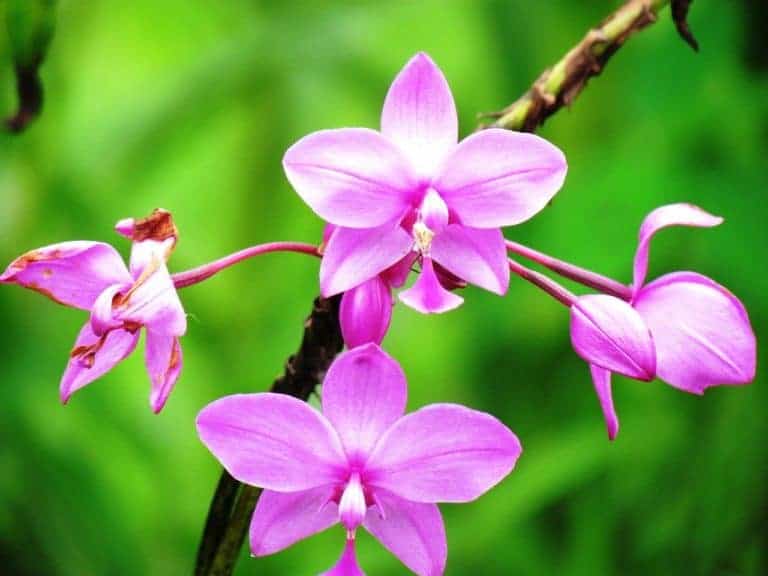
For nearly two centuries, Costa Rica’s forests have drawn collectors chasing the same prize. It has one of the richest orchid floras on the planet, with estimates running from about 1,500 to nearly 1,700 species, and a large share of them grow nowhere else on earth.
That rarity, paired with a market willing to pay heavily for the right bloom, has made Costa Rica a persistent target for plant smuggling. The trade reaches back well before Costa Rica had any law to stop it and the story begins with the guaria morada. In the 1830s George Ure Skinner, a British trader based in Guatemala, collected Central American plants and shipped them to England, feeding the Victorian craze for tropical orchids.
English botanist James Bateman named the purple orchid Cattleya skinneri in his honor. Botanists have since reclassified it as Guarianthe skinneri, though most Costa Ricans still know it simply as the guaria morada. In 1939 President León Cortés Castro declared it the national flower. The honor did nothing to slow demand, and decades of collecting badly depleted wild populations. Conservationists have spent years repropagating and reintroducing it, along with its yellow-flowered relative Cattleya dowiana.
Lycaste orchids tell a similar story as several species in the genus are found only in Costa Rica, and collecting pressure has pushed some, including Lycaste dowiana, into steep decline in the wild, prompting repropagation efforts to restore them. The main international tool against this trade is CITES, the Convention on International Trade in Endangered Species. Signed in 1973 and in force since 1975, it now has more than 180 member countries, Costa Rica among them.
Every orchid species falls under CITES, most in the category that requires export permits, with the rarest given the same top-tier protection as tigers and great whales. The treaty’s record on orchids is disputed since some botanists argue it has done little to prevent extinctions. They point out that news of an upcoming stricter listing can set off a rush of collecting before the rules take effect, while slow permitting for legitimate research often lags behind the pace of habitat loss.
The people doing the collecting work far from any courtroom. In Costa Rica they are known as materos, and they operate deep in cloud forests and jungles, hunting rare and newly described species for an international orchid market valued in the billions of dollars. Smuggling methods have ranged from hidden vehicle compartments to suitcases packed with live plants to shipments accompanied by falsified paperwork.
Orchids are not the only target as Cycads, an ancient plant group prized by collectors for their slow growth and rarity, are among the most trafficked plants in the world. One American collector who visited Costa Rica in 1979 later recalled gathering Zamia seeds because seeds could leave without the export permit a live plant required, and said enforcement at the time was lax enough that whole plants would hardly have been harder to take.
The problem extends beyond wild plants. When Costa Rica passed its plant breeders’ rights law in 2008, legislative records cited earlier cases of Colombian rice varieties and Canadian and Dutch potato varieties being used without authorization, part of the argument that Costa Rica needed a formal system to protect breeders and meet its trade obligations.
The trade is far from historical as authorities seized 4,366 animal and plant specimens at Costa Rica’s main airports and border crossings between 2024 and 2025, according to the Judicial Investigation Agency’s forensic biology section. Orchids were among the plants recovered, and in one case more than 300 were found in a single traveler’s luggage.
John Vargas, head of that forensic biology section, has said the number of wildlife cases referred for scientific identification has risen by 330 percent since 2023. Those figures helped prompt #WhatYouCarry, a campaign launched in late July by Humane World for Animals, the Judicial Branch and airport operator AERIS. It asks travelers to take home photographs and memories rather than pieces of the country’s biodiversity.
Nearly two centuries after Skinner’s first shipments left Central America, demand for Costa Rica’s orchids has not faded. What has changed is the effort to protect them, from international treaties to airport inspections to greenhouse repropagation, all racing against a trade that has never really stopped.





