

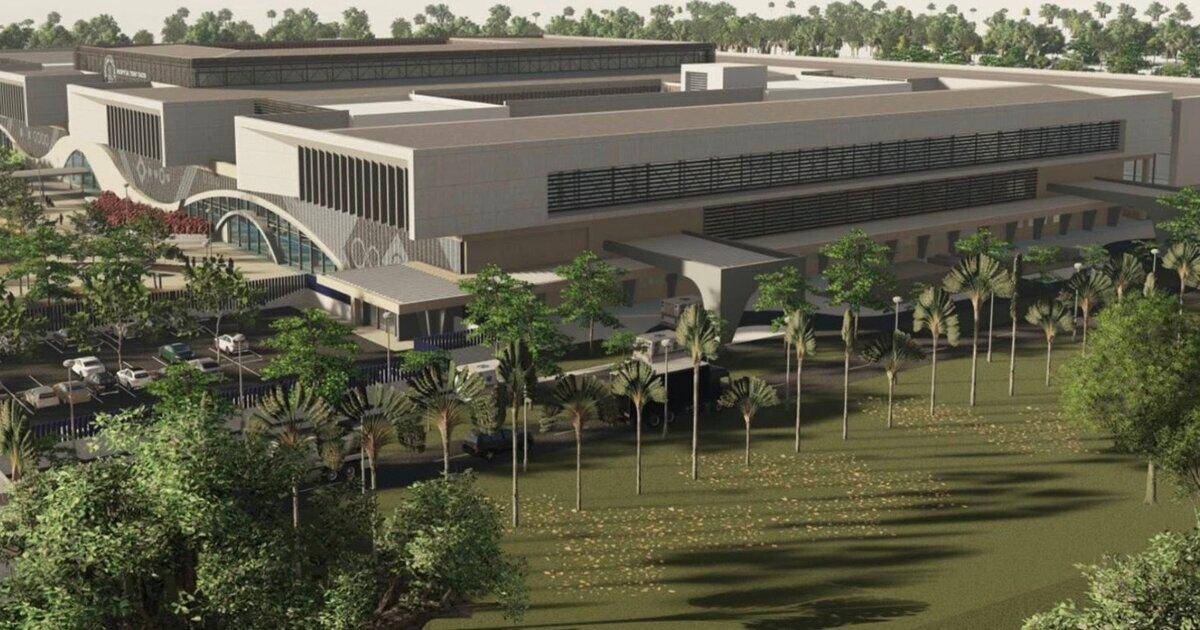
Costa Rica’s public health system is preparing to relaunch the tender for a new hospital in Limón during the final week of July, seven months after the first competition for the roughly $400 million project closed without a single company submitting an offer.
The Caja Costarricense de Seguro Social (CCSS) has rewritten the terms of the competition to address the objection contractors raised most consistently the first time around. Under the original terms, the winning firm would have been locked into its quoted price for the full life of a project expected to run several years, with no mechanism to recover cost increases if the exchange rate moved, if steel and cement rose, or if freight became more expensive. Jorge Granados, the CCSS manager of infrastructure and technology, confirmed that the institution has secured a change to that provision for the new tender.
The absence of a price-adjustment clause was not an oversight. The first competition was structured as a turnkey contract covering design, construction and equipment in a single award, and the regulations accompanying the General Public Contracting Law bar price readjustment mechanisms in contracts of that type. Granados told the CCSS board earlier this year that when the institution surveyed the companies that had declined to bid, the inability to adjust prices was the reason they named most often. On a project of this size and duration, he said, ordinary movement in input costs becomes a risk the bidder alone would have to absorb.
Construction firms cited additional concerns. Security conditions in the province and the repeated closures of Route 32, the highway that connects the Caribbean coast to the Central Valley, both came up in the CCSS survey, along with uncertainty over the colón’s behavior against the dollar. The institution has characterized those as secondary to the pricing question, though they help explain why a project in Limón in particular drew no takers.
The second change to the tender is structural. The first competition was open only to companies that had cleared an earlier international prequalification round, which in practice narrowed the field to five Costa Rican firms. Representatives of all five visited the 19-hectare (47-acre) site in June of last year, and none of them bid when the window closed in December. The new process discards prequalification entirely and will be run as an open public tender, which allows companies beyond that original group, including foreign firms, to compete alongside them. Mónica Taylor, the CCSS executive president, has said the institution intends to draw bidders from abroad.
The financial figures attached to the project have shifted with the currency. The tender declared unsuccessful was valued at approximately ¢208.78 billion, a figure set when the colón stood considerably weaker against the dollar than it does now. The CCSS currently describes the project as costing close to $400 million, which at the Banco Central de Costa Rica reference rate of ¢455.40 to the dollar would translate to roughly ¢182 billion. The gap between those two numbers over a period of months is a fair illustration of the exposure contractors said they were unwilling to carry.
How quickly the relaunch translates into visible work on the ground is the open question. Taylor has previously indicated that awarding a contract of this scale would take about a year. Granados has since offered a longer estimate, warning that even with the tender published in the coming days, the contracting and award process for a project of this magnitude can run up to two years before construction begins. Once building starts, he has estimated roughly two and a half years to completion, with late 2029 as a tentative date for the hospital to open its doors.
That timeline sits well beyond what the institution promised the province. In a 2023 press statement the CCSS said the facility would be ready by the end of 2027. President Laura Fernández has asked whether groundbreaking could be scheduled for August 31, 2027, the Day of the Black Person and Afro-Costa Rican Culture, a date that would now mark the start of construction rather than the opening the province was originally told to expect.
The failed tender has drawn official scrutiny. The Defensoría de los Habitantes opened an investigation into the process, requesting that the CCSS submit an improvement plan for the project along with the specific adjustments planned to the tender terms, the contracting model and the participation conditions, and the corrective measures it intends to take in the short, medium and long term. The ombudsman’s office framed the review as a matter of verifying efficiency, reasonableness and transparency in a project it described as essential to the right to health for the population of Limón.
The current Hospital Tony Facio Castro serves the entire Caribbean province, including the cruise port at Limón, the beach communities of Cahuita and Puerto Viejo, and the agricultural districts along Route 32. Its physical condition has been the central argument for replacement for years, and every month the new tender does not produce a contract is another month the province waits on a building the CCSS itself has called urgent.
Whether the revised terms are enough to attract offers will be visible within weeks of publication. If the second competition also closes without bids, the institution will be back at a starting point it has now reached twice.





