

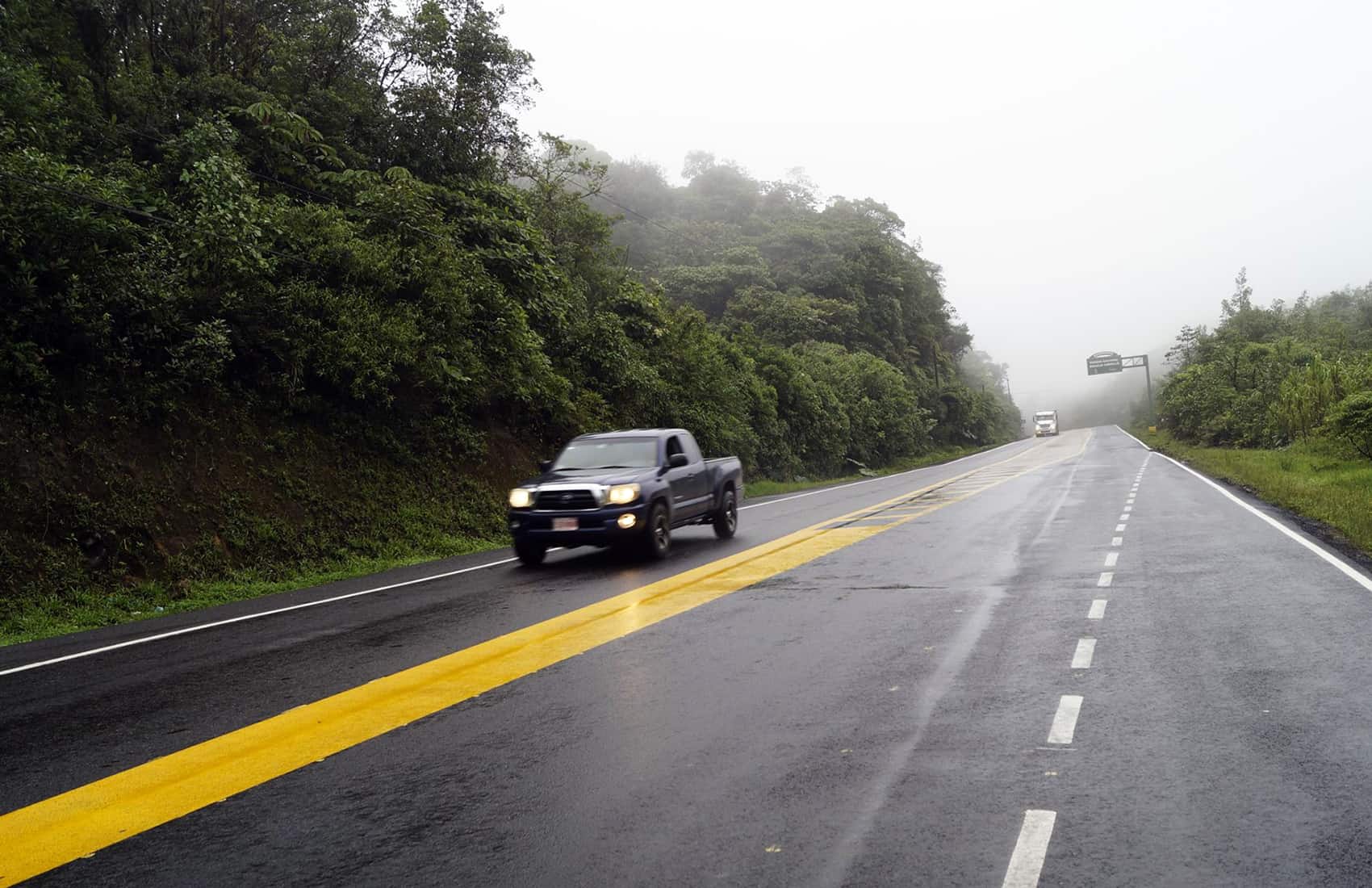
If you spent the school break at the beach and you’re driving home today, here’s the one thing you need to know: Route 27 is going to run in a single direction this afternoon, and it isn’t the direction of the coast.
Between 2 p.m. and 6 p.m., every lane on the 47-kilometer (29-mile) stretch from Pozón to the toll at the Ciudad Colón crossing will point one way — toward San José. The idea is to clear out the crush of people coming back from Puntarenas, Guanacaste and the central Pacific after a week off, and it works, up to a point. What it also means is that for those four hours, nobody is driving that stretch toward Caldera. Not you, not anyone.
The road actually closes earlier than that. Crews start setting up at 1 p.m. and don’t finish putting everything back until 7 p.m., so the disruption is really a six-hour window with a four-hour reversal sitting in the middle of it. Plan around the outer hours, not the inner ones.
The speed limit drops to 60 kilometers per hour (37 mph) for the whole operation, and police will be out checking it. That number tends to annoy people who feel they’ve earned a fast drive home. Ignore the annoyance. You’ll be on a road where every lane is running the wrong way, the signs have all been switched around that morning, and a few thousand drivers are navigating a layout they’ve never seen before. Sixty is not a suggestion born of caution for its own sake.
If you need to go the other way — toward the coast — during those hours, you have three options and none of them is quick. Route 3 takes you through Atenas, Aguacate and Orotina. Route 1 sends you over Cambronero. Route 239 winds through Ciudad Colón, Puriscal, San Pablo, Turrubares and Orotina. There will be officers on all three. Add serious time to whatever your usual estimate is.
Now the part that turns a routine Sunday headache into something worth taking seriously: it’s going to rain. Tropical Wave 22 is crossing the country today, and the afternoon forecast calls for showers and thunderstorms right across the central and southern Pacific, around the Gulf of Nicoya and through the western Central Valley. Look at a map of that and you’re looking at a map of your drive home — landing in the same hours as the reversal.
Parts of the country are also under a risk of flooding today, so it’s worth checking conditions on your whole route, not just the highway. Wet road, unfamiliar lanes, temporary signs, everyone tired and in a hurry. That’s the combination that fills emergency rooms on the last Sunday of a school break.
So: leave early if you possibly can. Getting off the coast before noon skips the whole thing. If you can’t leave early, slow down, watch the signs, and do what the crews on the road tell you.
And if you’re heading back to the beach next weekend, mark it now as the same operation runs again on Sunday, July 19, the day before classes start back up.





