

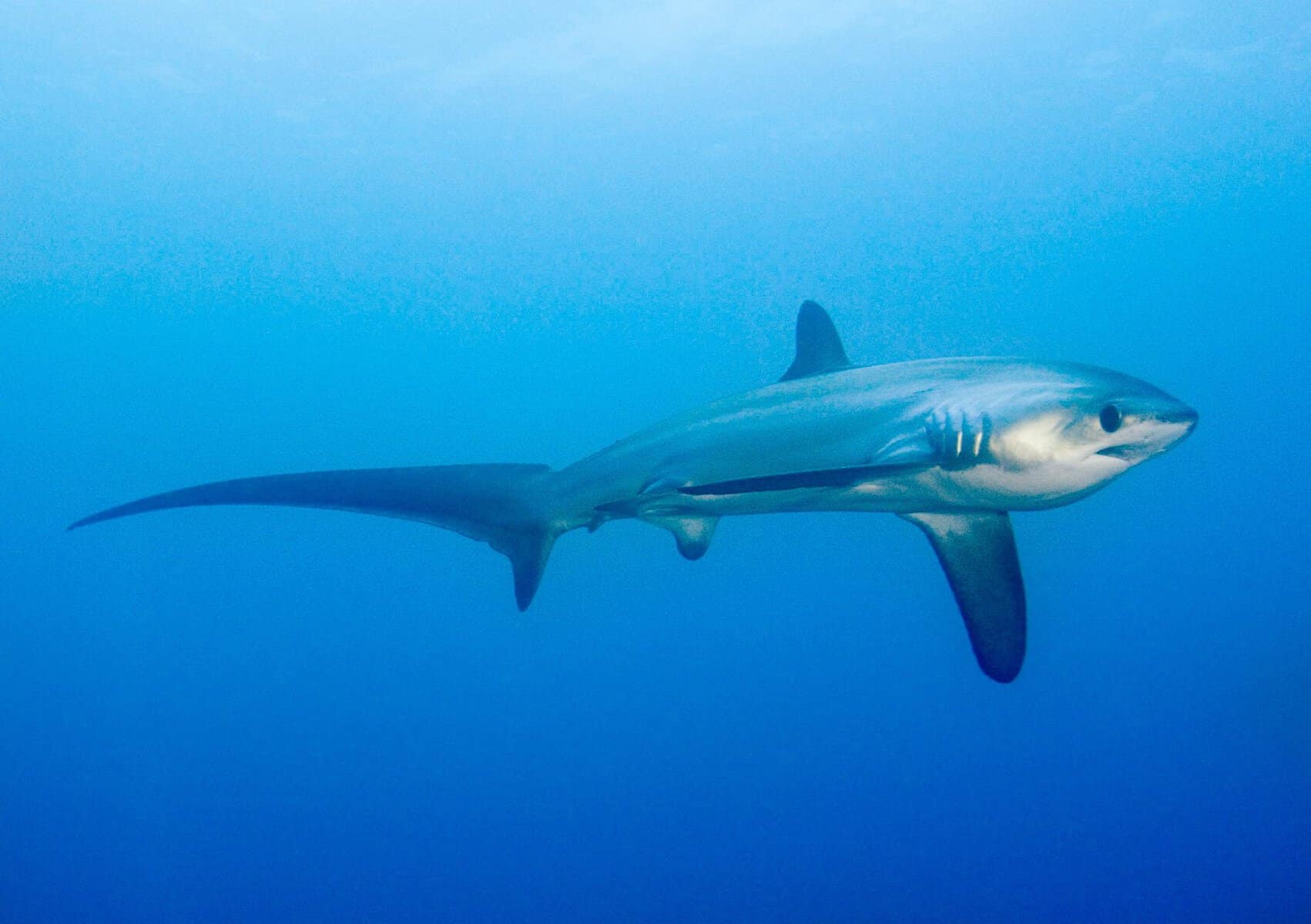
An environmental lawyer has asked a Costa Rican court to immediately suspend exports of three thresher shark species, arguing that stronger international protections became legally binding late last month. Walter Brenes Soto filed the request with the Administrative and Civil Finance Court as part of an ongoing lawsuit over the export of silky sharks and thresher sharks.
He wants the court to modify an earlier precautionary ruling because of what he describes as a major change in the species’ international legal status. The request covers the pelagic thresher shark, Alopias pelagicus; the common thresher shark, Alopias vulpinus; and the bigeye thresher shark, Alopias superciliosus.
All three species were added to Appendix I of the Convention on the Conservation of Migratory Species of Wild Animals, known as CMS, during the treaty’s 15th Conference of the Parties in Campo Grande, Brazil, in March. The sharks were already included in Appendix II but were moved into the convention’s strongest protection category, which covers migratory species considered threatened with extinction.
Under the convention, amendments to the appendices take effect for member countries 90 days after their adoption unless a government files a formal reservation. The new protections took effect on June 27, 2026. Brenes argues that Costa Rica had not implemented the measures or publicly disclosed a formal reservation by that date.
He maintains that the government is therefore required to stop authorizing exports of the three species. Appendix I requires countries within a listed species’ range to prohibit its capture, except under narrowly defined circumstances, and to take steps to protect its habitat and migration routes.
The treaty does not regulate international wildlife trade in the same way as CITES, the Convention on International Trade in Endangered Species. Brenes’ legal argument is that Costa Rica cannot approve exports of shark products obtained through fishing that the country is now required to prohibit under CMS and its own wildlife laws.
The filing cites a June 8 letter from the Ministry of Environment and Energy, identified as CARTA-MINAE-DM-114-2026, in which the ministry said it was still conducting technical and legal analyses before determining Costa Rica’s position on the amendment.
Brenes contends that the period for considering whether to accept the amendment has already passed and that the government must now apply the Appendix I protections. The latest request is part of a case that began in June 2024, when Brenes sought a temporary suspension of exports involving silky sharks and the three thresher shark species while the broader lawsuit moved through the courts.
The court initially rejected the precautionary request in December 2024, but an appeals court overturned that decision the following February and ordered a new review. In September 2025, the Administrative and Civil Finance Court temporarily stopped the exports and brought the Costa Rican Fisheries and Aquaculture Institute, known as Incopesca, into the proceedings.
The court later lifted the emergency measure after considering government and fishing authority arguments involving technical studies, CITES Appendix II controls and findings used to determine whether wildlife exports would harm the survival of the species. Brenes says the CMS decision changes the legal circumstances that existed when the court allowed exports to resume.
He also submitted a June 2026 fisheries report prepared by the U.S. National Oceanic and Atmospheric Administration for Congress. The report identified Costa Rica for failures involving international rules against illegal, unreported and unregulated fishing. It found that Costa Rica failed in 2022, 2023 and 2024 to ensure that scientific observers monitored at least 5% of the fishing effort by longline vessels longer than 20 meters operating within the Inter-American Tropical Tuna Commission area.
By the end of 2024, Costa Rica had not established a national onboard observer program for those vessels, had no observer coverage for its longline fleet in the commission’s region and had not submitted required observer reports or operational data for at least five years.
The report also stated that Costa Rica did not appear to have reported catches of relevant species to the commission after 2020, despite having more than 150 Costa Rican-flagged longline vessels on its register. It noted some progress, including a pilot project involving human observers and electronic monitoring. Costa Rica told international authorities in June 2025 that it expected the project to help the country meet the 5% requirement.
Brenes submitted the findings to challenge whether the scientific information used to support continued shark exports is complete and independently verifiable. The court must now decide whether the international listing and the fisheries management findings justify restoring a temporary export suspension while the underlying lawsuit continues.
A ruling in Brenes’ favor could also influence how Costa Rica applies international wildlife treaties when protected marine species are caught by commercial fishing fleets.





