

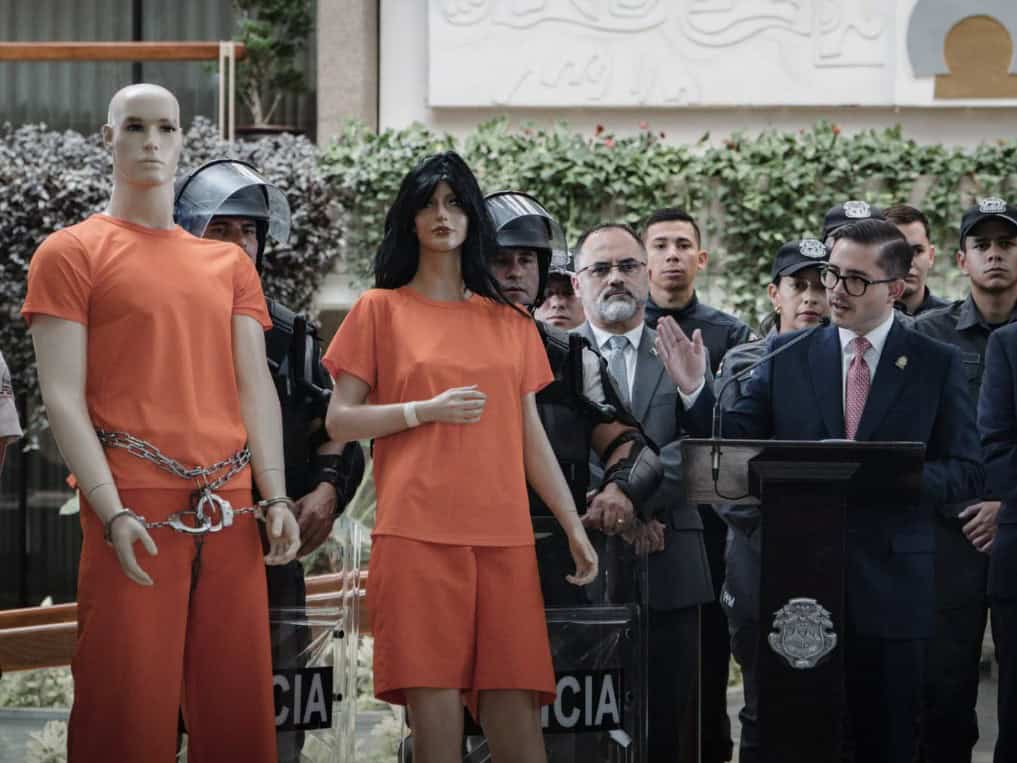
Costa Rica will require inmates at its new maximum-security prison to wear orange uniforms, bringing back a practice the country has not used in its prison system since the 1970s and adding another visible marker to one of the government’s most closely watched security projects.
The Ministry of Justice announced the measure Wednesday as officials reported that construction of the Centro de Alta Contención contra el Crimen Organizado, known as CACCO, is 64% complete. The prison is being built next to the La Reforma penitentiary complex in San Rafael de Alajuela and is intended to hold inmates classified as high-risk or linked to organized crime.
Justice Minister Gabriel Aguilar presented the uniform prototype during the government’s weekly press conference. He said the orange clothing meets security standards and international rules, and will be mandatory for inmates sent to CACCO. Prisoners at the new facility will not be allowed to receive outside clothing.
The uniforms will be produced inside the prison system by women inmates at the CAI Vilma Curling women’s prison, commonly known as El Buen Pastor. According to the Ministry, 26 sewing machines will be used for the work, with technical support from the National Learning Institute. Officials said fabric, thread and shoes will be donated by private companies, allowing the project to operate at no cost to the state.
Aguilar said the workshop could produce up to 12,000 garments per month. The government says the uniforms are meant to improve control inside the prison by making inmates easier to identify, simplifying searches, reducing the internal trade of clothing and helping authorities respond more quickly in the event of an escape. Officials also framed the measure as part of a broader push for order and discipline in the prison system.
Costa Rica has not used inmate uniforms in its prison system since the era of the old Penitenciaría Central, which closed in the 1970s. CACCO is being promoted as the centerpiece of Costa Rica’s harder line against organized crime. The prison will have capacity for 5,100 inmates, divided into five modules of 1,020 people each. The project covers roughly 91,000 square meters, with about 31,000 square meters used for the prison structure and related construction.
The facility is modeled in part on El Salvador’s Centro de Confinamiento del Terrorismo, or CECOT, the massive prison that became a symbol of President Nayib Bukele’s security crackdown. Costa Rica received Salvadoran technical support for the project, including guidance tied to design and security systems, while officials have said the model must be adapted to Costa Rican law and constitutional protections.
Bukele visited Costa Rica in January for a formal event tied to the prison project, less than three weeks before the country’s presidential election. His presence drew criticism from opposition parties, and the Supreme Electoral Tribunal reminded authorities that a foreign president could not participate in Costa Rica’s electoral process.
The prison is moving forward as Costa Rica continues to face historically high violence. The country recorded 873 homicides in 2025, the third-highest total in its history, behind 905 in 2023 and 876 in 2024. Authorities have linked much of the violence to organized crime and drug trafficking.
Costa Rica’s prison system is also under severe pressure. Oversight figures have warned that the prisons are operating well above capacity, with recent reports showing overcrowding at levels considered critical by international standards. The Mecanismo Nacional de Prevención de la Tortura has placed real prison capacity at fewer than 14,000 people, while the number of people held in closed prison facilities has continued to rise.
Critics say CACCO will not solve the wider overcrowding problem by itself. Even if the new prison takes in the roughly 2,000 inmates currently held in high-containment units, it would represent only a fraction of the total prison population. Prison oversight voices have also warned that building more cells does not replace the need for prevention, rehabilitation and alternatives for lower-risk inmates.
The government argues that CACCO has a narrower purpose: to separate the most dangerous inmates from the rest of the system and prevent organized crime leaders from operating inside mixed prison populations. The complex is expected to include biometric identification, medical areas, watchtowers, communication-blocking technology and other high-security controls.
For now, the orange uniforms have become the latest symbol of that shift. Officials say they will be ready when the first inmates arrive.





