

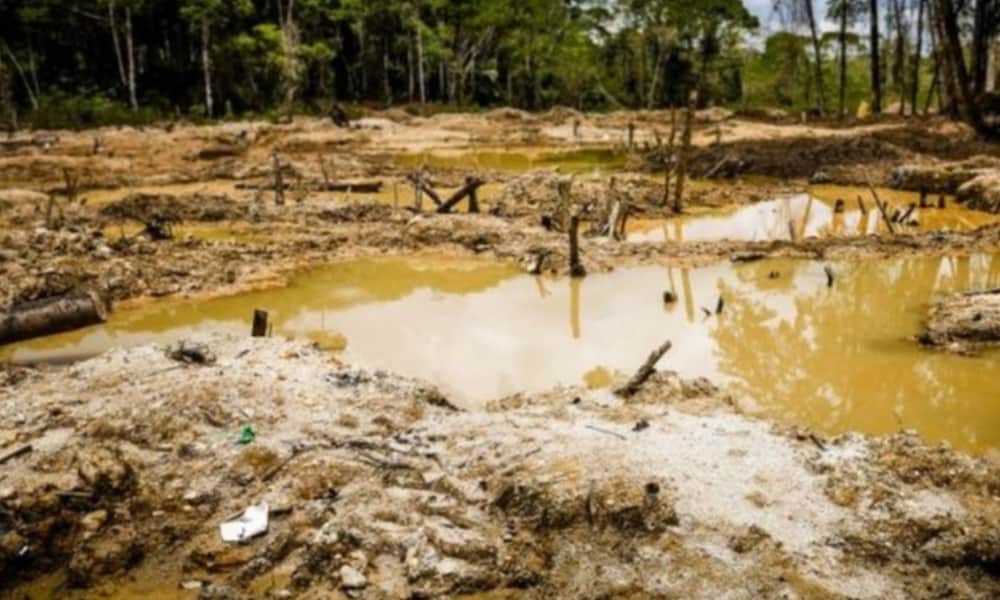
Costa Rica’s illegal gold mining problem is no longer confined to the long-running Crucitas debate, the Colegio de Geólogos de Costa Rica warned, calling for a national strategy to track gold, strengthen state controls and respond differently to each mining region.
The professional association said the country needs a technical plan for gold mining that goes beyond emergency police operations and political arguments over whether to reopen large-scale extraction. Its proposal centers on traceability, tighter regulation of processing plants, stronger oversight by the Dirección de Geología y Minas, and formalization in communities where mining is already a source of family income.
The Colegio said its position follows technical visits and meetings with local authorities and community actors in Abangares, Montes de Oro and San Carlos. Those areas, it said, face different social, environmental and institutional realities, making a single national response inadequate.
The sharpest warning concerns Crucitas, in Cutris de San Carlos near the Nicaragua border. According to the Colegio, the situation there has moved beyond mining and become a broader crisis involving security, public health, governance and environmental control. The group said illegal mining and the lack of an integrated state response have worsened the problem.
That framing is important because Crucitas is often treated as a binary fight over open-pit mining. The geologists are arguing that Costa Rica’s gold problem is wider and more uneven. In Abangares, they point to a mining tradition with deep social and economic roots, where regulation would need to consider formalization for families who depend on the activity. In Montes de Oro, they warn that illegal extraction and processing are showing signs of growth and could worsen if the state does not intervene early.
The Colegio is asking President Laura Fernández for a meeting to present a technical proposal. Its recommended route includes a national gold-mining strategy led by the Executive Branch, with coordination among the institutions responsible for mining, environmental protection, municipal oversight and law enforcement.
One of the central ideas is gold traceability: a system to identify where the metal comes from, how it moves, and where it is sold. The Colegio also wants stricter control over processing plants and a review of how gold of uncertain origin is financed and commercialized.
The group also called for more technical capacity in the field, including strengthening the Dirección de Geología y Minas and placing geologists in strategic cantons where mining activity is present or expanding.
Costa Rica’s legal framework is already complicated. Law 8904 declared the country free of open-pit metallic mining and says no permits or concessions may be granted for open-pit metallic exploration or exploitation, except for scientific and research purposes. At the same time, the law recognizes reserve mining areas such as Abangares, Osa and Golfito, where small-scale, family subsistence and artisanal mining may be allowed through worker cooperatives under specific conditions.
That split helps explain why the Colegio is pushing differentiated responses rather than one national formula. Formalizing small-scale activity in a place such as Abangares is not the same as confronting the uncontrolled illegal extraction reported around Crucitas.
Crucitas remains the political center of the debate. Legislative file 24.717, presented in November 2024, seeks to authorize and regulate open-pit metallic mining in Cutris de San Carlos under a special framework. The bill has advanced in the Assembly but remains controversial, with the University of Costa Rica recommending against its approval after warning that it would not provide an adequate response to illegal mining in the area.
The new warning from the geologists adds pressure on the government to define whether its mining policy will focus narrowly on Crucitas or treat illegal gold extraction as a national governance problem. For communities near mining zones, the issue is no longer abstract. It touches jobs, police control, environmental damage, public health and the state’s ability to know where Costa Rican gold is going.





