

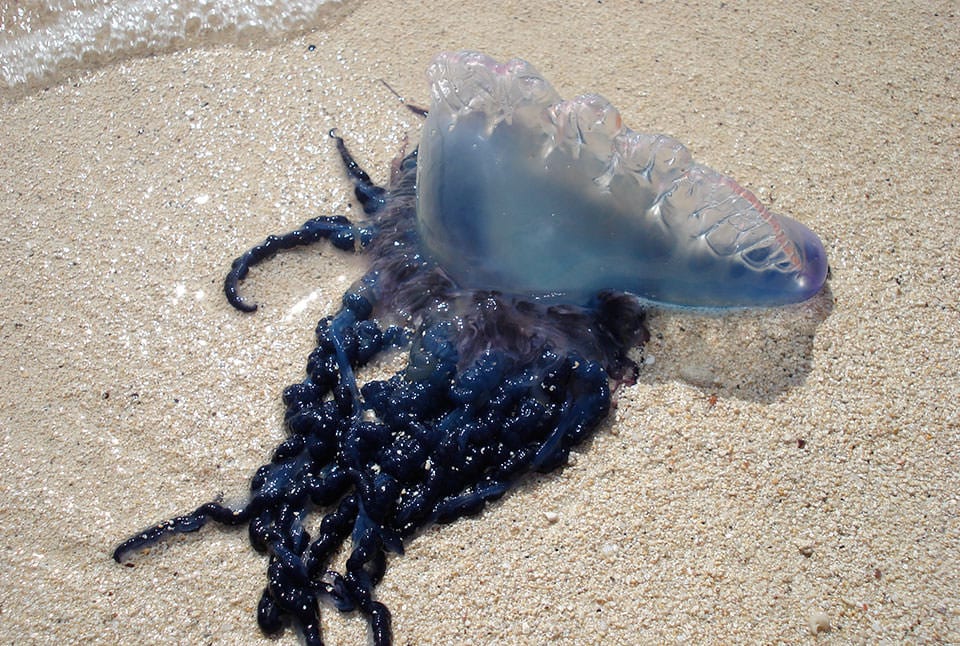
Portuguese man-of-war have been reported along several beaches on Costa Rica’s Caribbean coast, including Cahuita, Tortuguero, Manzanillo, Punta Uva, Puerto Viejo and Cocles, after beachgoers shared photographs and videos of the organism on social media. The reports have prompted caution for anyone entering the water or walking along the shoreline. The sightings do not mean beaches are closed, but people in affected areas should stay alert and avoid touching anything that resembles the organism.
The Portuguese man-of-war, known scientifically as Physalia physalis and in Spanish as the carabela portuguesa, fragata portuguesa or agua mala, is often mistaken for a jellyfish, a floating plant or a piece of blue-purple seaweed. It is not a single animal but a floating colony of specialized organisms that drift with the wind and currents, which is how they wash toward shore. Its appearance can draw attention, especially when it strands on the sand, but the organism can deliver a painful sting through long tentacles that may be difficult to see and can trail several meters behind the float.
Costa Rica’s Center for Research in Marine Sciences and Limnology (Cimar) at the University of Costa Rica has warned in previous years that Portuguese man-of-war can appear on the country’s coasts, and that contact with the tentacles can cause skin irritation, burns and intense pain in the affected area. According to Cimar, the tentacles carry toxins the colony uses to defend itself and capture prey. The organism has been documented before along the southern Caribbean, including near Cocles and Playa Chiquita.
People should not touch a Portuguese man-of-war in the water or on the beach. Even specimens that appear dead or stranded can still sting, and detached tentacles may remain dangerous. Children and pets should also be kept away from anything that looks like a blue or purple floating balloon, plastic bag or plant-like mass.
Anyone who sees one in the water should get out and alert others nearby. If one is found on the sand, it should be left alone and reported to lifeguards, park staff, local authorities or emergency personnel in the area.
If stung, leave the water immediately and avoid rubbing the skin, which can worsen the reaction. Cimar recommends seeking medical attention as soon as possible after contact. Medical help should be sought without delay if the pain is intense, if the sting covers a large area, or if symptoms include trouble breathing, dizziness, nausea, vomiting, chest tightness or signs of an allergic reaction. In Costa Rica, emergencies can be reported by calling 911.
The warning comes during a period of heavy public use of coastal areas, including the mid-year school break. Beaches along the Caribbean remain open according to local conditions, but the presence of Portuguese man-of-war can shift quickly with wind, currents and surf, so conditions may vary by beach and throughout the day. Anyone who spots one should stay clear, avoid entering nearby water, and alert lifeguards, park staff or local authorities.
For more on the species, the U.S. National Oceanic and Atmospheric Administration maintains a general guide the Portuguese Man O War





