

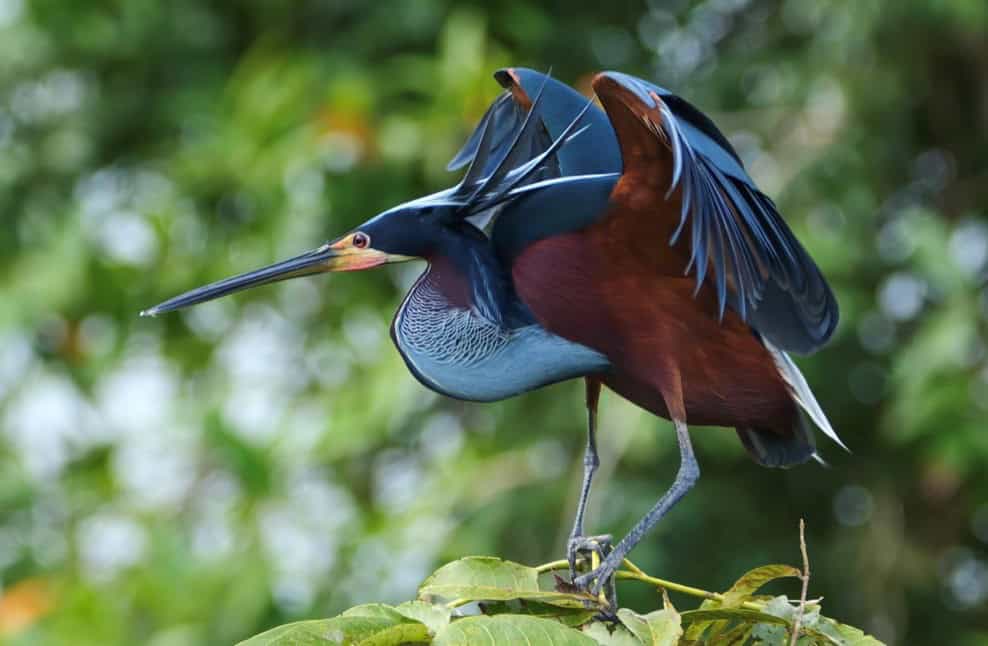
Around 1,000 agami herons have made a private estate in Guatuso their home, creating an unusual concentration of one of the most elusive heron species found in Costa Rica. Its near the Caño Negro wetlands, the property has become an important refuge and breeding site for the birds, prompting researchers, local residents, and the landowners to work together to study and protect the colony.
Researchers from the National Distance Education University (UNED) are monitoring the site and plan to continue carrying out censuses. Their work will focus not only on determining how many herons are present but also on counting nests and chicks to better understand the colony’s reproductive success.
The agami heron ranges from Mexico to South America but is rarely seen because of its secretive behavior and preference for densely vegetated wetland habitats. In Costa Rica, the species is primarily associated with humid areas in the Caribbean region and the Osa Peninsula.
It is also among the most colorful herons in the Neotropics. While many heron species are dominated by white, gray, brown, or dark tones, the agami heron is known for its distinctive and vibrant plumage.
Efforts to study the Guatuso colony began after the property owner contacted UNED and requested assistance in researching the birds. The owner also expressed an interest in investing resources to maintain the environmental conditions that have allowed the colony to establish itself.
The initiative has since expanded beyond scientific monitoring to include environmental education and community participation. People working on the estate are being trained to recognize threats and understand how their activities can affect the areas used by the birds for feeding, resting, and nesting.
For nearby communities, the colony could also become an opportunity to promote birdwatching and nature-based tourism in Katira, particularly because of its proximity to the Caño Negro wetlands. Community leader Odir Rojas Gómez stressed that the presence of such a large colony brings both opportunities and responsibilities.
“We want the communities to be part of its protection and for people who come to learn about it to understand that they are facing a space we must care for future generations,” he said. Researchers, however, warn that increased attention could pose risks if tourism is not carefully managed.
Herons and other waterbirds can be particularly vulnerable to disturbance during nesting periods. Visitors approaching too closely, excessive noise, or a constant human presence can cause adult birds to temporarily leave their nests, potentially exposing eggs and chicks to predators or falls.
For that reason, researchers are considering measures such as establishing minimum viewing distances, using binoculars and telescopes, and creating camouflaged observation areas. The objective is to avoid mass tourism while allowing people to experience the colony without disturbing it. “We don’t want the interest sparked by this gathering to end up becoming a threat,” said Ever Shion Salas, project designer and manager at UNED.
Continued monitoring of adults, nests, and chicks will help researchers determine how the colony develops over time and what conservation measures are necessary to protect this unusual gathering of agami herons.





