

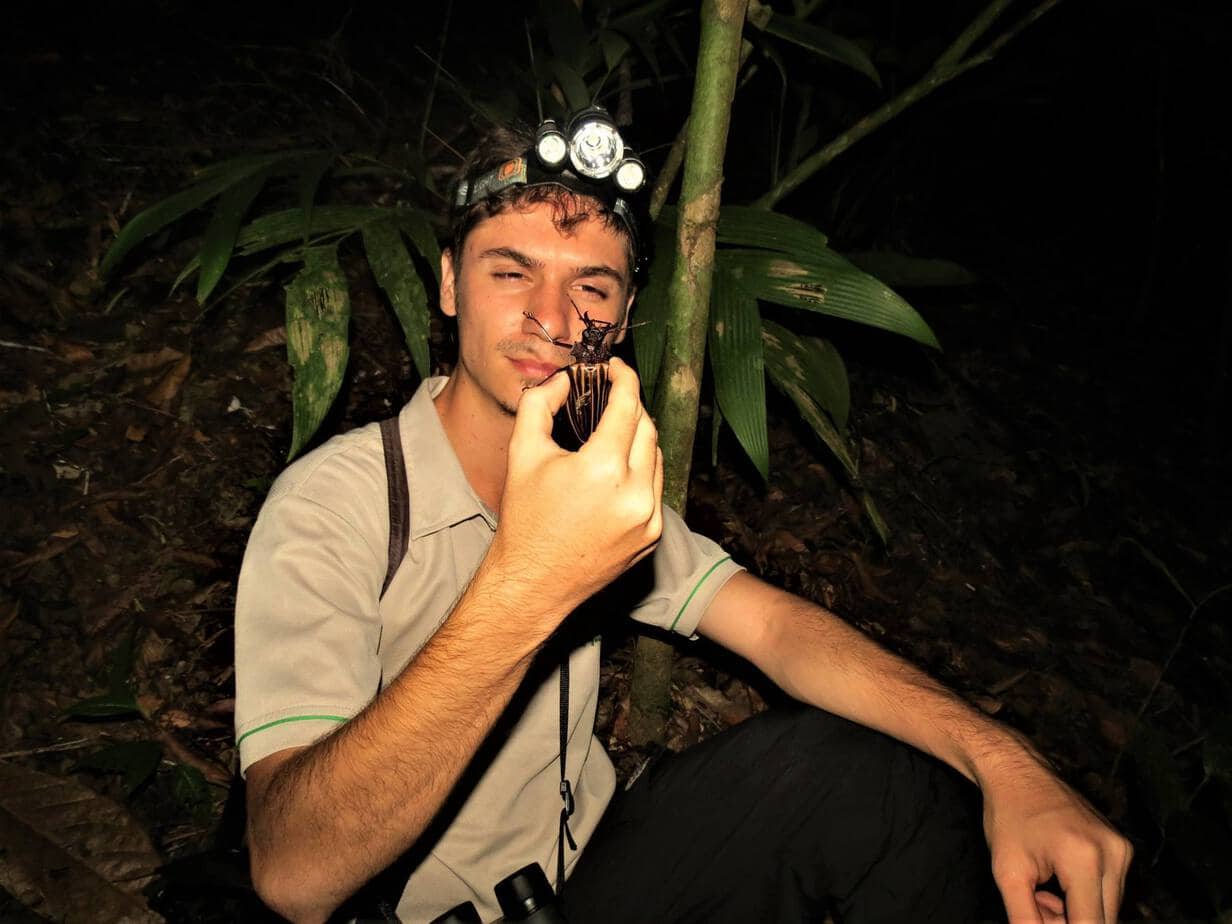
A major new study built on more than three decades of fieldwork in Costa Rica’s Guanacaste Conservation Area suggests Earth may be home to far more insect species than scientists have long believed. The research, published in Proceedings of the National Academy of Sciences, estimates that the planet has about 14.2 million to 20.3 million insect species under its most conservative calculation.
A separate estimate in the study, using a wider range of uncertainty, approaches 30 million. That is far above the commonly accepted global estimate of roughly 6 million insect species and points to a striking conclusion: most insect life on Earth is still unknown to science.
The study is based on one of the most intensive tropical insect inventories ever assembled. Researchers analyzed more than 1.6 million insects collected in the Área de Conservación Guanacaste, or ACG, a protected area in northwestern Costa Rica that includes tropical dry forest, cloud forest and rainforest.
Much of the core data came from Malaise traps, tent-like field traps used to collect flying insects. Scientists also drew on decades of caterpillar-rearing programs, ecological observations and DNA barcoding, a technique that identifies species by reading a short section of genetic code. That genetic work revealed an enormous number of cryptic species, meaning insects that may look nearly identical to the human eye but are genetically distinct.
Researchers say between 93% and 97% of the world’s insect species may still lack formal scientific descriptions. In plain terms, most insects have not yet been named, classified or fully understood.
The work grew out of the long-running bioinventory program associated with conservation biologists Daniel Janzen and Winnie Hallwachs, along with Costa Rican parataxonomists and international researchers. Parataxonomists are highly trained local biodiversity specialists who work in the field collecting specimens, documenting ecological relationships and feeding data into scientific databases.
The Costa Rican team’s contribution is central to the study. For decades, ACG staff and collaborators have tracked insects, plants, caterpillars and parasitoid wasps across protected ecosystems, creating a rare long-term record of tropical biodiversity.
The study also used a deep inventory of Microgastrinae, a highly diverse group of small parasitoid wasps. These wasps lay eggs inside caterpillars, and their close relationship with host species made them useful for estimating how much insect diversity remains hidden even in a heavily studied area.
Researchers then compared the estimated richness of insects in ACG with global patterns for other groups, including trees, mammals, amphibians and moths, to project how many insect species may exist worldwide. The findings do not mean scientists directly counted every insect species on Earth. They are a statistical estimate based on field data, DNA evidence and ecological comparisons. But the study argues that older estimates have likely understated the true scale of insect diversity.
For Costa Rica, the publication is also a reminder of the global value of long-term conservation work. The Guanacaste Conservation Area is not only a protected landscape, but a living research site that has helped reshape one of biology’s biggest questions: how much life is actually out there?
Alejandro Masís, director of the Guanacaste Conservation Area, said the findings point to the need to keep discovering, understanding and protecting biodiversity at a time when ecosystems face mounting pressure. Robert Puschendorf, a Costa Rican conservation biologist and associate professor at the University of Plymouth, said the study underscores that conservation is not only about known species, but also the countless organisms that remain undescribed.
That point may be the study’s most practical message. If most insect species are still unknown, habitat loss, climate change and pollution may be affecting forms of life humanity has not even identified. Costa Rica has long promoted itself as a biodiversity leader. This study gives that claim scientific weight, showing how decades of protected-area management, local field expertise and international research can produce findings with worldwide importance.





