

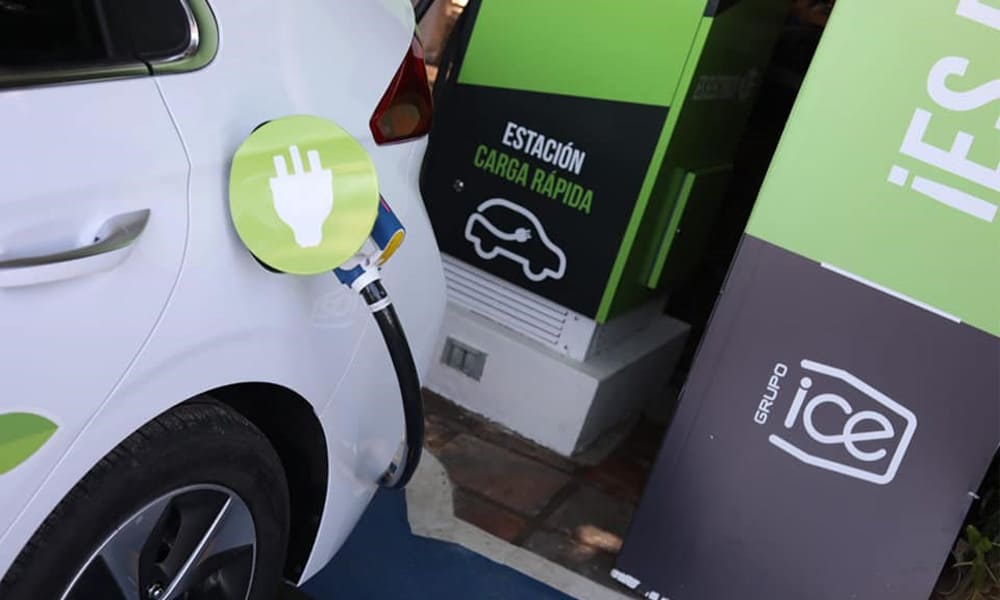
Costa Rica’s push toward cleaner transportation is getting a new boost, as the Costa Rican Electricity Institute, known as ICE, announced a $4.6 million plan to install 180 new public chargers for electric vehicles over the next three years. The chargers will have a capacity of 21 kilowatts and will be rolled out in stages across our country.
ICE said the first phase includes 25 new charging points in 2026, with the first units already active at ICE agencies in Limón, Guápiles, Puerto Jiménez and Golfito, as well as Hotelera del Sur in Pérez Zeledón. For electric vehicle owners, the expansion is meant to fill one of the biggest gaps in Costa Rica’s clean transportation plans: reliable access to public charging outside the Greater Metropolitan Area and along longer travel routes.
The new chargers are not the same as high-speed roadside chargers that can refill a battery more quickly. ICE described them as 21 kW semi-fast chargers, a lower-cost technology that is easier to install. According to the institution, they can take many electric vehicles from about 20% to 60% battery in roughly one hour, depending on the model and charging conditions.
“This initiative shows our commitment to electric mobility and to a more accessible and inclusive energy transition,” said Marco Acuña, president of Grupo ICE. “From the Institute, we are working to strengthen connectivity and bring charging services to communities that today have limitations, helping their integration into tourism and commercial activity.”
The stations will operate through ICE’s “¡Es Eléctrico!” mobile app, which allows users to locate chargers, start charging sessions and pay for the service. ICE said the rate will be ₡99.70 per kilowatt hour consumed, plus value-added tax.
The plan fits into Costa Rica’s broader decarbonization strategy, which aims to reduce dependence on fossil fuels and move the country toward net-zero emissions by 2050. Transportation remains one of the country’s hardest problems in that transition, since private vehicles, buses, trucks and motorcycles still rely heavily on gasoline and diesel.
Costa Rica has made notable progress in electric mobility in recent years, helped by tax incentives, more available models and rising interest among drivers. But the charging network has not always kept pace with demand. EV owners and mobility groups have repeatedly pointed to gaps in charging coverage, especially for longer trips and travel outside the Central Valley.
That issue matters not only for residents, but also for tourists and rental-car companies. Costa Rica markets itself heavily as a sustainable destination, yet visitors considering an electric rental car still need confidence that they can drive between beaches, national parks, mountain towns and regional hotels without worrying about where they will recharge.
ICE’s first locations suggest the new rollout is aimed partly at improving that kind of regional connectivity. Limón and Guápiles are important access points for Caribbean travel. Puerto Jiménez and Golfito serve the southern Pacific, including routes connected to the Osa Peninsula. Pérez Zeledón is a key stop between the Central Valley and the southern zone.
The practical impact will depend on where the remaining chargers are placed, how reliably they operate and whether the network expands in areas where EV drivers now face the most uncertainty. The 21 kW chargers offer convenience, but they are better suited for stops during meals, errands or hotel stays than for very quick highway charging.
Still, the investment marks another step in Costa Rica’s effort to make electric mobility less concentrated in urban areas. If the rollout proceeds as planned, our country’s public charging map will become broader over the next three years, making electric travel more realistic for drivers outside San José and for those exploring more remote parts of the country.





