

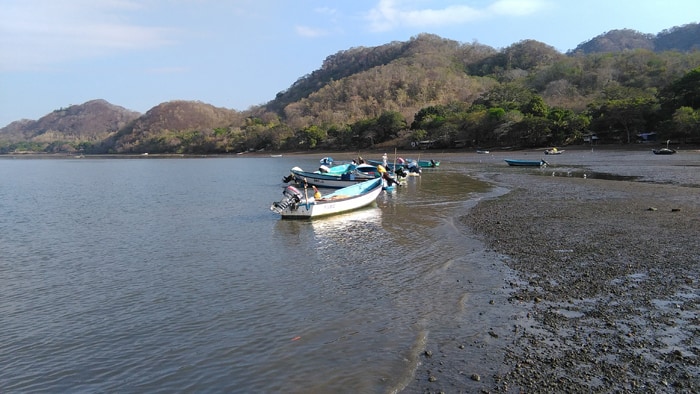
Four fishermen from the Roxana II remain missing in Costa Rica’s North Pacific after rough seas linked to Tropical Storm Cristina caused multiple boating emergencies off Guanacaste. The vessel was last reported in the Playa San Juanillo area of Santa Cruz on Monday, June 8. Authorities believe the boat may have capsized in heavy surf generated as Cristina moved parallel to the Central American Pacific coast, bringing rain, strong winds and dangerous maritime conditions to parts of Costa Rica.
The search has been extensive. Costa Rica’s Aerial Surveillance Service joined the National Coast Guard Service and the Red Cross in the operation, flying nearly 19 hours and covering about 3,150 nautical miles. By Saturday afternoon, authorities had reported no confirmed sign of the Roxana II or its crew.
The case unfolded alongside another rescue that briefly raised hopes. A Nicaraguan fisherman aboard a separate panga, Kila, was found alive after more than a day at sea, balancing on the overturned hull of the boat. Three others from that vessel reached safety on their own. The four men from Roxana II remain missing.
The disaster has become one of the clearest human stories from Tropical Storm Cristina. It is also a reminder of the economic pressure facing Costa Rica’s small-scale fishing communities. For many artisanal fishermen, staying ashore is not a simple decision. A day without fishing can mean a day without income. Several days of bad weather can quickly turn into missed rent, unpaid bills, empty coolers and difficult choices at home.
That pressure is especially hard in coastal communities where fishing remains one of the few steady ways to earn a living. Small crews often work from pangas and modest boats, with limited equipment and little financial room to absorb a bad week. When the weather changes quickly, they may be far from shore, low on fuel, or forced to decide between waiting out bad conditions and trying to return through dangerous seas.
In the case of Roxana II, family members said the fishermen had been at sea for about 10 days before the emergency. Their last communication came late Sunday night, hours before the accident. The message was simple and worrying: the tide was high and the wind was strong.
Cristina formed on June 8 off the Pacific coast of Nicaragua and moved slowly near Central America, keeping Costa Rica under heavy rain and high surf conditions. Emergency officials warned the maritime sector about rough seas in the Pacific and reported two capsized boats that same day in Santa Cruz.
The warnings were necessary. The problem is that warnings alone do not solve the conditions that put fishing crews at risk. Costa Rica’s artisanal fishing sector carries much of the burden of feeding local markets and sustaining coastal economies, but many fishermen work with fragile incomes, limited formal protection and uncertain access to licenses or support programs. Research and public policy documents have pointed to widespread informality in the sector, leaving many workers outside the systems that would make it easier to receive aid, modernize equipment, or stop fishing during dangerous weather.
Our country has recognized the problem on paper. A $75.1 million World Bank-backed sustainable fisheries program was approved to improve fisheries management, strengthen coastal infrastructure, help fishing communities find better markets, and support the recovery of nearshore resources. But years after its approval, concerns remain over slow execution and whether the people most exposed to the risks are seeing enough benefit on the ground.
That gap matters. For a fisherman deciding before dawn whether to go out, or deciding at sea whether to return through a rising swell, policy delays are not abstract. They can mean older boats, weaker safety systems, fewer savings and no cushion when the weather turns.
Costa Rica’s coast is central to our country’s image and economy. It draws tourists, supports restaurants, supplies local markets and anchors communities that have lived from the sea for generations. But the people who fish those waters often do so with little margin for error.
The missing crew of Roxana II should not be reduced to another storm statistic. Their disappearance points to a deeper problem along the coast: the people who depend most directly on the ocean often have the least protection when it becomes dangerous.
The search continues, and families are still waiting for answers. Whatever the final outcome, the tragedy has already shown the cost of a system that asks small fishing crews to carry too much risk alone.





