

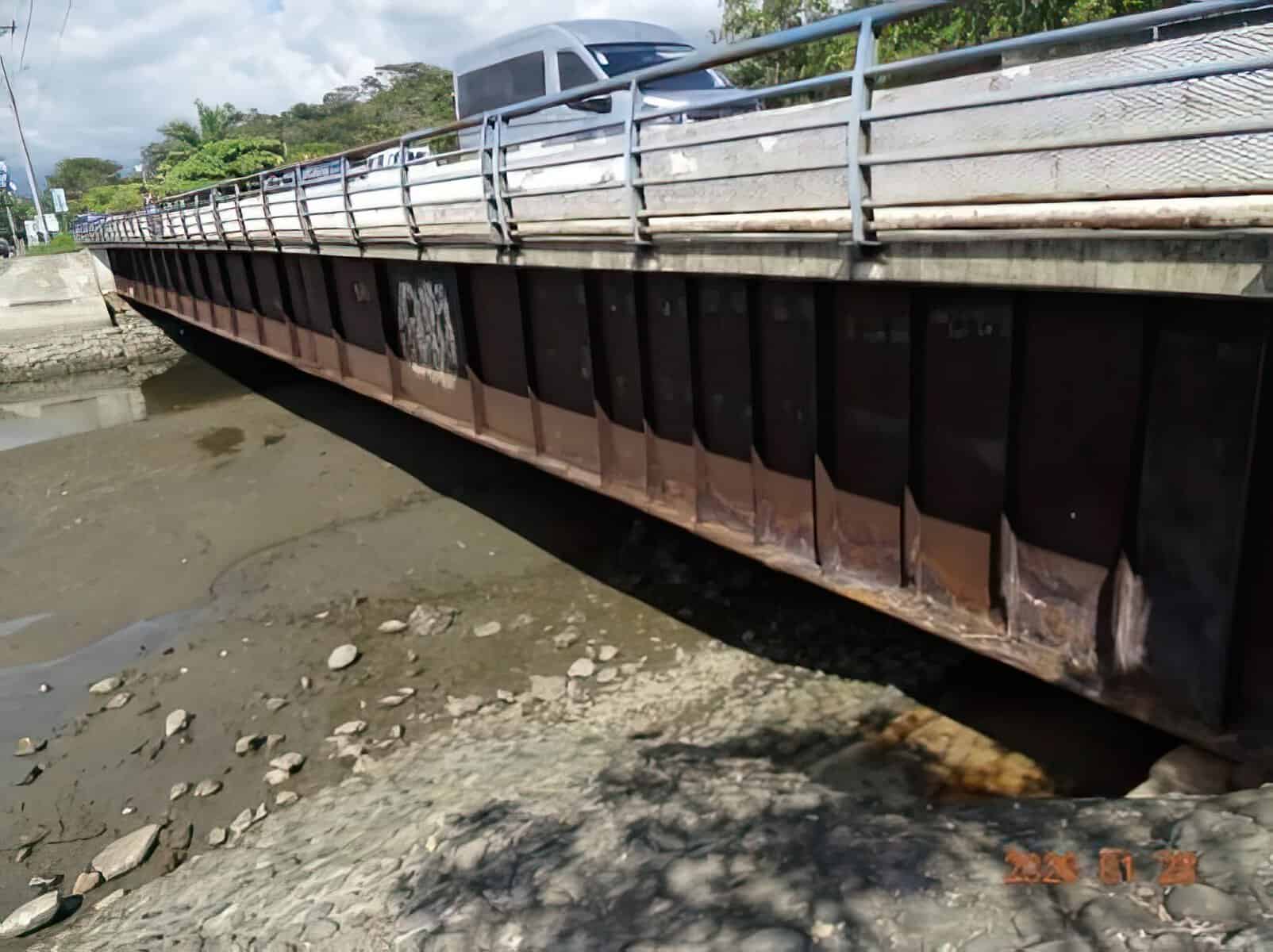
A bridge on the main car route toward one of Costa Rica’s most-visited places has been flagged as at risk of collapse, according to a special inspection carried out by the Laboratorio Nacional de Materiales y Modelos Estructurales (Lanamme) at the University of Costa Rica.
The structure spans the Boca Vieja estuary at kilometer 2.17 of Route 235, the secondary road that links central Quepos with the community of La Managua and the corridor leading to Manuel Antonio, home to the national park of the same name and a cornerstone of the central Pacific tourism economy.
Lanamme engineers assigned the bridge a rating of “imminent failure,” the most severe classification in the laboratory’s system, after finding severe corrosion running the full length of the superstructure’s main girders. The deterioration is most acute along roughly 12 meters (39 feet) at each end of the span, a pattern the report warns could lead to a collapse of the superstructure in the short term.
The bridge is not an aging relic. It opened in December 2016, built by the Ministerio de Obras Públicas y Transportes (MOPT) and the Consejo Nacional de Vialidad (Conavi) at a cost the ministry put at ₡1.56 billion (roughly US$3 million), and was promoted at the time as a modern two-lane concrete replacement that would improve access to a region the government itself described as having high tourism potential. Less than a decade later, the same authorities are being told the structure may not be safe to carry the traffic it was designed for.
Lanamme recommended an immediate detailed inspection and a load-capacity analysis to establish the maximum weight the bridge can safely bear, followed by inclusion of the structure in a short-term program of major rehabilitation or reconstruction. The report frames the corrosion as a known and worsening problem rather than a sudden discovery, pointing to a documented decline in the bridge’s condition over time.
As of yet, neither the MOPT nor Conavi had announced traffic restrictions, load limits, or emergency repairs in response to the warning. That leaves drivers, tour operators, and shuttle services heading to and from Manuel Antonio using a bridge that engineers have rated one step from failure, with no posted guidance on whether it should still carry heavy vehicles.
For an area whose economy depends heavily on visitor access, an unplanned closure of the Boca Vieja crossing — whether ordered by authorities or forced by further deterioration — would sever a primary route into the tourism zone with no obvious substitute.





