

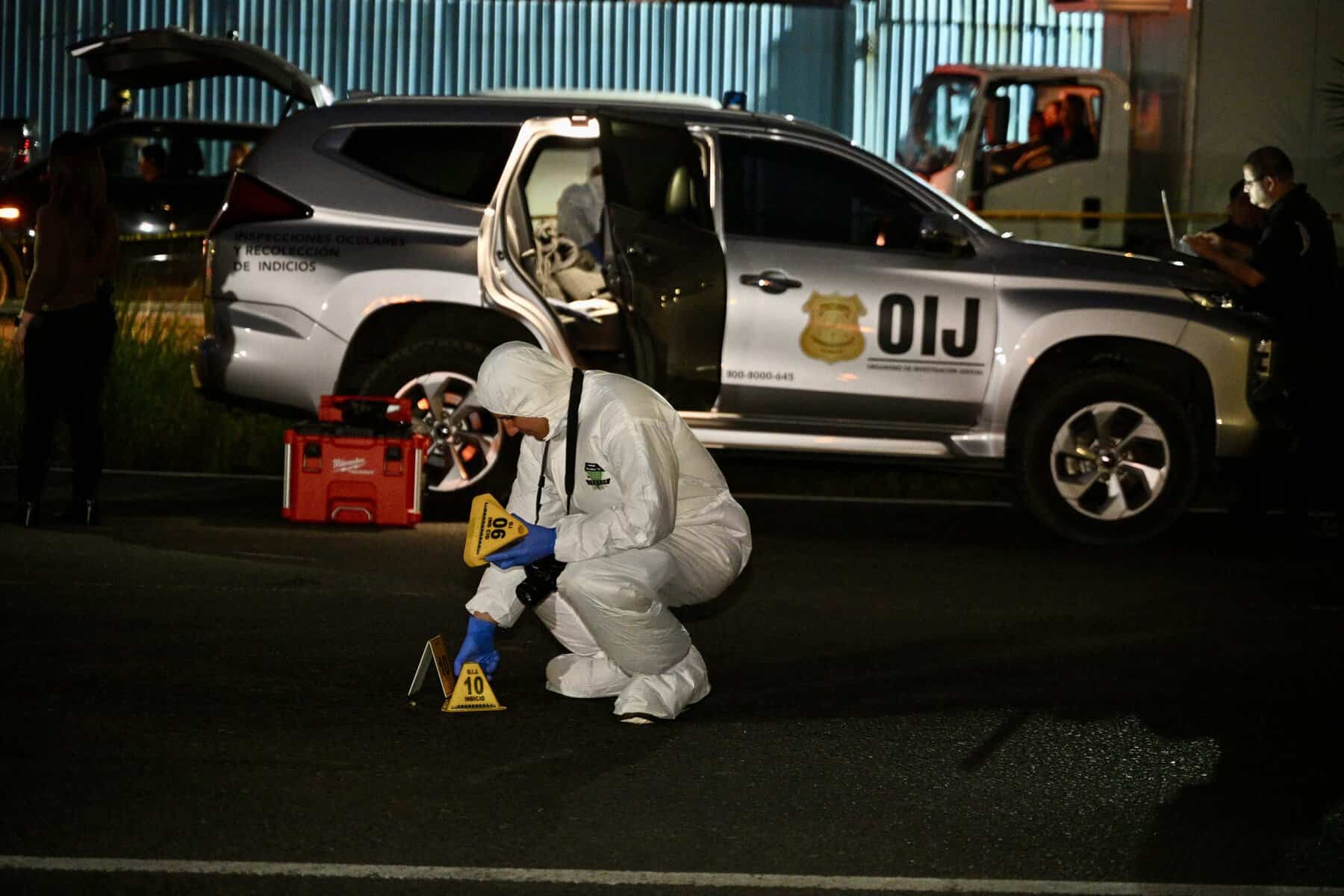
Investigators believe the two gunmen who killed journalist Camilo Rodríguez Chaverri on Route 32 may have had help following him, said Vladimir Muñoz, acting deputy director of the Judicial Investigation Agency (OIJ). Muñoz said today that the attackers knew which vehicle the journalist was driving.
Investigators are examining whether a second motorcycle or another vehicle trailed Rodríguez and whether the gunmen received instructions before the attack. Agents are collecting security camera footage to reconstruct the routes the suspects used to reach the scene near San Miguel de Santo Domingo, in Heredia, and to flee.
According to the OIJ’s account, the attackers knew Rodríguez was alone in a red pickup. They pulled alongside, confirmed he was their target and opened fire, then circled the vehicle and fired again from a second angle. Muñoz said the men checked that Rodríguez was dead before fleeing toward San José. Based on how they acted, he said, they apparently set out to make sure he would not survive.
Agents have also searched Rodríguez’s home in Santo Domingo with authorization from prosecutors and the Heredia Criminal Court. Muñoz said they seized electronic devices, equipment and documents that will undergo forensic analysis as investigators try to establish a motive and identify those responsible.
Attorney General Carlo Díaz said prosecutors will review the allegations Rodríguez published on social media, including the people he named, along with anyone else who may have had a reason to attack him. No arrests had been announced as of Tuesday afternoon, and the OIJ has not publicly identified any suspects.
Rodríguez, 50, had spent three days with his parents in Guápiles and set out for San José around 1 p.m. yesterday, according to his brother, Andrés Rodríguez. The Costa Rican Red Cross received the alert about the shooting at 3:21 p.m., about 6 kilometers (3.7 miles) from his home.
The journalist had filed about 10 complaints over threats in the past two years, according to the OIJ. Laura Lara, one of his lawyers, said he had worn a bulletproof vest for roughly three weeks as the threats mounted and had it on when he was shot. Lara said Rodríguez turned down the Public Ministry’s victim and witness protection program because he believed it would restrict his work. Díaz had said yesterday that the journalist declined that protection despite the threats.
International press freedom groups added their voices on today Reporters Without Borders called the killing an alarm signal for press freedom in a country long regarded as a regional benchmark. The group urged authorities to determine whether the killing was linked to his publications and the threats against him.
José Zamora, Americas director of the Committee to Protect Journalists, said authorities should thoroughly examine any link to Rodríguez’s journalism and prosecute both the gunmen and whoever ordered the killing. The Inter American Press Association demanded an exhaustive and independent investigation.
His wake was scheduled for this evening at a funeral home in central Cartago, his brother said. A funeral Mass is set for Wednesday at 2 p.m. at the San Esteban parish, known as the Iglesia del Carmen, in Cartago’s El Carmen neighborhood. The OIJ has asked anyone with information to call its confidential line at 800-8000-645.
According to the attorney general, Rodríguez is the third journalist killed in Costa Rica, after Parmenio Medina in 2001 and Ivannia Mora in 2003. Whether investigators reach anyone beyond the two gunmen is likely to define how this case is remembered.





