
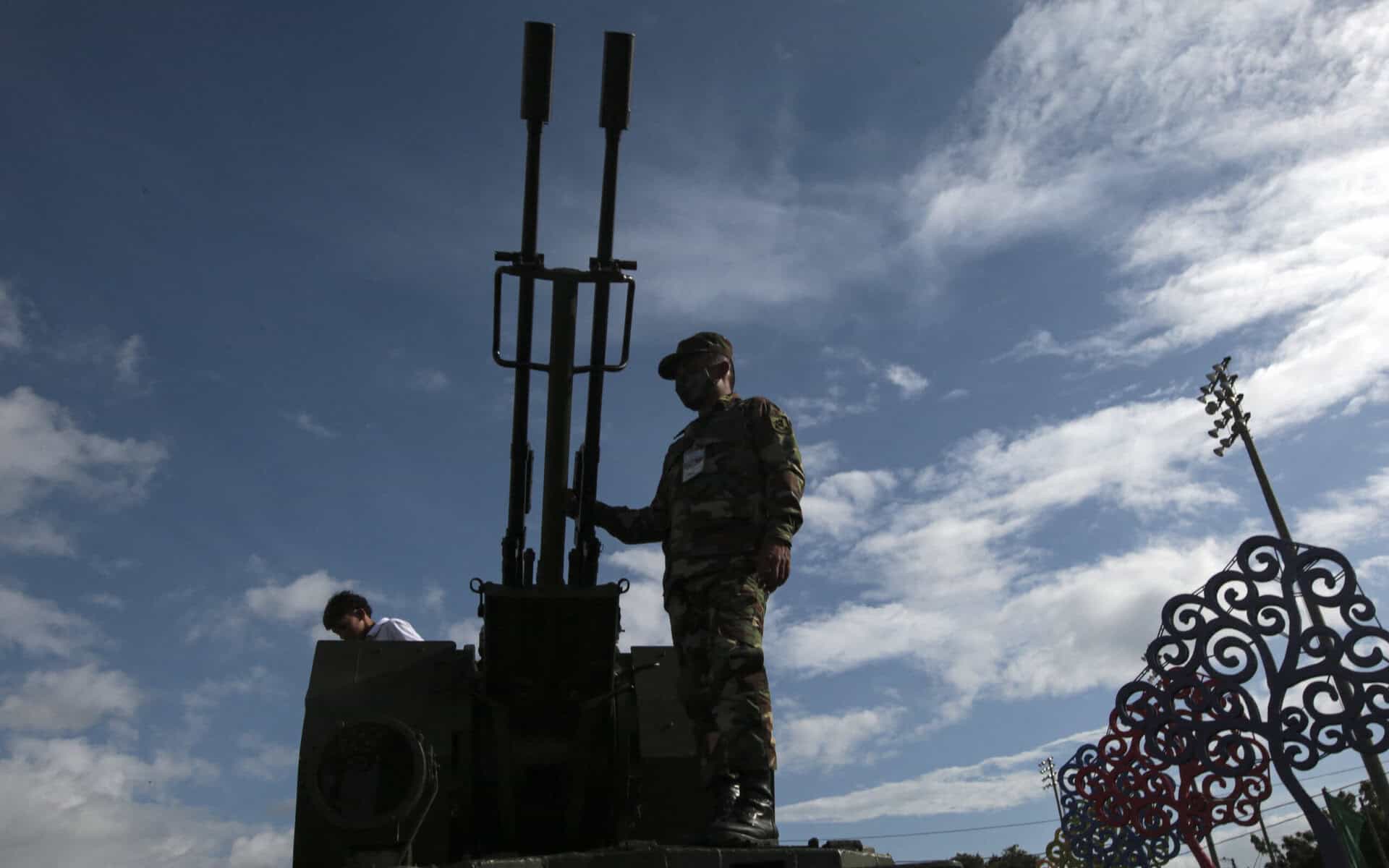
Costa Rican Foreign Minister Manuel Tovar expressed concern Thursday over the “significant presence of Russian military personnel” in Nicaragua, during an interview in Paris about the priorities of his term. Tovar became foreign minister in early May under Costa Rica’s new president, right-wing leader Laura Fernández, who promised a hard line against drug trafficking during her inauguration.
As he himself acknowledges, he takes office at a time when the world is “changing rapidly,” and Costa Rica, “a small country with an open economy” and “no army,” must defend the rules-based international order to avoid being overwhelmed. On his first international tour, which took him to New York, Brussels and now Paris, he has worked to defend the candidacy of Costa Rican Rebeca Grynspan for UN secretary-general.
“She is committed to restoring the United Nations system’s central role in mediation and the resolution of international disputes,” Tovar said, calling his compatriot the “strongest candidate” because of her career and background.
Russians in Nicaragua
Iran, Lebanon, Israel, Gaza… Conflicts around the world have increased, and although an ocean separates Costa Rica from Ukraine, the country, which supports Kyiv and has joined the future special tribunal intended to prosecute Russia’s invasion, feels a threat on its border. “In Nicaragua, there is a significant presence of Russian military personnel. They recently renewed a military cooperation pact with Moscow, and it seems to me that those troops are very far from where they should be,” he said.
“That is a factor that worries us, particularly knowing that there is a war in the heart of Europe caused by Russia in Ukraine, and we do not feel comfortable,” the Costa Rican official added. Nicaragua is Russia’s main ally in Central America and, in 2008, recognized the Moscow-backed independence of the separatist Georgian regions of Abkhazia and South Ossetia, as well as the annexation of Crimea in 2014.
The two countries have maintained close economic and military cooperation since Daniel Ortega returned to power in 2007. Ortega is a longtime Moscow ally who governed Nicaragua from the triumph of the Sandinista revolution in 1979 until 1990.
Costa Rican model
Beyond the defense of the international order, one of Tovar’s priorities is “national security,” and in that regard he defends a “Costa Rican model” for fighting drug trafficking. An admirer of President Nayib Bukele, the new Costa Rican president reiterated in her inauguration speech that she will soon open a prison inspired by El Salvador’s mega-prison for gang members, but that will not be the only front.
According to the foreign minister, there is more: extraditions, border and customs controls and, especially, international cooperation. “These cartels have a GDP larger than that of my country and the capacity to innovate. Nothing will be resolved if we do not address it collectively” among the final markets for those drugs, Europe and the United States, and the producing and transit countries in Latin America, he added.
Although the United States already cooperates on patrols along Costa Rica’s coasts, Tovar ruled out, “by constitutional mandate,” land operations involving armed U.S. military personnel. “But if there are agents who, without carrying weapons, collaborate on intelligence work, they are welcome, both from the United States and from Europe,” he said.
On recent tensions with Panama, which has blocked the entry of Costa Rican products since 2020 for sanitary reasons, Tovar said he agreed with his Panamanian counterpart, Javier Martínez-Acha, to “de-escalate tensions” and create “technical working groups” in the coming weeks to resolve the disputes.
“I hope that through dialogue we can reach a good outcome,” he said.