

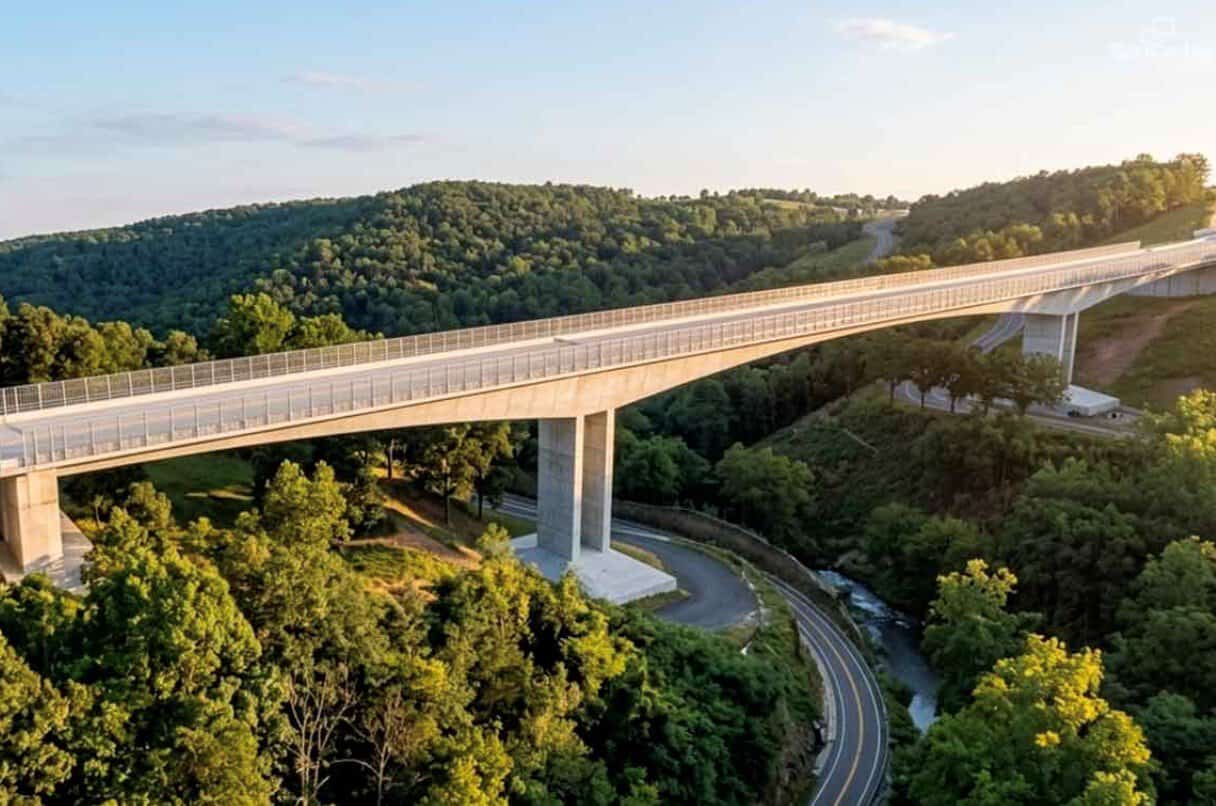
Construction is continuing on a 308-meter (1,010-foot) bridge that Costa Rican officials say will become one of the longest four-lane bridges in Central America. The Cañuela Bridge will cross the Cañuela River between the areas of Naranjo and San Ramón. It is the largest and most technically demanding structure included in the southern section of the long-delayed highway to San Carlos.
Crews are currently building the bridge’s foundations, which include two abutments and two central piers. The structure will rest on 94 concrete piles driven 25 meters (82 feet) into the ground. Each pile measures 1.2 meters, or nearly 4 feet, in diameter. Once completed, the bridge will carry four lanes of traffic across the steep and mountainous terrain separating Costa Rica’s Central Valley from the Northern Zone.
The bridge forms part of Punta Sur, an 8.2-kilometer (5.1-mile) section of National Route 35 running from the Bernardo Soto Highway near San Miguel de Naranjo to Sifón, in the district of Volio de San Ramón. The entirely new road will have two lanes in each direction, internal and external shoulders, central safety barriers and horizontal and vertical signs. It is being designed for traffic traveling at up to 80 kilometers per hour (50 mph).
Construction is taking place on at least eight work fronts along the route. Current work includes major earthmoving operations, drainage systems, large culverts, excavations and pile-supported retaining walls needed for bridges and viaducts. In addition to the Cañuela Bridge, crews are working on the Guarumal overpass, the San Roquillo Bridge, the Alto Palmas overpass and the Concepción de San Ramón overpass. Punta Sur will eventually contain 13 major structures, including bridges, interchanges, overpasses, underpasses and viaducts.
The project also includes wildlife crossings and design changes intended to improve the road’s ability to withstand extreme rainfall and other effects associated with a changing climate. Costa Rican construction company MECO is carrying out the work. Construction officially began in May 2025 with approximately $196 million in financing from an Inter-American Development Bank loan.
The current completion date for Punta Sur is April 2028. The section is an important piece of the wider plan to complete the highway between the Bernardo Soto Highway and the San Carlos area, a project Costa Rican governments have pursued for decades. Punta Sur will not complete that connection by itself. A separate central section must link Sifón with La Abundancia near Ciudad Quesada before drivers can use the entire new corridor between the Central Valley and the Northern Zone.
Once all sections are finished, the highway is expected to provide a faster and safer route for anyone traveling between San José, San Ramón, Ciudad Quesada and other Northern Zone communities. The government estimates that the wider road project will directly benefit more than 848,000 people and improve transportation for the agricultural, tourism and commercial sectors.





