

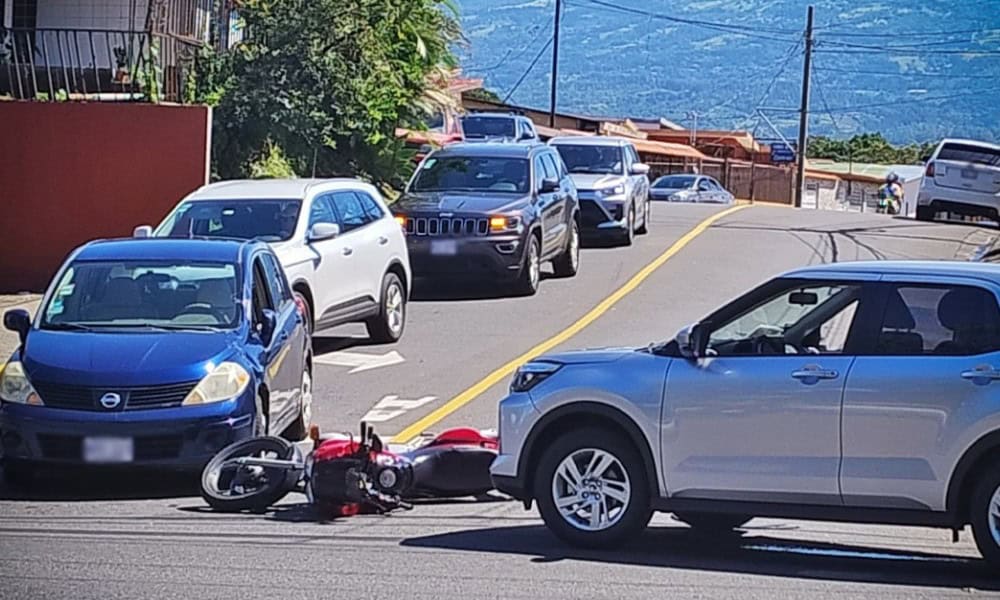
Costa Rican lawmakers are considering a bill that would bring back prison sentences for drivers who flee the scene of a traffic accident without helping injured victims. The proposal, filed under legislative bill No. 25.598, was introduced Thursday by ruling-party Representative Mayuli Ortega Guzmán of the Partido Pueblo Soberano.
The bill would add Article 144 bis to Costa Rica’s Penal Code and create a specific crime for failure to render aid in traffic accidents. The bill is currently listed as presented, with no committee assignment or votes registered yet. The measure targets drivers who are involved in a crash and leave without stopping, helping injured people, preventing injuries from getting worse, or immediately alerting authorities when they can do so without putting themselves or others at risk.
Under the proposal, a driver who flees after a negligent crash could face six months to two years in prison, a fine equivalent to 20 to 60 days’ wages, and a license suspension of one to three years. If the accident was caused intentionally, the penalty would rise to two to five years in prison, a fine equivalent to 60 to 120 days’ wages, and a license suspension of three to five years.
The bill would not replace other charges that may apply after a crash. Its text states that the penalties would be imposed without prejudice to other possible crimes, including negligent homicide, negligent injury, reckless driving, or other offenses. Ortega said the proposal is aimed at protecting victims left on the road after serious crashes.
“The right to life and personal integrity must take precedence over any indifference. Today we are presenting a bill that seeks to send a clear message: in Costa Rica, it can no longer be acceptable to abandon an injured person on the road,” she said.
The bill revives a legal issue that Costa Rica has already debated. The country’s 1970 Penal Code included prison time for someone who left the scene after a traffic accident that caused injury or death. That provision was later struck down by the Constitutional Chamber in 1993, after the court found that it violated the presumption of innocence by effectively forcing a suspect to help with the criminal investigation.
The new bill attempts to avoid that constitutional problem by framing the offense as failure to render aid, rather than failure to remain for investigative purposes.
The proposal states that the obligation would be limited to providing help, activating emergency services, or taking steps to prevent further danger to the life or physical integrity of the victim. It also says the rule cannot be interpreted as a duty to testify against oneself, admit responsibility, confess facts, provide incriminating evidence, or assist a criminal investigation in violation of constitutional and human rights guarantees.
“The bill does not aim to force anyone to admit guilt. What it seeks is something much more humane and fundamental: that no one should allow a person lying on the road to die when they are able to help,” Ortega said. Costa Rica’s current Penal Code already includes a general failure-to-render-aid offense under Article 144, but the bill argues that the existing law does not specifically address drivers involved in crashes who abandon injured victims.
The bill cites the scale of Costa Rica’s road safety problem as part of its justification. It says that, as of March 11, 2026, a person died or was seriously injured in a collision every three hours. It also cites 80,153 traffic accidents handled by Traffic Police in 2024 and more than 51,000 traffic accident responses by the Costa Rican Red Cross in 2025.
The proposal also acknowledges a data gap: it says no consolidated public series was found for hit-and-run cases involving injured victims between 2024 and 2026. Because Costa Rica’s Legislative Assembly is currently in extraordinary sessions, the bill must be called by the Executive Branch to move forward before August 1. Otherwise, it would wait until lawmakers return to ordinary sessions.
The proposal still needs to move through the legislative process. If approved, however, fleeing after a crash involving injured or endangered people would carry prison time, fines, and the possible loss of a driver’s license.





