
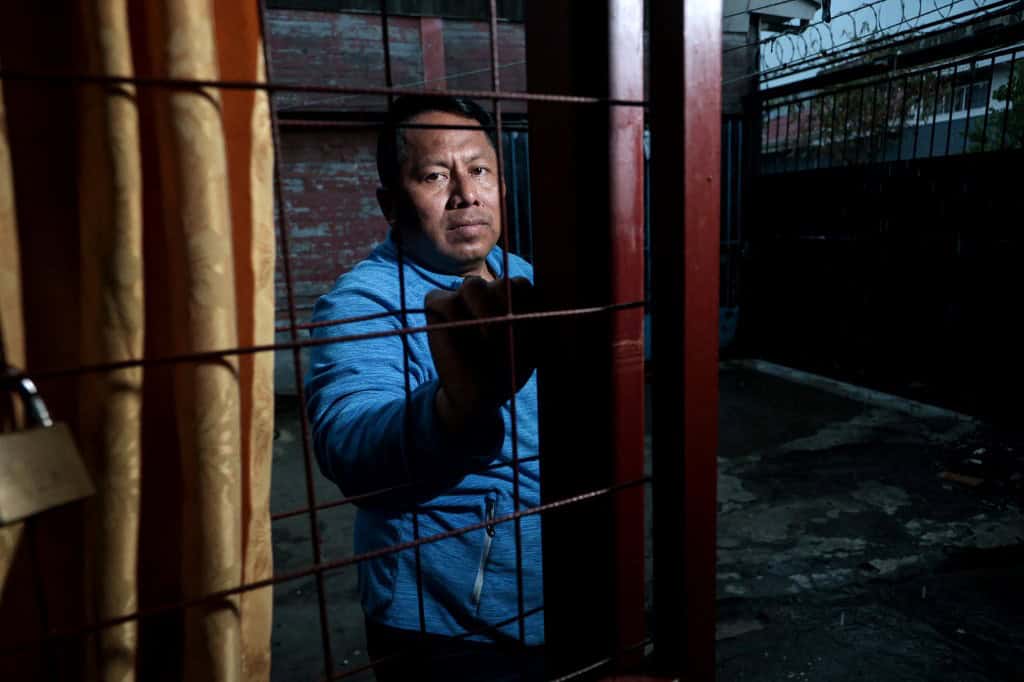
Gabriel Putoy does not even go out alone to take out the trash, nor does he pass through the same place twice: Nicaraguan exiles in Costa Rica live in fear of being reached by the persecution of Daniel Ortega and Rosario Murillo’s government. The gate to his house does not open for just anyone. A dozen crimes or attempted killings of exiles have occurred over the past five years, according to a March report by United Nations experts.
“They monitor us. We do not feel safe. This uncertainty is terrible,” the 49-year-old teacher told AFP in a room that serves as a living room, kitchen, and bedroom, dominated by a niche holding a plaster Virgin Mary. The apartment is reached after crossing a patio with laundry hanging beside a wall painted with Nicaragua’s coat of arms. The apartment is small, but it houses seven expatriates who have known each other for years and look after one another.
According to the UN Group of Human Rights Experts on Nicaragua, the country has an “extensive” network to monitor, intimidate, and attack exiled opponents, involving the army, police, immigration officials, and diplomats. “They are trying to silence the hundreds of thousands of Nicaraguans in exile,” Reed Brody, the U.S. expert on the group known as the “dictator hunter,” he said.
Ortega, 80, who has been in power for nearly two decades, and his wife accuse international organizations of being “interventionist” and “liars,” and accuse their opponents of having tried to overthrow them during massive protests in 2018. His repression left some 300 dead, political prisoners, and a diaspora in Costa Rica, the United States, and Spain that includes around 400 activists, intellectuals, religious figures, and journalists stripped of their nationality and property after being accused of “treason.”
Putoy crossed into Costa Rica wearing flip-flops through an unofficial border crossing in 2019, after being released following a year in prison, which he says was because he participated in marches and worked at a Catholic school.
Ideological motives
Fear surged after the killing of retired army major Roberto Samcam, who was shot eight times at the door of his home in San José in June 2025. In her apartment, surrounded by plants, books, and photos of her husband, Claudia Vargas said that the killing was preceded by “death threats” and a “defamation campaign on social media.”
Samcam, 66, went into exile with his family in 2018 after denouncing the army’s repression during the protests. “The dictatorship ordered his killing. His crime shows how government intelligence operates,” said Vargas, 53. On the street in broad daylight, opposition figure Joao Maldonado survived two shooting attacks in 2021 and 2024. His wife was left in a wheelchair.
“Repression does not end just because you cross the border. I have no doubt this was ordered from Nicaragua,” said his lawyer, Marlon Medina. Without mentioning Managua, Costa Rica’s Judicial Investigation Police, which did not respond to AFP’s questions because the cases remain under investigation, cited “ideological motives” in Samcam’s killing and the attacks against Maldonado.
“It is a new phenomenon” in a country with a tradition of asylum, said Medina, who called for easier ways to report such cases.
The defeat of fear
“Transnational repression” has pushed many to leave Costa Rica in search of safer and more distant refuge. Maldonado left a year and a half ago, but others refuse to go. In an improvised television studio inside the house they rent, two journalists in their 30s, among the 300 who have gone into exile since 2018, break through censorship with their digital outlet Nicaragua Actual, founded seven years ago.
“We do not resign ourselves to losing our right to inform,” Yelsin Espinoza said, pleased that 60% of their audience is in Nicaragua. His colleague Gerall Chávez says he will continue “despite the threat, persecution, and exile.” “Dictatorships pass, and journalism remains,” he stressed.
Recently, on their newscast, they spoke about the outrage among exiles over a visit to Costa Rica by Nicaragua’s foreign minister, Valdrack Jaentschke, who, according to UN experts, created a “spy” network at the embassy in San José. For Samcam’s widow, a human rights activist, staying silent is not an option either.
“I will not let fear defeat me, because that is what those in power are trying to do: silence us,” she said. Espinoza and Chávez dream of reporting from Nicaragua; Putoy dreams of embracing his two teenage children who remained there; and Vargas dreams of transferring and burying her husband’s remains.
“Hope is what sustains us,” she said.