
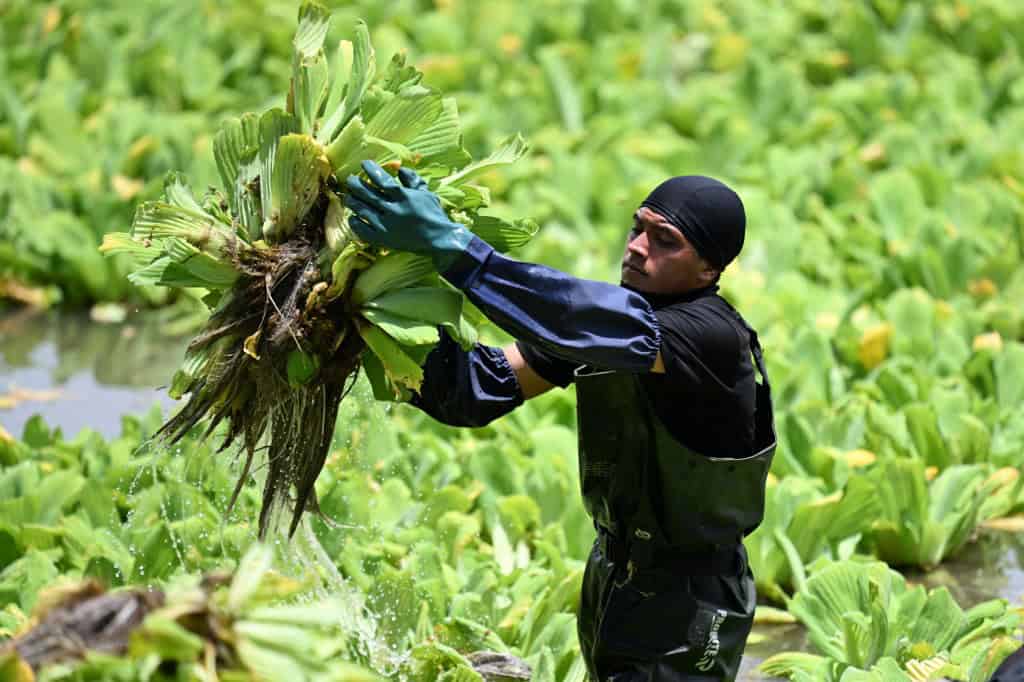
With mechanical shovels, barges, and by hand, hundreds of soldiers and artisanal fishers are working tirelessly this Friday to remove a floating plant that covers El Salvador’s Lake Suchitlán, in hopes of restoring prosperity to this tourist area.
The so-called “water lettuce” (Pistia stratiotes), about 30 centimeters in diameter, has spread across the surface of this artificial reservoir, located 45 km from the capital, feeding on chemical pollutants that arrive via its tributaries.
To revive the economy of the lakeside communities, the government deployed 360 soldiers to remove the plants. “I think this cleanup work is important, (but) I think they should have acted sooner,” said Eduardo Orellana, a 74-year-old builder from the area.
The lake hosts rich biodiversity, with migratory birds on its islands, but now much of its surface is blanketed by the “lettuce.” Its spread has been aided by wind and heavy rains, paralyzing artisanal fishing and tourism.
To support the soldiers, the government hired around 340 locals, mostly artisanal fishers who had been out of work for months since navigating through the plants had become impossible.
Wearing waterproof suits up to their waists, the soldiers patiently pull out the invasive plants, supported by three barges, while the fishers load the plants into baskets amid a nauseating stench. Local merchants are hopeful the lake will regain its splendor.
“It’s affected us because, honestly, we have eight restaurant areas and we still have to pay all the waiters and waitresses, and […] if tourists don’t come, how are we supposed to make money?” said merchant Julia Álvarez.
Around 50 restaurant workers lost their jobs in Puerto San Juan de Suchitoto, a tourist town known for its colonial-style houses with tile roofs, Álvarez, 52, added. The floating plant covers roughly half of the lake’s 13,500 hectares, according to military estimates.
For environmentalist Ricardo Navarro, head of the NGO Salvadoran Center for Appropriate Technology, the lake is facing “the consequence of neglecting to treat contaminated water.” “Those plants found the perfect breeding ground in the lake,” said Navarro.
The reservoir, built in the 1970s, supplies water to a hydroelectric plant and is fed by the Lempa River, which in turn receives water from other contaminated rivers.