
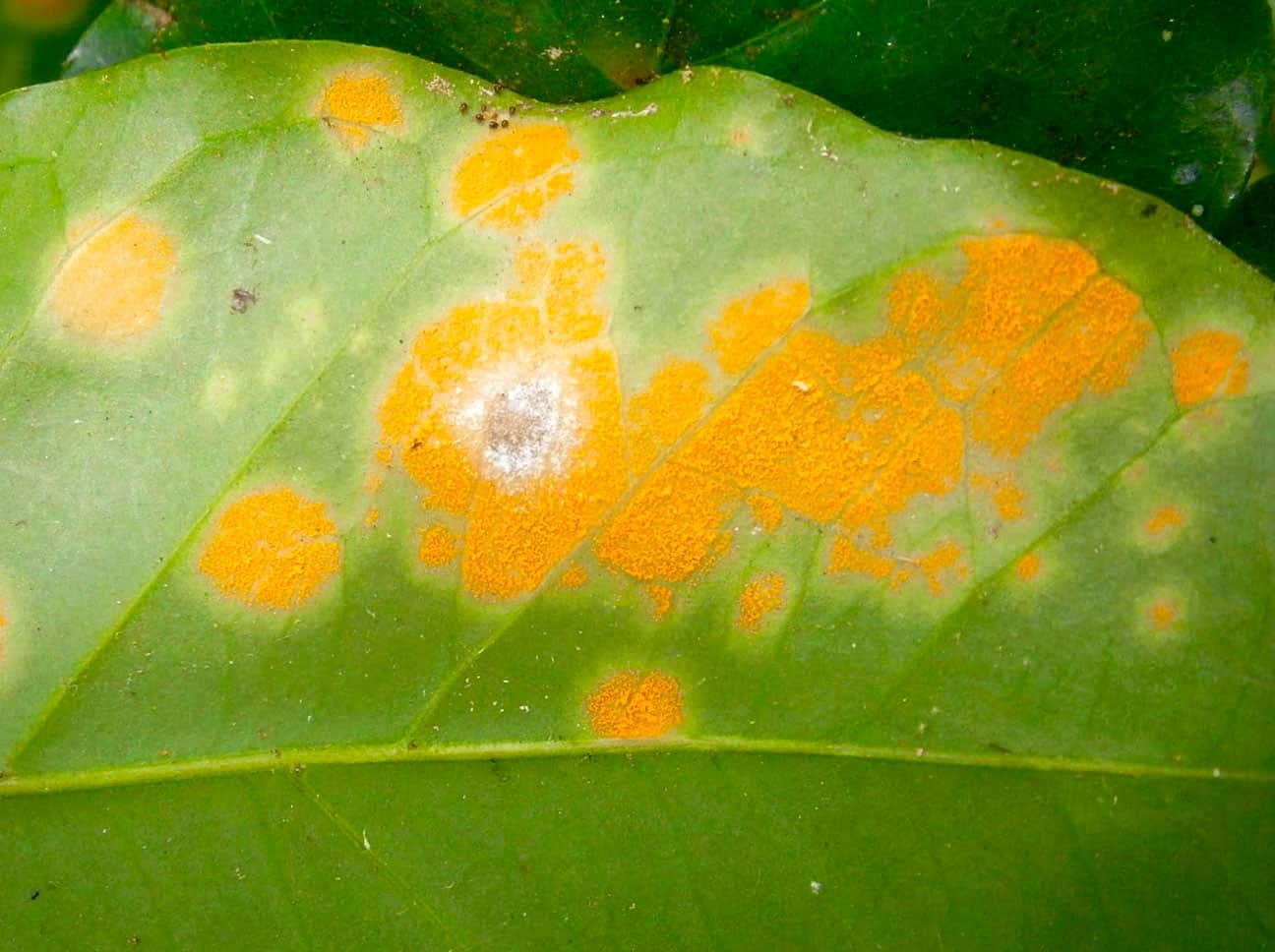
Vice President Luis Liberman and Minister of Agriculture and Livestock Gloria Abraham on Wednesday signed an emergency decree to combat a highly destructive fungus known as “roya,” which has devastated coffee crops, particularly in the southern region of Costa Rica.
Roya is caused by the fungus Hemileia vastatrix, and has destroyed more than 7,000 hectares of coffee in the Southern Zone canton of Pérez Zeledón, and 3,000 hectares in Coto Brus. It also has been detected in several other regions throughout the country.
The emergency decree sets in motion a two-year response plan that can be extended.
The fungus affects coffee leaves and causes fruit to prematurely fall off the plant. Farmers must completely prune affected plants to restore their ability to produce. Roya was first detected in Costa Rica in 1983, but an unusually dry climate has caused roya to become more widespread.
The decree sets the framework to allow public and private institutions to provide financial resources and other assistance to the Plant Health Department, which will distribute aid and supervise response programs in coordination with the Coffee Institute of Costa Rica, or ICAFE.
Abraham told The Tico Times that the decree allows officials to access emergency funds from the Plant Health Department and ICAFE to finance the purchase of agrochemicals to distribute to farmers. She said that a decrease in rainfall and hotter temperatures caused the fungus to spread more this year than in the past.
According to Jorge Ramírez, ICAFE’s technical director, officials will respond to “all of the requests from farmers in order to protect their harvests.” He said aid packages of fungicides would be distributed in March or April, as seasonal rains set in.
Officials estimate that up to 50 percent of Costa Rica’s 2013-2014 coffee crop could be affected in regions hardest hit by roya – about 10 percent of the national harvest. Pablo Jiménez, owner Café de Altura de Pérez Zeledón S.A., who lost 15 percent of his crop this year to roya, told The Tico Times he thinks the problem is manageable.
“It’s certainly true that climate has favored the spread of the fungus and damaged many crops, but with regular attention, the problem doesn’t get too much out of hand. The real problem is that in the Southern Zone, farmers have limited resources, and their crops are more easily affected.”
He recommended a broad program of pruning, shade control and constant application of fungicides. Marvin Barrantes, owner of Café Lila in Coto Brus, said preventive action helped save most of his crops. However, he said heavy fungicide use is expensive.
“Farmers who didn’t have the resources [to respond to roya] throughout the year lost everything. Those of us whose coffee plantations are in good shape were able to respond because we took out loans to support our businesses. Small producers don’t have that access to credit.”
For Barrantes, last year’s coffee prices were too low to sustain production.
Ramírez, disagreed, saying that although coffee prices have dropped in the last year, revenue is sufficient to cover production costs.
“The cost of production ranges from $92-$100 per fanega [256 kilograms of coffee], which leaves $55 profit per fanega for producers,” Ramírez said.
According to the daily La Nación, the fungus also has destroyed at least 1.7 million quintales in Nicaragua, Honduras and El Salvador (Central American coffee is generally sold in 46-kilogram quintales).
Abraham said that since 2010, officials have implemented a program to replace aging coffee plants to increase production. Part of that program is an effort to use plants that are more resistant to roya, the minister said.