

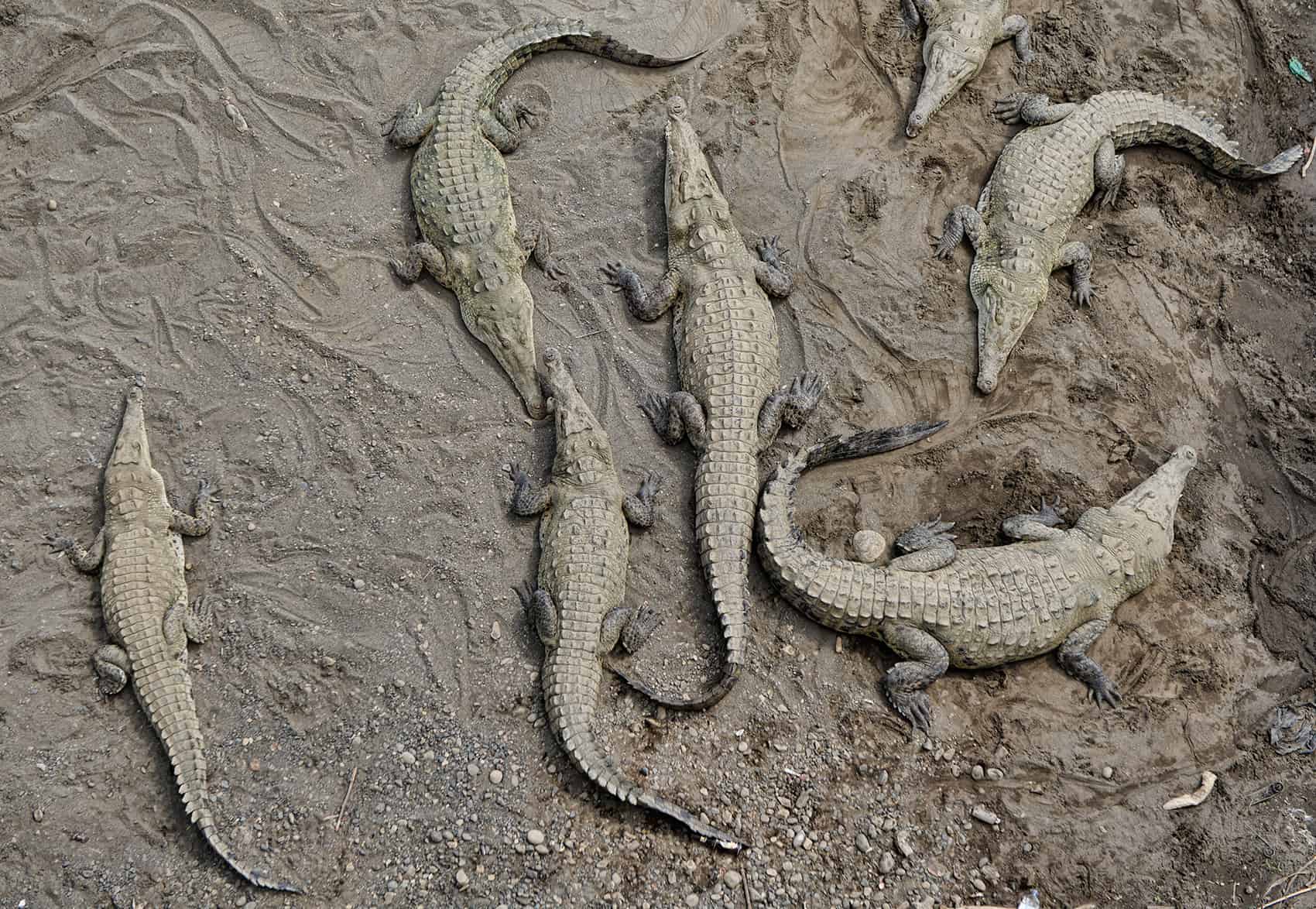
Only about 13% of the lower Tárcoles River offers high-quality habitat for its crocodiles, according to a new study from the National University (UNA), which found that the best nesting and nursery areas are scarce, scattered and hemmed in by human activity. The research, a licentiate thesis by Amanda Bogantes Barrelier at UNA’s School of Geographic Sciences, mapped 5.48 square kilometers (2.1 square miles) of the river.
The study area runs from several kilometers upstream of the Route 34 bridge on the Costanera Sur to the river’s mouth on the Pacific. The results were presented to the press on Friday. Bogantes combined high-resolution aerial imagery with earlier records and geographic modeling to identify where crocodiles are most likely to nest and shelter their young. The models weighed land use, distance from the river channel and slope.
Of the area studied, 86.41% rated as medium or low suitability for crocodile habitat. Just 12.52% rated high, and 0.25% rated very high. The study found that favorable nursery zones depend on small patches of riverside vegetation with little connection between them. Several of the best areas sit close to farmland, human settlements, infrastructure and mining operations.
Much of the most suitable habitat falls inside the 50-meter (164-foot) protection strip that the Forest Law sets along rivers. Even within that strip, the study identified human uses of the land. Bogantes said the findings point to a potential vulnerability in the crocodiles’ habitat. She warned that the loss of nesting and refuge areas could compromise the animals’ reproduction and survival.
The study did not count the river’s crocodiles or measure their mortality, survival or breeding success, and its results do not show that the population is at risk. Its aim is to pinpoint the areas that most need protection. Bogantes said the maps could guide conservation, habitat restoration and land-use rules. They could also help identify places where conflicts between people and crocodiles are likely to arise.
The lower Tárcoles is home to one of Costa Rica’s best-known populations of American crocodiles, and the crocodile viewing from the Route 34 bridge draws a steady stream of visitors traveling between San José and the central Pacific beaches. The river collects runoff from much of the Central Valley before it reaches the coast, and pollution in Costa Rica’s rivers remains a long-running concern for the wildlife that depends on them.





