
Did you know there is a rare and unusual intestinal parasite whose scientific name mentions our country? I am referring to the ‘Angiostrongylus Costaricenses’, an abdominal parasite discovered and named by two Costa Rican scientists in the early 1970s. For several years a number of sick patients with the same mysterious symptoms had been noted by doctors at various clinics and hospitals within the country.
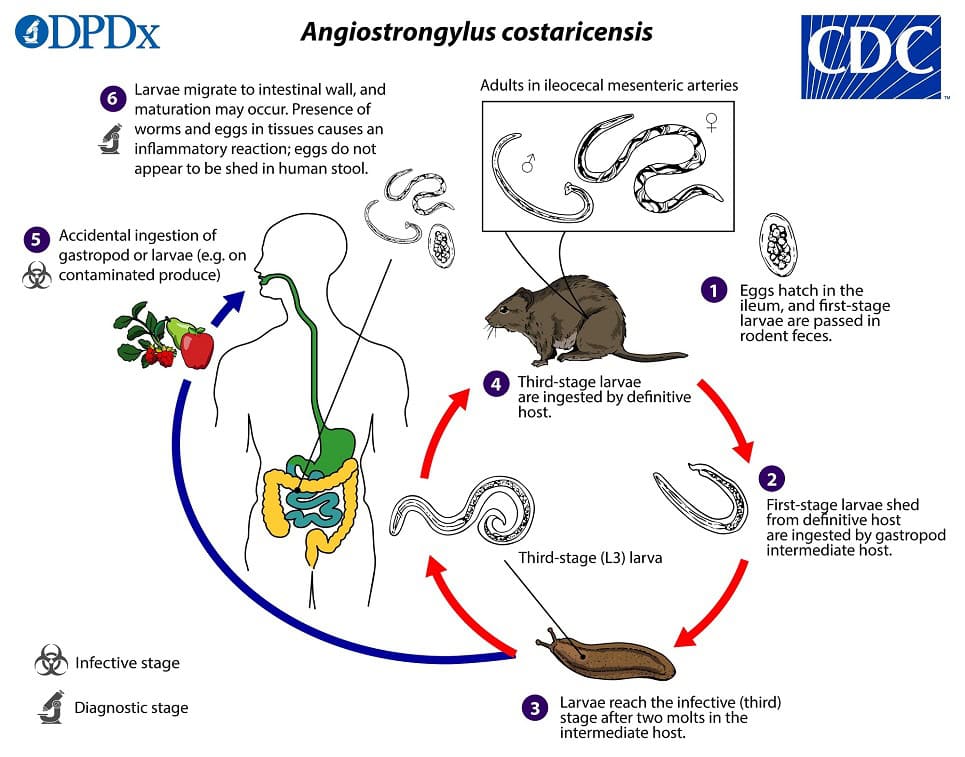
Severe abdominal pain caused by intestinal inflammation and accompanied by high fever was the most common complaint, but finding the cause remained an elusive task. The scientists discovered a pattern, a cycle that began, as many illnesses do, with rats. The rodents shed the parasite in their feces, slugs ate the excrement and became infected in their third larval stage. Humans became accidental hosts. Raw vegetables and fruits that had not been properly washed, were determined to be the main vehicles of transmission.
I know about this firsthand. My second year living in Costa Rica, I fell ill with what felt like the flu– high fever, nausea, a general state of exhaustion. I was caretaking a remote farm and on three occasions within a one month period I gobbled aspirin and made my way to a doctor in the city an hour away.
Twice I was questioned about my eating habits, particularly if I had eaten shellfish. Then I was prescribed antibiotics, which helped temporarily. However, these doctors went down the wrong diagnostic path. None were familiar with the scientific study a couple decades earlier.
Everything came to a head a couple weeks later, when I awoke with what I thought might be food poisoning. When the symptoms worsened throughout the day, I was driven to the hospital. Late that night a surgical team sliced open my belly, just to the right of my navel, and extracted an ulcerating parasite that measured 2 by 5 inches. (It looks worse in metric: 5 by 12 centimeters). A small section of my intestines came along for the ride, and while they were down there, my appendix was also removed.
I spent the next nine days recovering in the hospital. I was very curious as to what exactly had been removed from my body. Nurses repeated the phrase ‘la bobosa’. The slug. One of them brought me a few photocopied pages in Spanish. As I was in my early days here and still not totally proficient in the language, I labored through the scientific explanation. The cycle mentioned above was diagrammed.
For me the culprit was unwashed vegetables. I was eating a highly vegetarian diet, with raw salads being a daily staple. From that moment on, every piece of fruit and vegetable I ate was cooked or thoroughly cleaned. While Angiostrongylus Costaricenses has been identified in several regions, the need for surgery is still very rare. In all the years since my operation I have met one other person who had the same surgery.
Evidently the odds of this happening are akin to the odds of winning at the lottery. In my case though, there was no money to be had, just the souvenir of a five inch long zipper scar adorning my belly, like a tattoo of one more life experience in Costa Rica.