
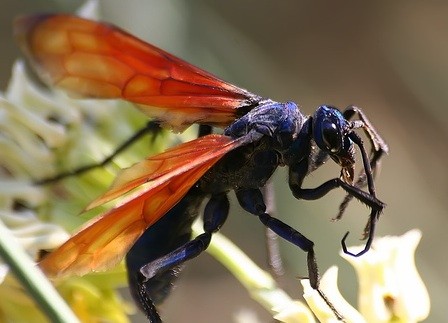
Costa Rica offers the entire spectrum of wild creatures. Some animals are particularly beautiful. Others are adorable. Today’s feature creature, the tarantula hawk, can most appropriately be described as terrifying. It’s too big, it can cause you intense pain, and its method for rearing young is the stuff of nightmares.
The tarantula hawk is known as the avispón or calenturón in Tico Spanish. I usually like to give scientific names of the creatures that I describe but there are approximately one gillion different species of tarantula hawk and for the life of me I couldn’t figure out which one haunts my front yard. For our proper dose of weird Greek words, let’s settle on the fact that all species of tarantula hawks belong to the family Pompilidae.
The tarantula hawk is neither a tarantula nor a hawk. It’s an enormous wasp. They can grow to over two inches long, which I think we can all agree is way too big for a wasp. They have blue-black bodies starkly contrasted with rust-orange wings. Their coloration is an example of aposematism.
Aposematism or aposematic coloration is a way for creatures to advertise to other animals that they are dangerous and should not be messed with. In this case, contrast between the dark body and the bright orange wings are saying to the world, ‘Not only am I not hiding, I’m specifically standing out with my colors because I’m dangerous.’
So what’s included in the diet of these large, dangerous insects? Baby monkeys? Whole families of birds? No. Adult tarantula hawks are mainly nectivorous. That is, their diet consists almost exclusively of sugar-rich nectar produced by flowering plants. So the big scary bug likes flowers.
The frightening part of this wasp’s lifestyle is how it brings the next generation of wasps into the world. The female tarantula hawk buzzes around in search of tarantulas. When she finds one, she quickly applies a powerful sting which paralyzes her prey. She then drags the enormous, incapacitated spider into her burrow, lays a single egg on its abdomen, and seals the entrance to the burrow shut. (Prepare yourself, this is awful.)
When the egg hatches, the larva tunnels into the still living spider and feeds on it from the inside, careful to avoid vital organs so it stays alive as long as possible, until the larva pupates into an adult wasp and emerges from the spider-husk to live its adult tarantula hawk life. Yikes!
That method of rearing young is truly bad news for tarantulas, but you and I aren’t big spiders so we’re in the clear, right? Well, no. Tarantula hawks aren’t particularly aggressive towards human beings. In my own experience they buzz around me while I’m doing my thing outside, and I overreact a bit while they couldn’t care less that I’m around.
My overreaction is based on the fact that tarantula hawks pack one of the most powerful stings in the animal kingdom. I found a quote on the internet where a researcher describes the sting as follows: ‘…immediate, excruciating, unrelenting pain that simply shuts down one’s ability to do anything, except scream.’
I’ve seen many tarantula hawks over the years. Most of my interactions are them flying somewhere in my vicinity and me getting a little too uptight about it. Twice I’ve seen them dragging their paralyzed tarantula prey to its slow demise. Once, the spider was being drug across a dirt road a night, and I caught the act with my headlights. Just a few weeks ago, my whole family watched in interested horror as a tarantula hawk pulled a stiff spider four feet up our backyard retaining wall and into the forest.
So next time that you’re enjoying the great outdoors in Costa Rica and a huge black and orange wasp buzzes by, stay calm and focus on the fact that they’re mostly docile and like flowers (and not that ‘excruciating, unrelenting pain’ thing).
About the Author
Vincent Losasso, founder of Guanacaste Wildlife Monitoring, is a biologist who works with camera traps throughout Costa Rica. Learn more about his projects on facebook or instagram. You can also email him at: vincent@guanacastewildlifemonitoring.com