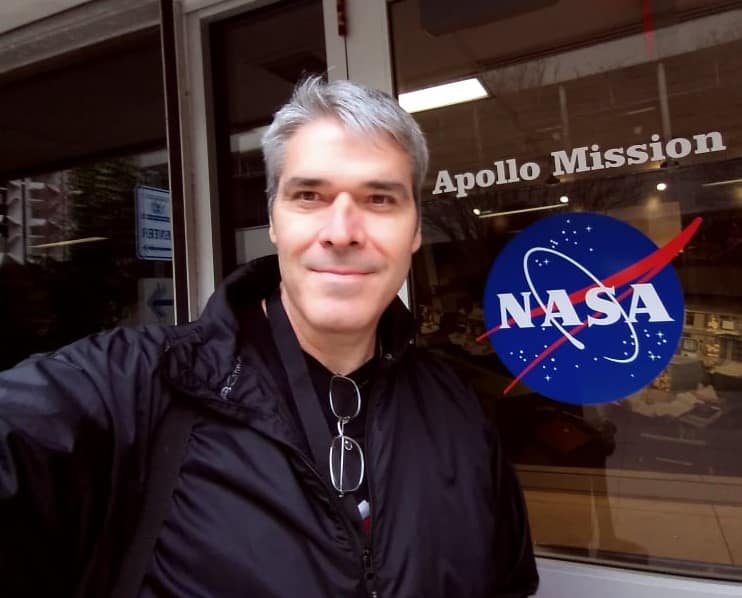
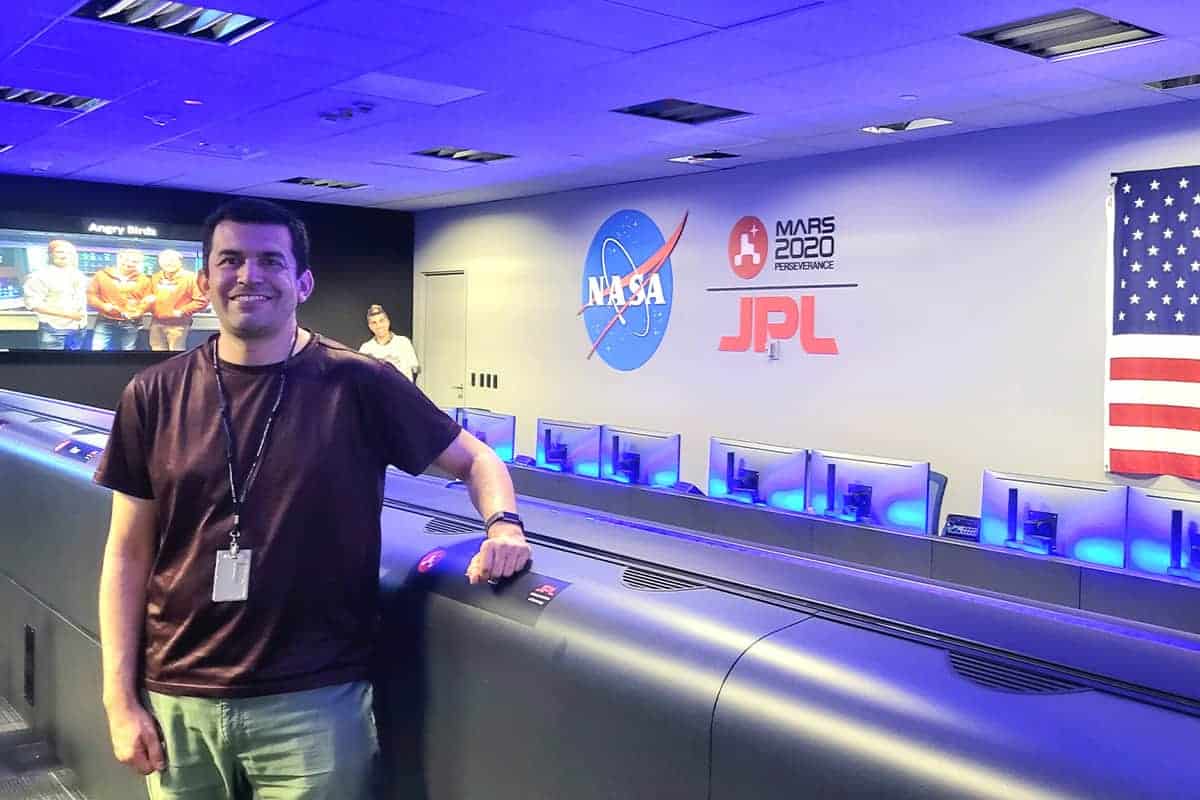
Mauricio Hess is from Moravia, San Jose and works at NASA’s Jet Propulsion Laboratory (JPL). In this interview he talks about his work and path to NASA’s most prestigious research and development center.
“Helping to push the frontier on space exploration with a very talented group of colleagues, through mathematics and algorithms, is an amazing experience and a dream come true, and I’d like to help other Costa Ricans who would like to work in this area in any way I can.”
Where did you grow up and attend school in Costa Rica?
I grew up and went to school in Moravia, but spent a few years in the US as a teenager. I obtained a BS and MS in Electrical Engineering at the Universidad de Costa Rica, where I also lectured for the MS program from 2005–2006.
I then went on to do a PhD at the University of California, Davis (jointly with Lawrence Livermore National Laboratory) and also worked in industry (Qualcomm Research and a startup) for a few years prior to joining JPL.
How long have you been working at the Jet Propulsion Laboratory?
I’ve been at JPL for a year and a half now. My background is in 3D computer vision and image processing. Our team does a lot of the ground-based processing of image and other data that comes off spacecraft and rovers, for example from the Perseverance rover and Ingenuity helicopter currently on Mars.
The algorithms, resulting software, and products developed are used for analyses by other science teams, as open-source software and data for Academia and other entities, and for sharing to media outlets. It’s a very exciting team to be a part of!
What is your job and your favorite thing about it?
I’m a Geospatial Image Data Specialist. My work lies at the intersection of computer vision research and development, image processing, data science, mathematics, and software development.
What I most enjoy is being able to come up with new algorithms that can be applied for obtaining different visual representations of spacecraft data and use it to help in obtaining new scientific results. For me, working at NASA has been a goal since I was a small child.
I’ve always been extremely passionate about space exploration, and sometimes I still find it hard to believe that now I’m actually working on this myself. Helping to push the frontier on space exploration with a very talented group of colleagues, through mathematics and algorithms, is an amazing experience and a dream come true, and I’d like to help other Costa Ricans who would like to work in this area in any way I can.
What are you focused on these days?
I’m working on two main projects, one involving the ISS and instruments acquiring orbital images of Earth, and another which involves processing in-situ images such as those acquired by the Mars rover and helicopter. At a high level, the first involves geolocation for various instruments aboard the ISS, which acquire information about Earth’s “health” via orbital images, such as carbon emissions, evaporation, etc.
Geolocation refers to obtaining very accurate position and orientation information for each instrument by using a combination of the instrument and ISS telemetry information plus refinement via information from the images themselves.
The second project is related to 3D computer vision techniques to retrieve accurate position and location (pose) information for the rover and helicopter along with a map of the viewed scene. The resulting refined poses and point cloud can be used for other tasks such as creating meshes, used for science analysis, public outreach, etc.
What advice would you give to young people who are interested in working towards a space career?
This may sound cliché, but it mainly takes determination, lots of hard work, becoming comfortable with failure as long as it’s leading you on the right path, and strategically choosing which education and jobs will give you the best shot at getting there.
Furthermore, students should be confident and understand that the education Costa Ricans receive in institutions such as UCR and Tec is very high-quality and thorough, and there really isn’t a lot to envy universities in other countries regarding what we learn and the level of education we receive, despite differences in funding.
In other words, think big. We’re perfectly capable of being accepted into and succeeding in academic and scientific institutions the world over, including NASA.
With that mindset, the rest is all about hard work and strategically moving through phases that can help us reach that goal. As an example, my PhD research involved reconstructing cities and other terrain from aerial images, and it just so happens that the skills needed to do that can be applied pretty much as-is at NASA for space exploration.
The same can be said for many other careers, where the skillset is more important than the specific topic one works on. Once you become an expert in certain niche areas, especially if you have publications in that area and a research website, I’ve found that to be very useful in marketing yourself and increases your chances of being selected for a position not just at NASA, but at many of the tech companies.