

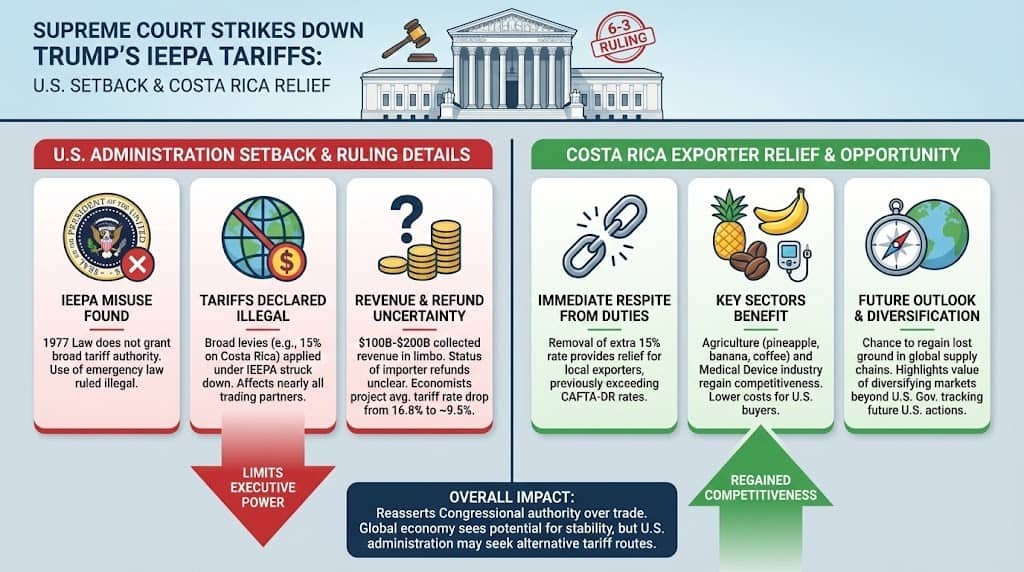
The U.S. Supreme Court delivered a significant setback to President Donald Trump by ruling his use of an emergency law to impose broad tariffs illegal, a decision that ripples through global trade and offers relief to Costa Rica’s exporters. The court, with its conservative majority, voted 6-3 on Friday to strike down the tariffs Trump applied under the 1977 International Emergency Economic Powers Act (IEEPA). Justices determined the law does not grant the president authority to impose such duties, which Trump labeled “reciprocal” and extended to nearly all U.S. trading partners.
Trump turned to these tariffs after returning to office in January 2025. He applied them not just to address trade imbalances but to exert pressure on issues like drug trafficking and migration. Nations such as Mexico, Canada, and China faced added duties for alleged failures in controlling fentanyl flows and border movements. Trump even levied tariffs on countries in conflict and later claimed they helped end eight international disputes in 2025, including the one between Thailand and Cambodia.
For Costa Rica, these tariffs posed a direct challenge to exporters. The U.S. set a 15% rate on Costa Rican products, exceeding those applied to other members of the Central America-Dominican Republic Free Trade Agreement. This hit key sectors like agriculture, where shipments of pineapple, banana, and coffee came under added strain. The medical device industry, which sends billions in annual exports to the U.S., also bore higher costs that risked cutting competitiveness and raising prices for American buyers.
The Supreme Court’s ruling upholds prior decisions from lower courts. A trade court in May had already found Trump overstepped his bounds with the broad levies and blocked most from going into effect, though the government appealed and kept some in limbo. Justices noted that if Congress meant to hand over tariff powers through the IEEPA, it would have stated so clearly, as in other tariff laws.
Three conservative justices—Brett Kavanaugh, Clarence Thomas, and Samuel Alito—dissented. Kavanaugh cautioned that unraveling the tariffs could create a “mess” in handling refunds and pending collections.
Economists project the reversal will drop the average tariff rate from 16.8% to about 9.5%. Gregory Daco, chief economist at EY-Parthenon, said this shift might prove short-lived if the administration pursues other routes to reinstate broad duties, such as time-limited tariffs needing periodic renewals. Those options would take longer and involve more red tape.
The verdict leaves hanging between $100 billion and $120 billion in tariff revenues collected last year, with some estimates reaching $200 billion. Justices did not specify if importers who sued the Trump administration can claim refunds, adding to the potential complications.
For Costa Rica, the decision brings immediate respite. Local exporters, already navigating tight global supply chains, now have a chance to regain lost ground. Some relief came earlier when the U.S. exempted bananas, pineapples, and other agricultural items in November 2025, but the broad ruling strengthens that. The Costa Rican Ministry of Foreign Trade is tracking Washington’s next moves, as Trump has hinted at alternatives to sustain trade pressures. Still, the outcome reinforces that Congress, not the president, holds sway over customs duties.
Trump had pledged to share some of those tariff proceeds with Americans, an idea now in question. The White House did not respond right away to requests for comment, but experts expect the president to appeal or rework his economic strategy. This setback arrives as the global economy steadies from past disruptions and highlights limits on executive power in trade matters. For export-reliant nations like Costa Rica, the ruling stresses the value of diversifying markets and bolstering bilateral pacts.





