

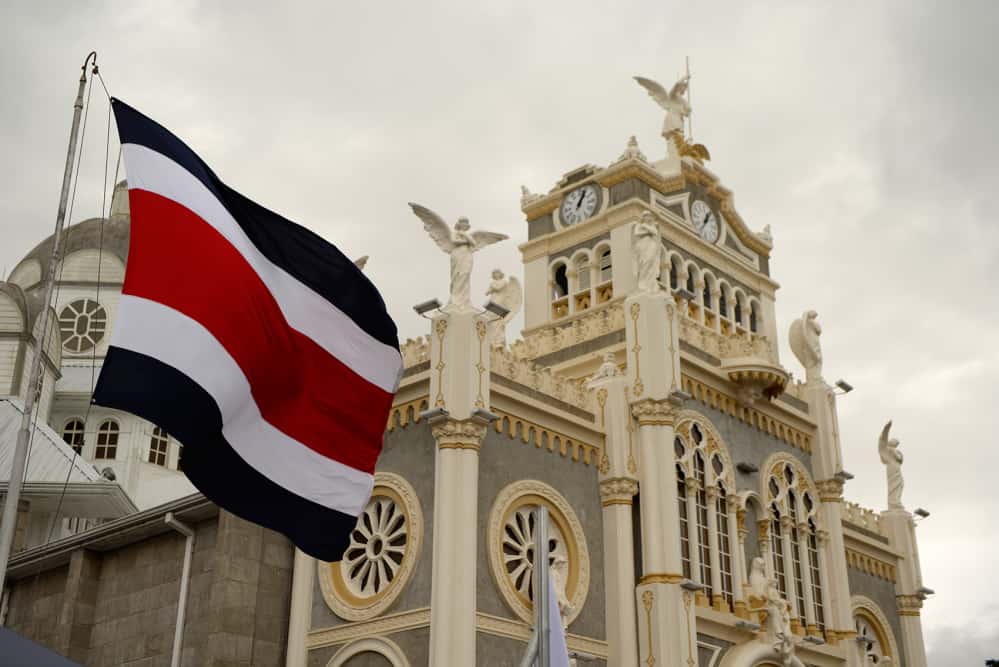
I am one of those baptized Catholics who had their years of intense faith despite the usual sermons and sometimes absurd traditions of the Catholic Church, that institution given a privileged position by the Costa Rican Political Constitution to the point of imposing the religion on our State – that is, on all of us.
I thought about my status as an apathetic Catholic when I reviewed the results of the most recent survey by the Center for Research and Political Studies (CIEP), which showed that 70 percent of Costa Ricans are – were? – Catholics, and that a similar percentage affirms that religion is very important in their lives. (Those who say religion is important aren’t necessarily all the same ones who said they are Catholic.)
Up to that point: no surprises. In my day-to-day life my ears are full of “blessings upon you,” “thank God,” “Diosguardísimo,” “whatever God wants,” and “God knows why we do things,” no matter the age, ideology or economic status of the speaker. Whether because of faith or oral tradition, Costa Rican language is aligned with our status as a confessional state.
The statistic that surprised me came a little further down: 55 percent of Costa Ricans approved the anachronism of maintaining an official religion for a diverse and changing collective. In the 21st Century, the majority of Costa Ricans feel comfortable with a decision made in 1847, when Costa Rica wasn’t even called a Republic. The majority supports a confessional status that only Costa Rica, in our entire continent, continues to maintain. What’s more, seven percent more would support if some changes were made, referring, I suppose, to giving Constitutional status to other Christian religions.
This is not a minor issue in Costa Rican public life. Christianity is in our public institutions’ chapels, in the debates of our Judicial Branch magistrates, in the little speeches of the evangelical legislators and other lawmakers who believe that their faith should be reflected in every bill or every discussion of human rights. Let’s be honest: traditional administrations and parties, supposedly lay in nature, have capitalized on and promoted the leadership of Justo Orozco and his confessional-party minions.
Christian churches played a role in the election of Johnny Araya for mayor of San José, and I received information – that I could not confirm – about the role they also played in the Liberation Party convention that resulted in the election of Antonio Álvarez Desanti as the Liberation candidate for 2018. It will not surprise me if his positions on human rights accommodate themselves in order to attract the population for which religion is a high priority and who think it should influence public life. It will not be very difficult for him to adjust his opinions to the needs of the moment, either.
So the question is: How long will we be a Catholic country by constitutional mandate? For a long time, it seems. Proposals to reform Article 75 of the Constitution aren’t a big priority for anyone. The plan for a “concordato” between Costa Rica and the Vatican included the possibility of giving lay status to our state in exchange for other privileged positions for the Catholic Church, but the administration of President Luis Guillermo Solís didn’t follow up on it. (Although it’s hard to believe it, the Vatican prefers lay states even though local bishops push for a confessional state. We are más papistas que el Papa, more papist than the Pope, you could say.)
There was also a bill put in play by a majority lawmaker, but the Legislative Assembly is barren ground for the adoption of any reforms that leave the Christian realm. Let’s not be surprised if the 2018 elections give more power to conservative groups, whether these are Christian parties, religious lawmakers or opportunistic politicians who read the same survey I did and aren’t ready to put their interests at risk in exchange for a little modernity.
Turn up the volume on those psalms. Let the mass continue.
This piece was written before the Legislative Assembly internal election on May 1, 2017. Read more about the election of an evangelical pastor to the Assembly presidency here.
Read more “No Sugar, Please” columns here.
Álvaro Murillo is an experienced journalist who specializes in political coverage and has written for La Nación, Semanario Universidad and El País.





