

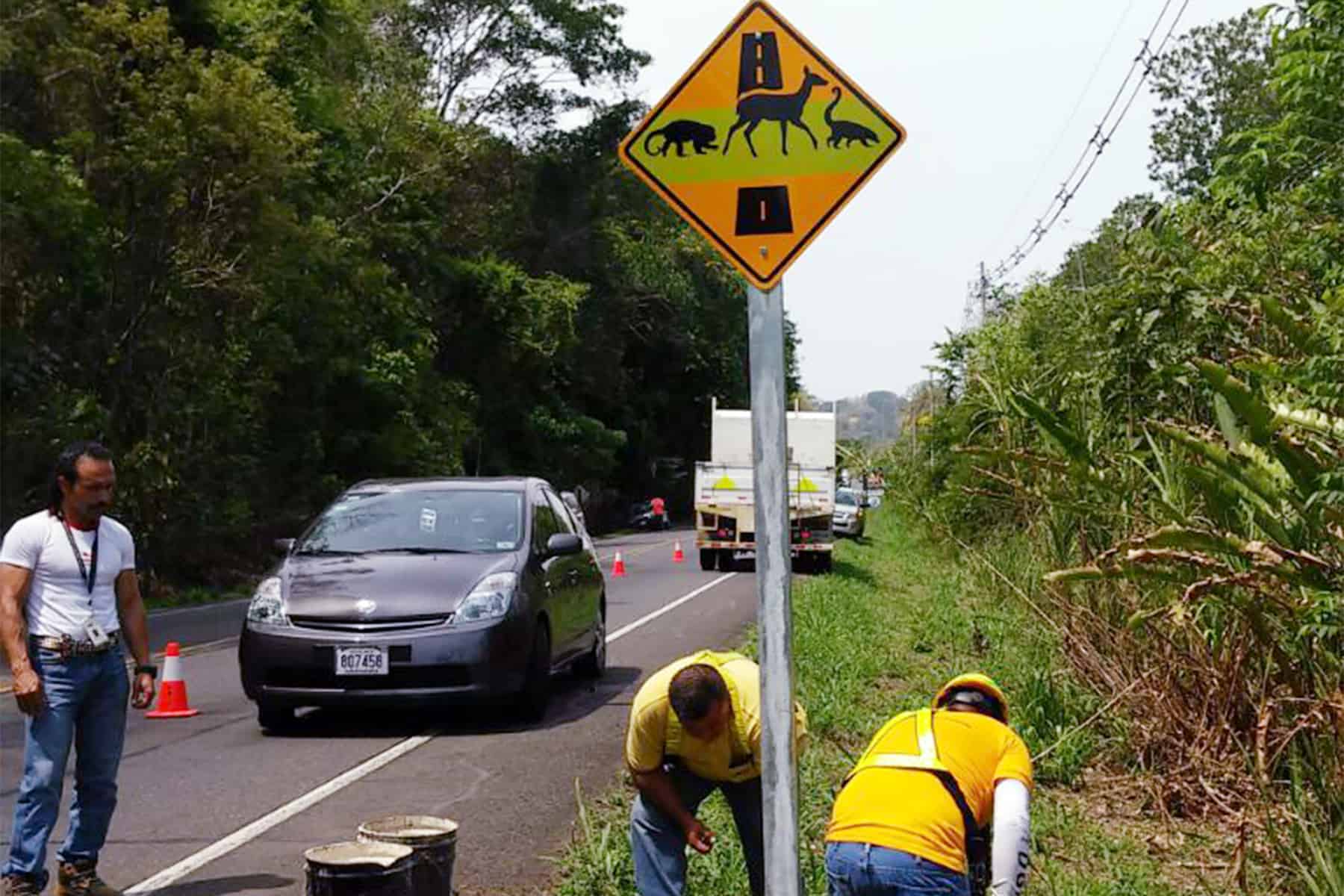
Costa Rica now has a law requiring wildlife crossings on public infrastructure projects, but the regulation that will actually put it into practice could take more than two years to arrive. The rule requires new road, bridge and other infrastructure projects to incorporate mechanisms allowing wild species to move safely across routes that would otherwise fragment their habitat, but before any of that happens the National System of Conservation Areas and the Ministry of Public Works and Transport still have to jointly write the technical regulation defining procedures, responsibilities and criteria for applying it.
Once that regulation takes effect, the conservation agency will then have up to 24 months just to identify the natural corridors wildlife use and the most vulnerable points on existing roads, meaning construction itself is still years away. The law took a long road to get here. It was filed in the legislature back in 2022 by then deputy Ariel Robles Barrantes and spent four years moving slowly enough that it nearly expired under the four year shelf life Costa Rican bills carry before automatic archiving.
Lawmakers voted 53 to 0 in June to extend it just before that deadline, and the bill finally cleared final approval in August with unanimous support. That gap between broad political agreement and years of inaction is a pattern environmentalists and officials both recognize. An environmentalist inside MOPT itself, Andrea Ávila, who runs the ministry’s transportation infrastructure project, has been candid about the reason nothing moved for years before the law passed.
She said every wildlife protection measure taken until now came from individual institutional initiative rather than obligation, and did not rule out a lack of political interest, since no law required new construction projects to include such measures. She specifically pointed to Lanamme, the University of Costa Rica’s highway research institute, saying it makes recommendations nobody follows because they carry no legal weight.
A wildlife biologist from the National University’s conservation institute made a similar point, saying the missing piece was never a shortage of impact studies but a legal framework forcing institutions to act on them. That track record matters because it suggests the coming regulatory delay has less to do with a lack of technical groundwork and more to do with institutional follow through. Much of the mapping work the new law assigns SINAC up to 24 months to complete already exists in some form.
A group tied to Universidad Latina compiled more than 19000 roadkill records dating back to 1996, and one 20-kilometer stretch of route 253 in Guanacaste alone was estimated to see around 7000 roadkill incidents annually as of 2019. Panthera, the University of Costa Rica and the Las Pumas rescue center separately tracked wild cat deaths and found 676 felines, jaguars, pumas, ocelots and margays among them, killed on Costa Rican roads between 2012 and 2025, with more than 4200 animals of all kinds struck between 2013 and the present.
Lanamme has also already developed and field tested a methodology for identifying exactly the kind of crossing points the new regulation calls for. Researchers working along the Barbilla Destierro biological subcorridor as part of the Jaguar Corridor Initiative compared roadkill and wildlife sighting data between a paved and an unpaved section of the same road as far back as 2015, documenting jaguar and margay crossings and raccoons using existing culverts.
A separate scientific guide on wildlife friendly roads, developed jointly by conservation and transportation researchers, has been informing individual projects like the route 32 expansion to Limon since 2014, where aerial rope crossings for monkeys and underground tunnels were installed based on monitoring data from that period. Follow up monitoring across existing structures has recorded 59 wildlife species safely using them, though researchers note some sensitive species such as the margay and spider monkey still show limited evidence the current designs work well for them.
None of that existing work resolves the underlying question of how quickly MOPT and SINAC will move once the regulation is actually written, but it does complicate the idea that a two year timeline for identifying priority corridors reflects how much work remains. Much of the mapping this law calls for has already been done piecemeal by university researchers and conservation groups over more than a decade, without a legal mandate forcing anyone to act on it. Whether the regulation leans on that existing research or starts largely from scratch may end up determining whether the two year estimate holds or stretches further.





