
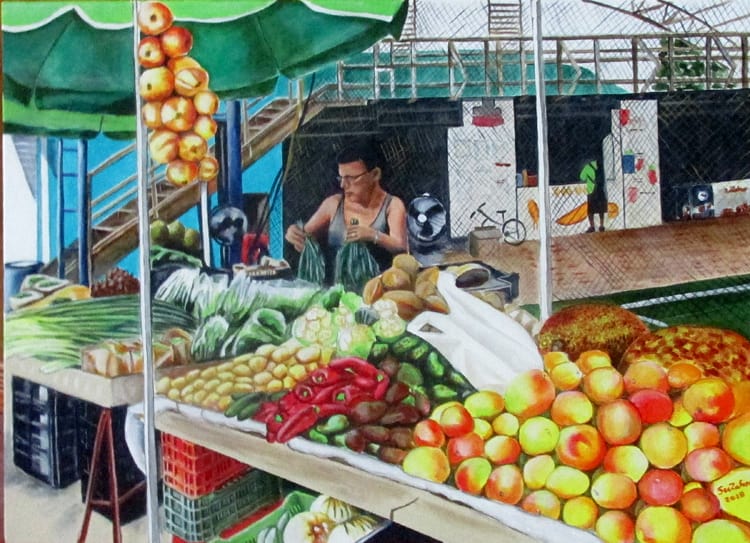
Every weekend, towns across Costa Rica close off a street or fill a covered hall with tables of mangoes, hands of banana, fresh cheese and just-caught fish. The feria del agricultor — the farmers market — is where most Costa Ricans have shopped for generations, and for residents and visitors alike it remains the single best place to buy local, eat seasonally and meet the people who grew the food.
There are more than 80 ferias operating around the country on a regular weekly schedule, according to a national directory built by University of Costa Rica students with support from the U.N. Food and Agriculture Organization. The platform, deferia.cr, lets shoppers look up market days, locations and products by canton — useful for newcomers who don’t yet know where their nearest feria sets up.
The draw is partly price. The National Production Council (CNP), together with the Economy Ministry (MEIC), publishes a weekly price comparison and has repeatedly found that fruit, vegetables and eggs cost less at the feria than at supermarkets, sometimes dramatically so. Recent CNP listings put a kilo of potatoes and a kilo of tomatoes well below typical supermarket shelf prices, though the council stresses the figures move week to week. Pineapple and eggs are among the few items that occasionally run cheaper at the supermarket.
But longtime feria-goers will tell you the appeal runs deeper than the receipt. The markets are built on what the Junta Nacional de Ferias del Agricultor calls precio justo — a fair price for the farmer who knows the true cost of production, and a fair price for the shopper who isn’t paying an abusive markup. With no middleman, money goes directly to small and family producers, many of whom travel from farming towns like Cartago, Puriscal, Guápiles and Orotina to sell what they picked days earlier.
Where and when to go
In the capital area, the upscale Feria Verde de Aranjuez is the best-known organic market, held Saturdays from 7 a.m. to 12:30 p.m. at the Polideportivo in Barrio Aranjuez, just east of downtown San José, with a second edition in Ciudad Colón. Beyond produce, it offers live music, food stalls, artisan cheese, bread, honey and crafts — more weekend outing than grocery run, and priced accordingly.
For expat-heavy suburbs west of the city, Escazú’s market runs Saturdays from about 5 a.m. to 1 p.m. along Avenida 32 in the town center, and Santa Ana’s takes over Avenida 1 on Sundays from roughly 5 a.m. to noon. Both are searchable in Waze and Uber under “Feria del Agricultor.”
On the Pacific coast, the Quepos market near the Manuel Antonio area sets up Friday afternoons and Saturday mornings by the malecón, with seafood, local cheeses and prepared foods alongside produce. Beach towns including Tamarindo run their own smaller weekly ferias.
How to shop like a local
Go early — by late morning the best produce is picked over and crowds thicken. Bring a sturdy reusable bag or a rolling cart, and bring cash; most vendors don’t take cards, though a handful of stalls in Santa Ana were among the first in the country to accept them. Buy what’s in season and don’t be shy about asking vendors how to pick or prepare something unfamiliar; sharing that knowledge is half the point. And while produce is the headline, many ferias also sell prepared breakfasts, plants, flowers and crafts, making them as much a community gathering as a place to stock the kitchen.
For anyone settling into life in Costa Rica, the weekly feria is one of the easiest and most rewarding habits to adopt — cheaper, fresher and far more local than any supermarket aisle.