
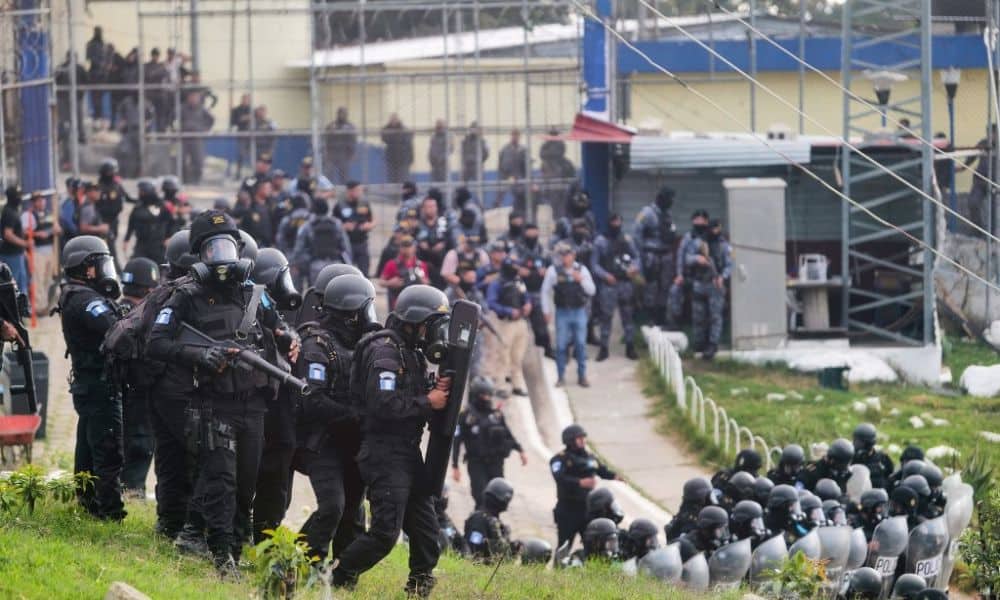
Guatemalan President Bernardo Arévalo on Sunday decreed a state of siege across the country after gangs killed eight police officers in recent hours and staged several prison riots, taking dozens of hostages. The measure will allow the suspension of certain constitutional guarantees to combat the Barrio 18 and Mara Salvatrucha (MS-13) gangs, labeled “terrorists” by the United States and Guatemala and accused of contract killings, extortion, and drug trafficking.
“I have decided to decree a state of siege throughout the entire national territory for 30 days starting today” in order to “guarantee the protection and security of citizens,” Arévalo said in a national address. The measure, which must now be ratified by Congress, where the opposition holds a majority, suspends the rights to assembly and demonstration and allows arrests and interrogations without a judicial warrant.
The president also announced that police had taken control of three prisons where gang members had held 46 people since Saturday, demanding that the gangs’ leaders be moved to prisons with less stringent security. “We have managed to fully restore the State’s control over the three prisons where the criminals had rioted,” Arévalo said. They are now “on their knees,” he added.
The special measures come after gangs killed eight police officers in several attacks carried out in the Guatemalan capital and nearby towns. “They have been cowardly attacked by these terrorists,” said Interior Minister Marco Antonio Villeda. According to the official, 10 other police officers were wounded, one alleged gang member was killed, and more than a dozen people were arrested.
The government declared three days of national mourning, and classes are suspended on Monday, while the U.S. Embassy asked its personnel to “shelter in place” and avoid “crowds.” Congress President Luis Contreras, an opposition figure, called for unity to confront “one of the most painful and challenging moments” the country is facing.
Prisons Retaken
On Sunday, authorities regained control of the maximum-security prison Renovación I in the town of Escuintla, about 75 kilometers (47 miles) south of Guatemala City, and freed nine guards who had remained kidnapped. Uniformed forces entered with armored vehicles and fired tear gas. After 15 minutes, they managed to control the prison and remove the hostages.
The Interior Ministry posted a video on X showing agents escorting an alleged leader of the Barrio 18 gang in handcuffs, with blood stains. Authorities identified him as Aldo Dupie, known as “El Lobo.” Police, together with the Army, also freed 28 hostages at the Fraijanes II penitentiary center, and another nine at Preventivo, east of and on the outskirts of the capital, respectively.
According to Arévalo, there were not “a single casualty” during these operations. “These groups, in desperation, tried to spread terror and chaos,” but “they will fail” because “we do not negotiate with criminals,” he added.
Soldiers in the Streets
Defense Minister Division General Henry Sáenz said the army “will remain in the streets” to continue “hitting” organized crime structures. “The State will use all its force and its monopoly on power to bring the peace and calm the public needs,” Sáenz said. Police Director David Custodio warned that officers may defend citizens’ “lives” by “using their firearms” if necessary.
Since mid-2025, gang members have staged multiple riots, including one in which a guard was killed by gunfire. In addition, 20 Barrio 18 leaders escaped from a prison, prompting the removal of the security leadership.