

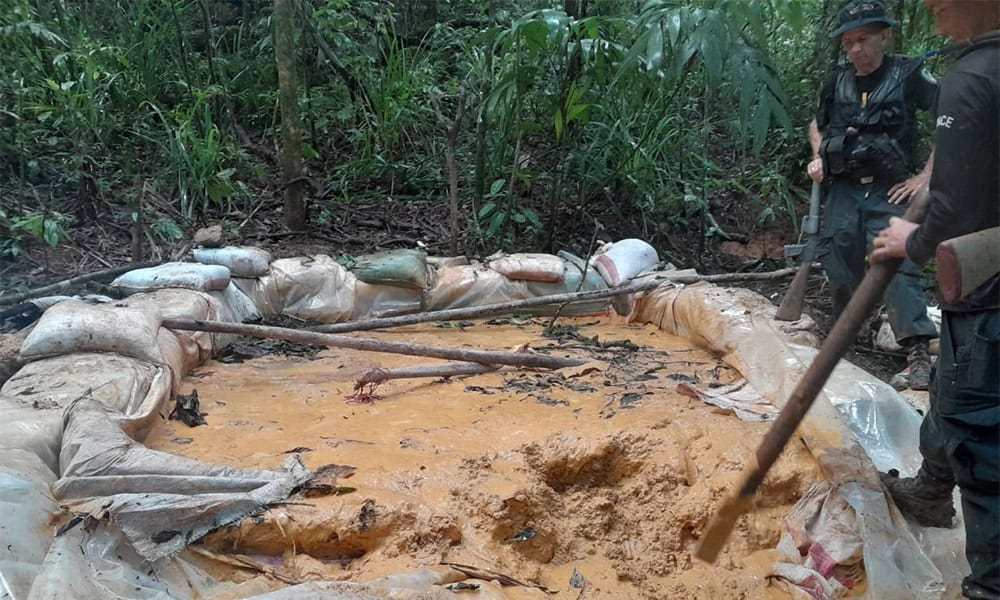
The environmental crisis in Crucitas persists. Police discovered and dismantled an artisanal mining material processing plant in a wooded area of Tatú Hill in Crucitas, consisting of a pool made of plastic, filled with cyanide, sediments, and water, according to the regional director of the police force in the northern border, Junier Villalta Rubí.
The images released by the authorities show a kind of pool in the middle of the forest, with a border made of sacks filled with what appears to be sand, plastic covering the bottom, and filled with water and mud, forming a kind of pond. The pool is covered with plastics held up with sticks to shield it from the rain. A pipe can also be seen.
“Thanks to the significant contribution made by our police officers in a challenging operational terrain, this cyanide pool has been located. It is important to highlight the work done by our police officers in patrols, not only in Crucitas but in all surrounding areas of the Cutris district,” declared Villalta.
Cyanide is a chemical substance used in the gold leaching process (to dissolve and separate it from the rock). Authorities emphasized that this is the second plant of this type to be dismantled in the area. On June 20, the police forces found the first such plant in a wooded area in the Chorreras sector. The pool contained a mixture of sediment and water and was equipped with a submersible pump, an electric plant, and a tombola-type machine.
According to the authorities, this is a novel procedure to extract gold; however, it is a quite common way of practicing artisanal mining in Nicaragua. Other issues have developed in Crucitas due to illegal gold mining, such as drug trafficking, human trafficking, and even the sale of high-caliber weapons.
Minister of Security Mario Zamora confirmed that there is “organized crime operating in the area.” He also pointed out that in the last six months, the methods to extract gold have evolved, performed by professionals, as he affirmed that even tunnels are being constructed to facilitate the crime.
Zamora mentioned that authorities presume the activity has become a transnational system, as they suspect that the gold leaves Costa Rica and is distributed outside the country.





